Use Case Catalog
Twelve sub-categories. Over sixty concrete use cases. One predictive database underneath.
Browse by capability. Each use case shows the outcome, the demo that showcases it best, the Aito operator(s) it uses, and the vertical(s) where it commonly lives. The catalog is the index — for code examples and full query patterns, follow the "Read more" link into the docs. For the live application, follow the demo tag.
What is a predictive application? Read the architectural argument →
Building an agent? See the same operators in a live agent's toolbox, benchmarked →
Analyze
Find what's already in the data.
Pattern discovery, calibration, forecasting, segmentation. The decisions a user makes after seeing the data — and the patterns the data already contains.
Pattern Discovery
Co-occurrence, lift, persona-affinity, statistically discoverable AND predictive patterns. Find what's already in the data.
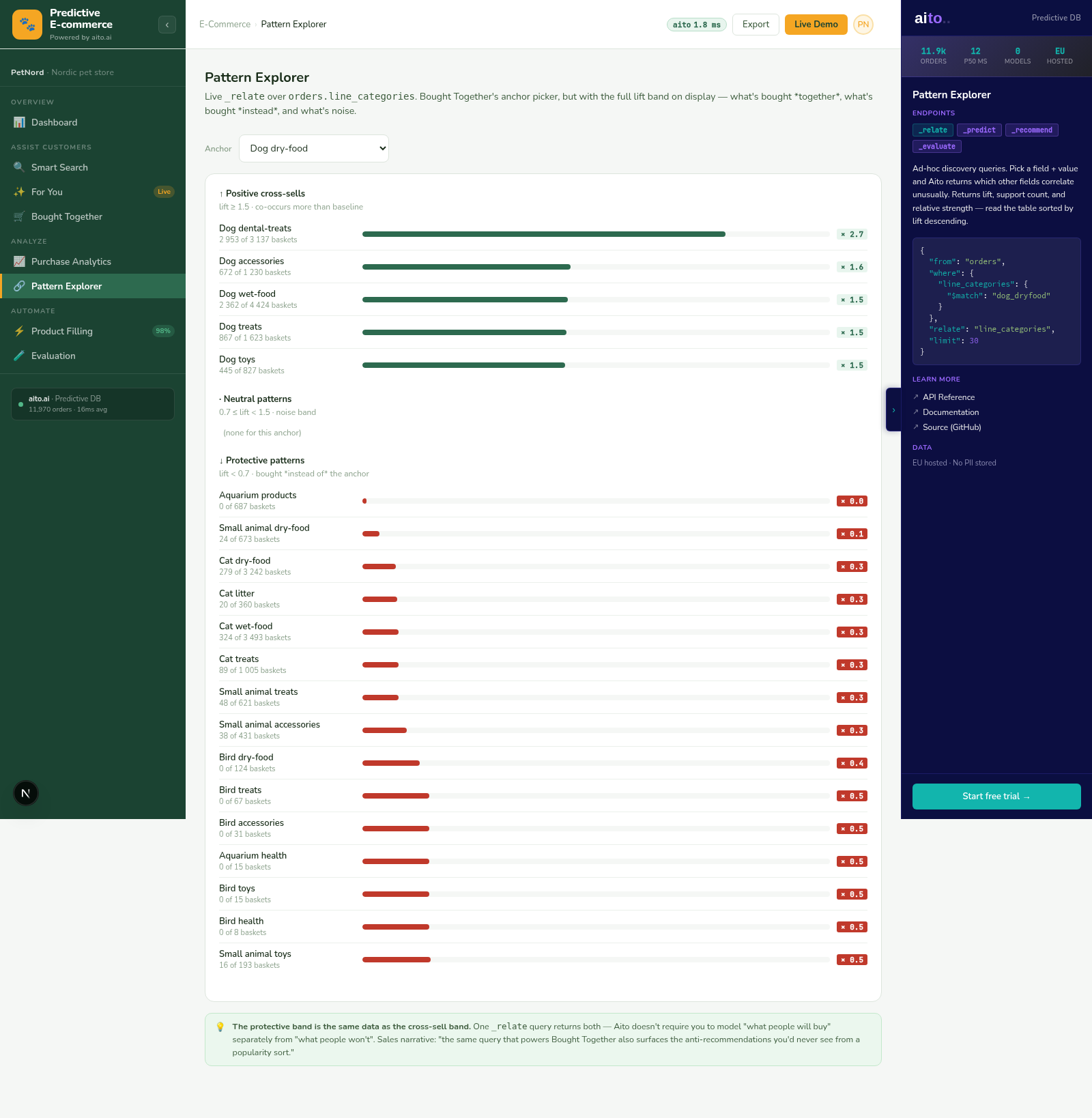
Pattern Explorer
Co-purchase lift patterns ranked by statistical significance. Dog dry-food cross-sells to dental treats at 2.72× in the PetNord fixture.
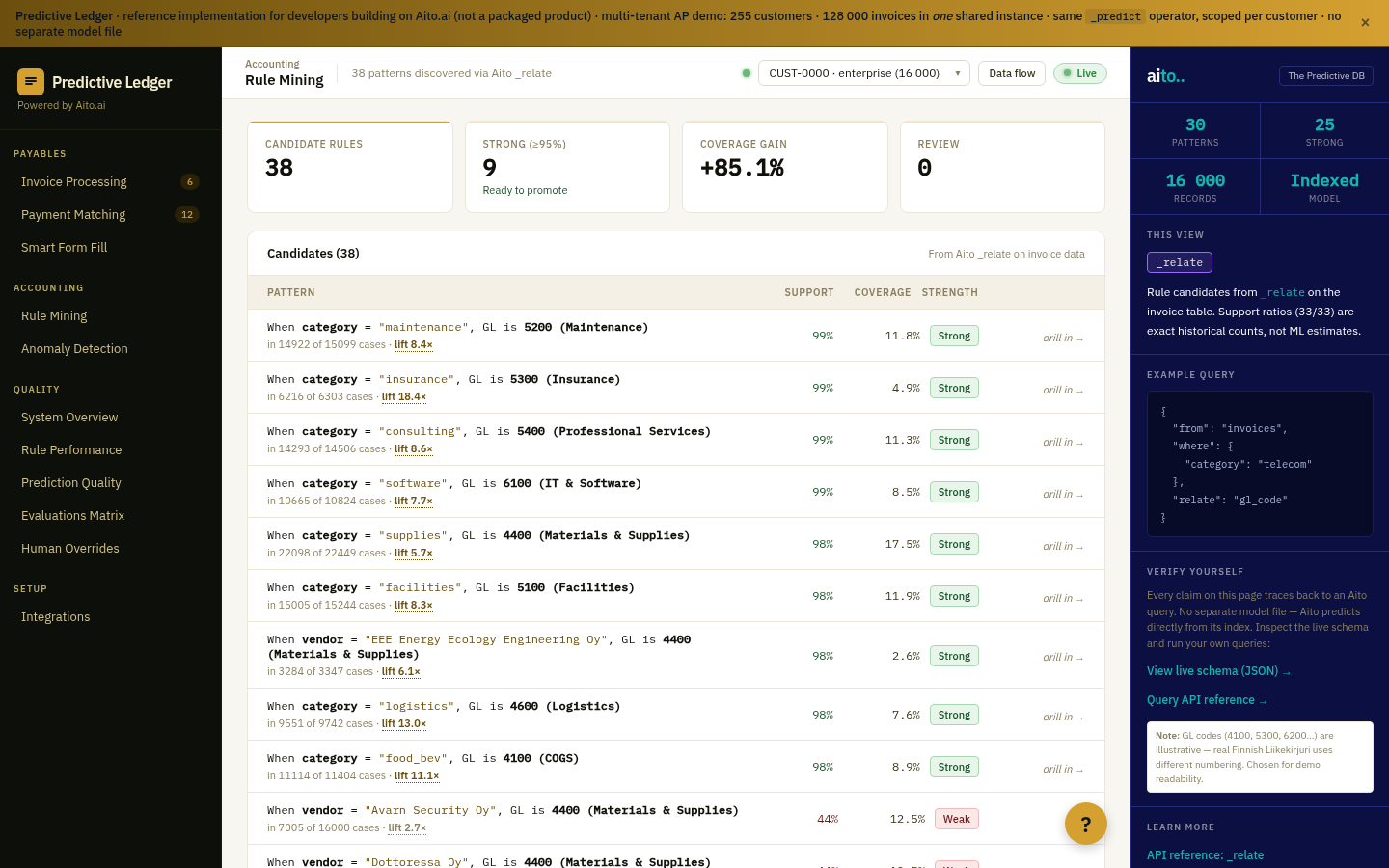
Rule Mining
Statistical patterns (category=telecom & gl_code=6200 → approver=Timo, 15.8× lift) mined live with _relate as rule candidates. In the ERP demo each candidate is promoted with sign-off and an audit-trail entry, or dismissed.
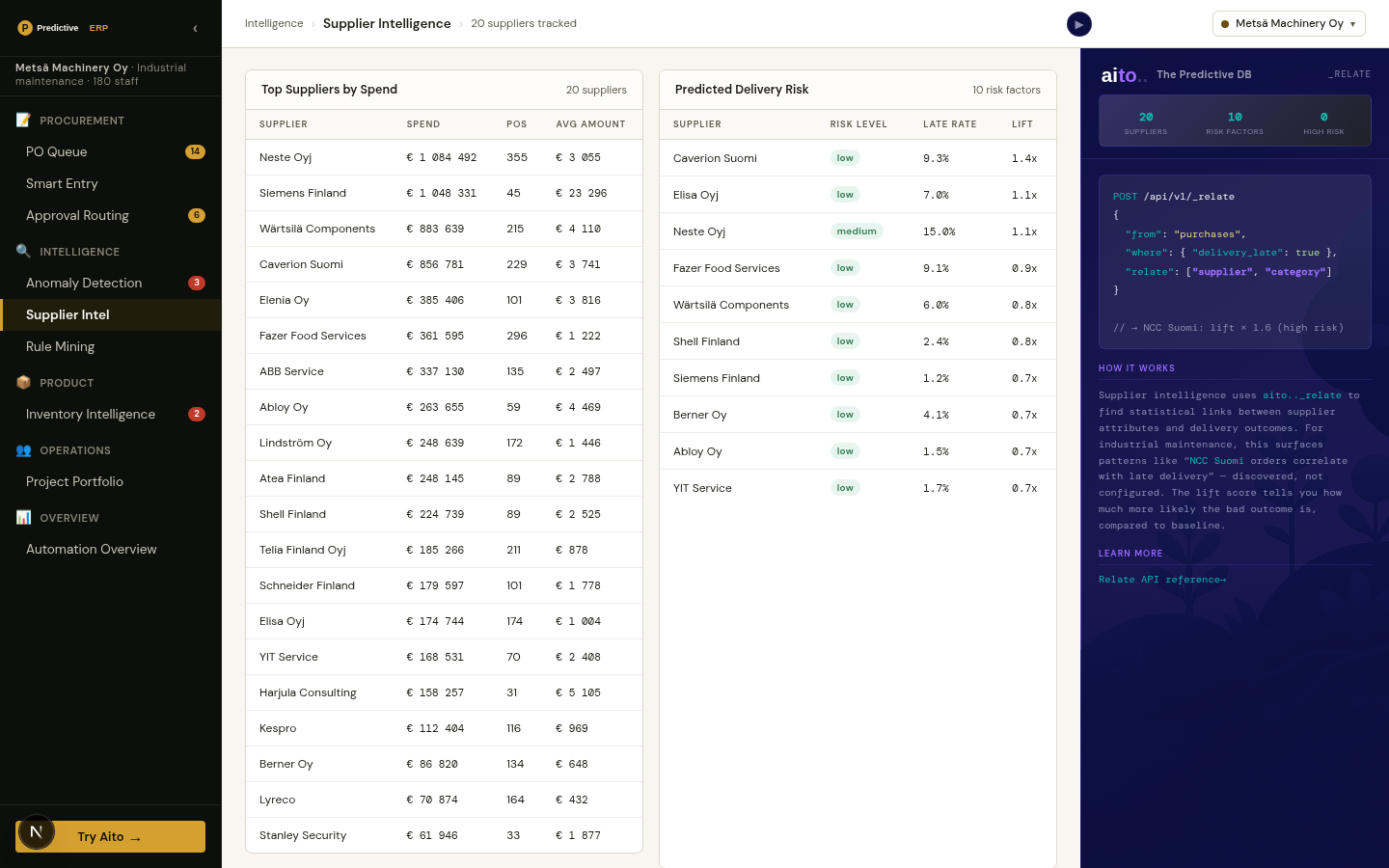
Supplier Intelligence
Spend leaderboard plus delivery-risk discovery via _relate: which suppliers are over-represented among late deliveries, with the late rate and lift behind each, mined from the purchase history.
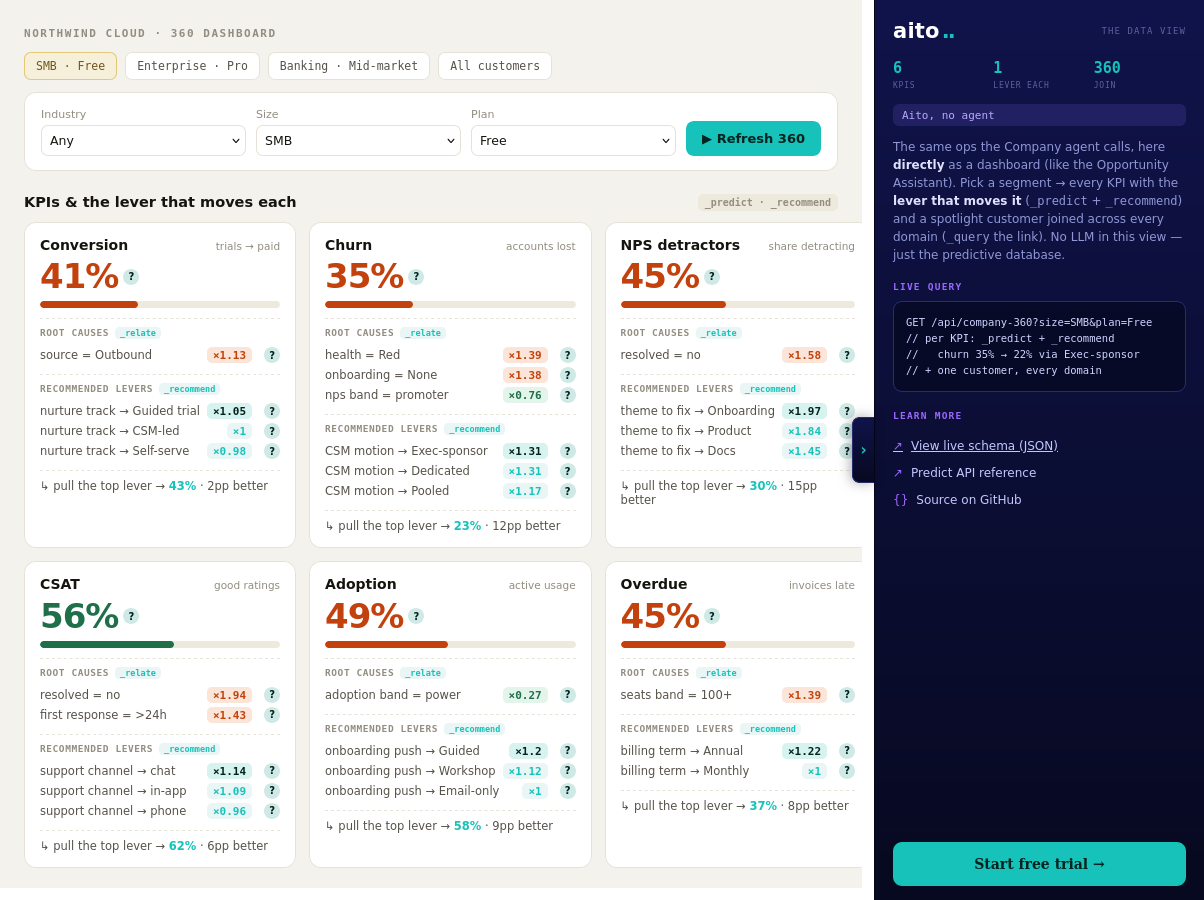
360 KPI Dashboard
Pick a segment and every KPI arrives diagnosed: the rate, its root causes via _relate scoped to the segment, and the lever that moves it via _recommend with projected lift.
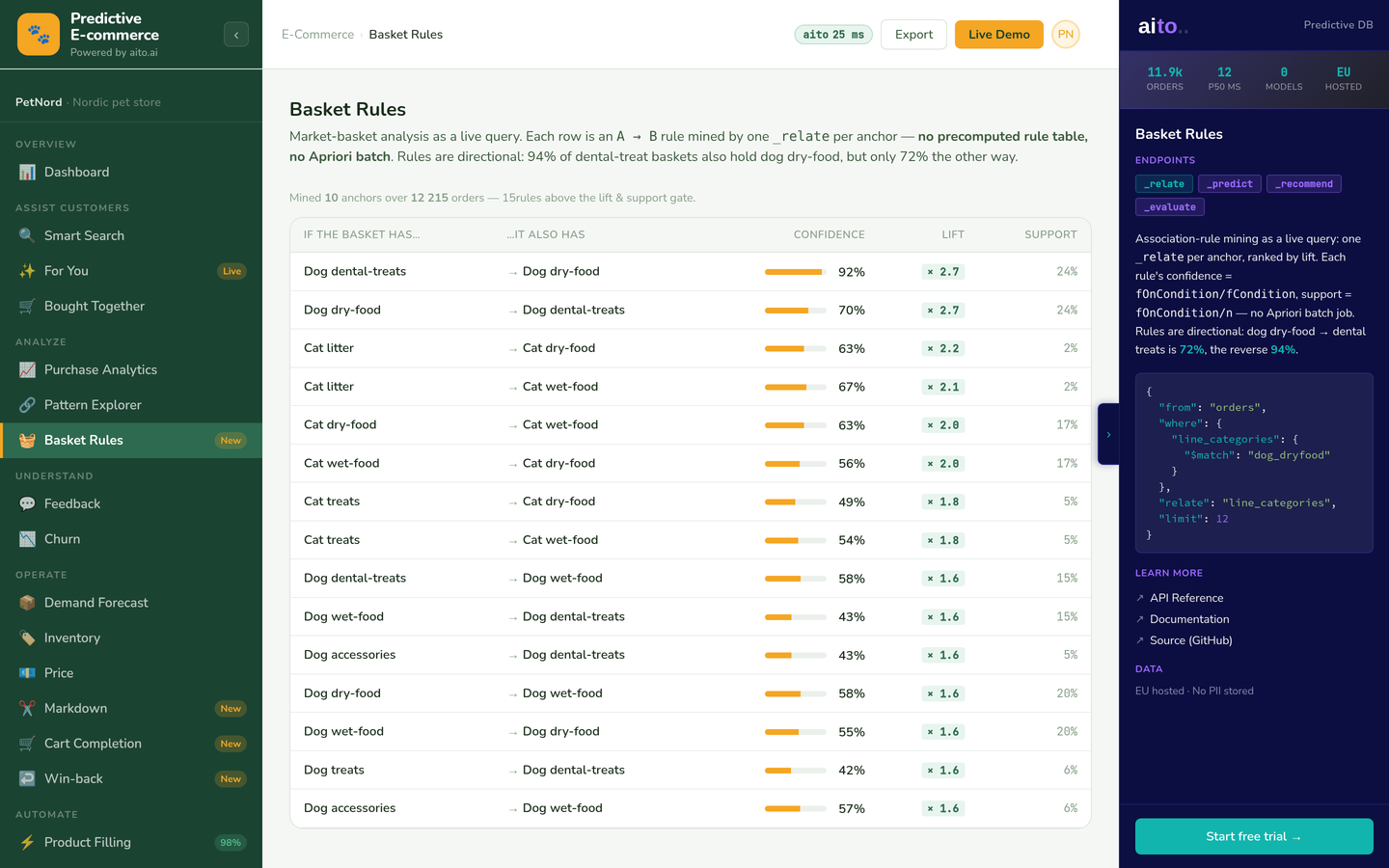
Market-Basket Rules
Directional A → B basket rules with confidence, lift, and support, mined live by one _relate per anchor category. No precomputed rule table, no Apriori batch job.
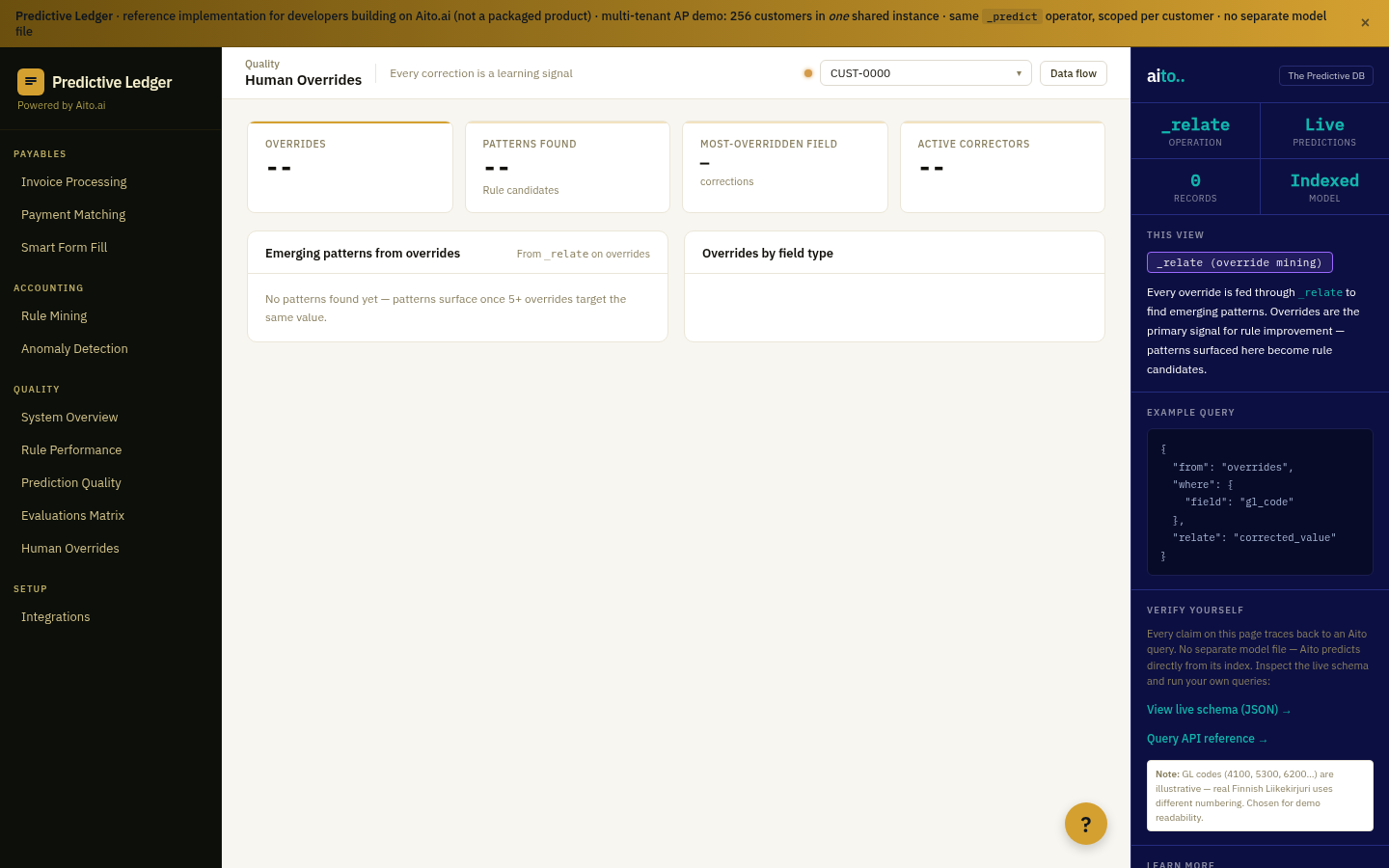
Override Mining
Every human correction is logged, and _relate over the override log surfaces the emerging patterns: which values people keep correcting to, and what drives the correction. Each pattern is a rule candidate.
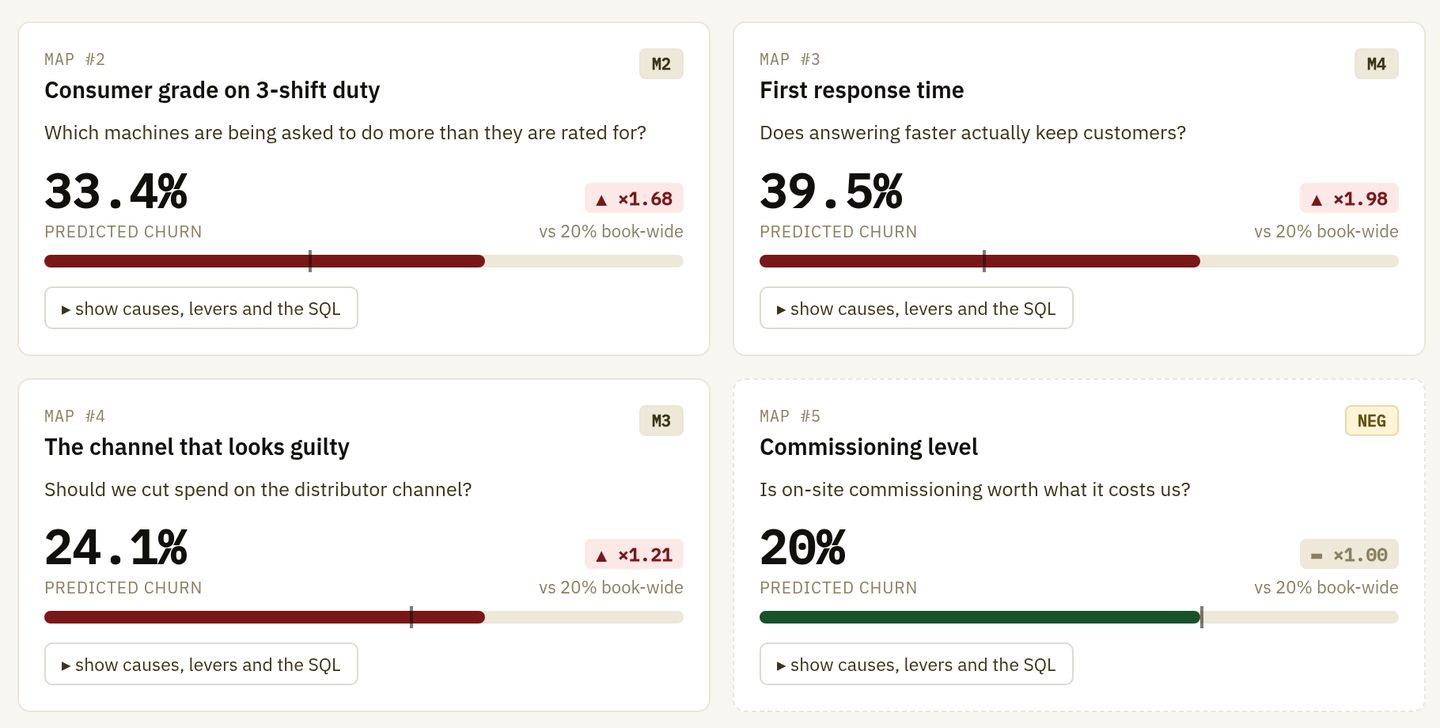
Confounder-Checked Root Cause
The distributor channel looks guilty for churn until climate is held fixed; conditioned, it drops out of the top drivers. A null-control card that finds no lever ships beside it, on purpose.
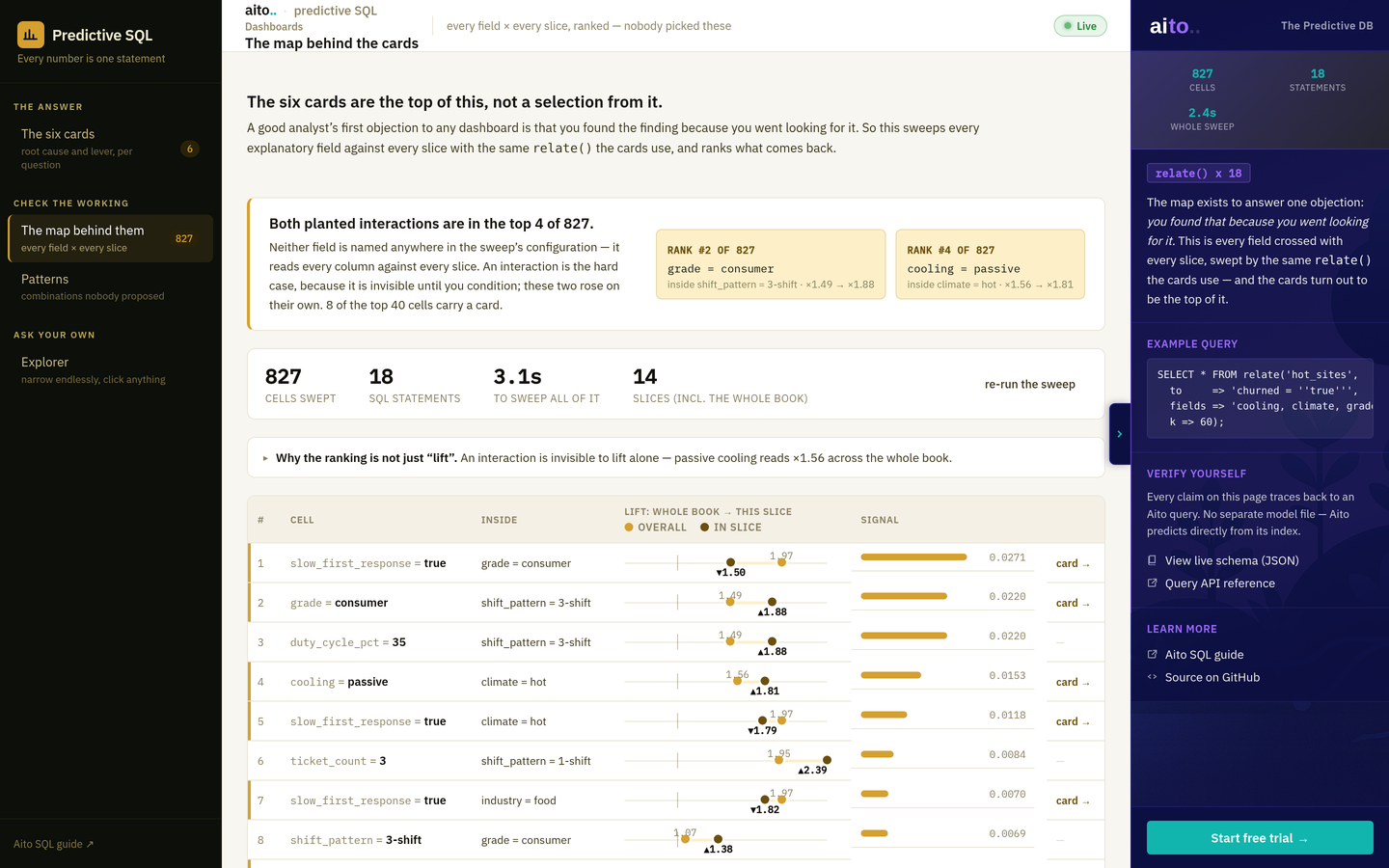
Exhaustive Driver Map
Every field × value × slice cell swept with relate() and ranked by how far its lift moves under conditioning: 827 cells from 18 statements. Interactions surface without anyone going looking for them.
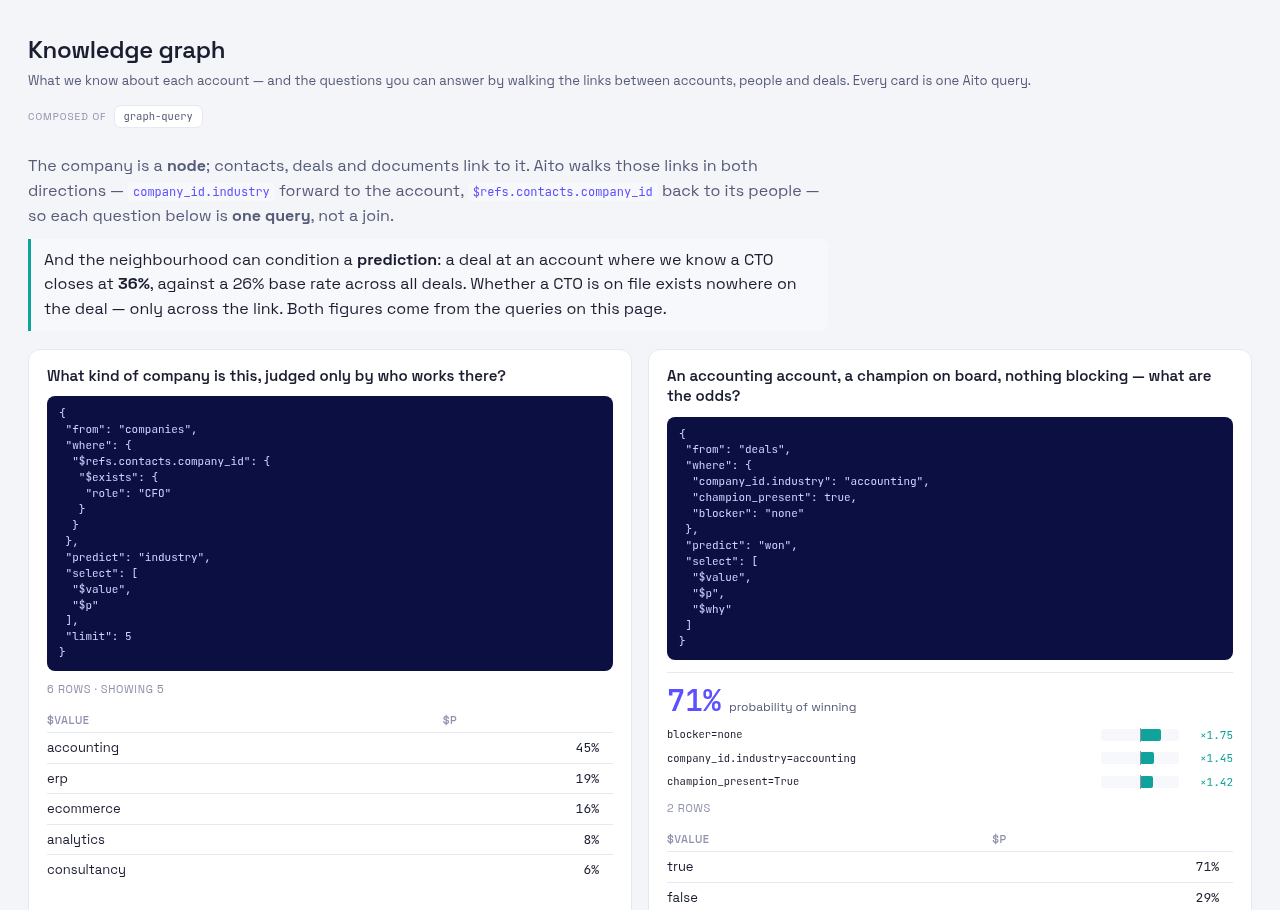
Prediction Over a Knowledge Graph
Accounts, contacts and deals are linked records, and one query reads the links both ways and predicts across them: an account's industry judged only by who works there, or a deal's odds from a fact that lives on its account, with $why naming the evidence.
Quality & Calibration
Score your own predictions. Surface where the system can and cannot help.
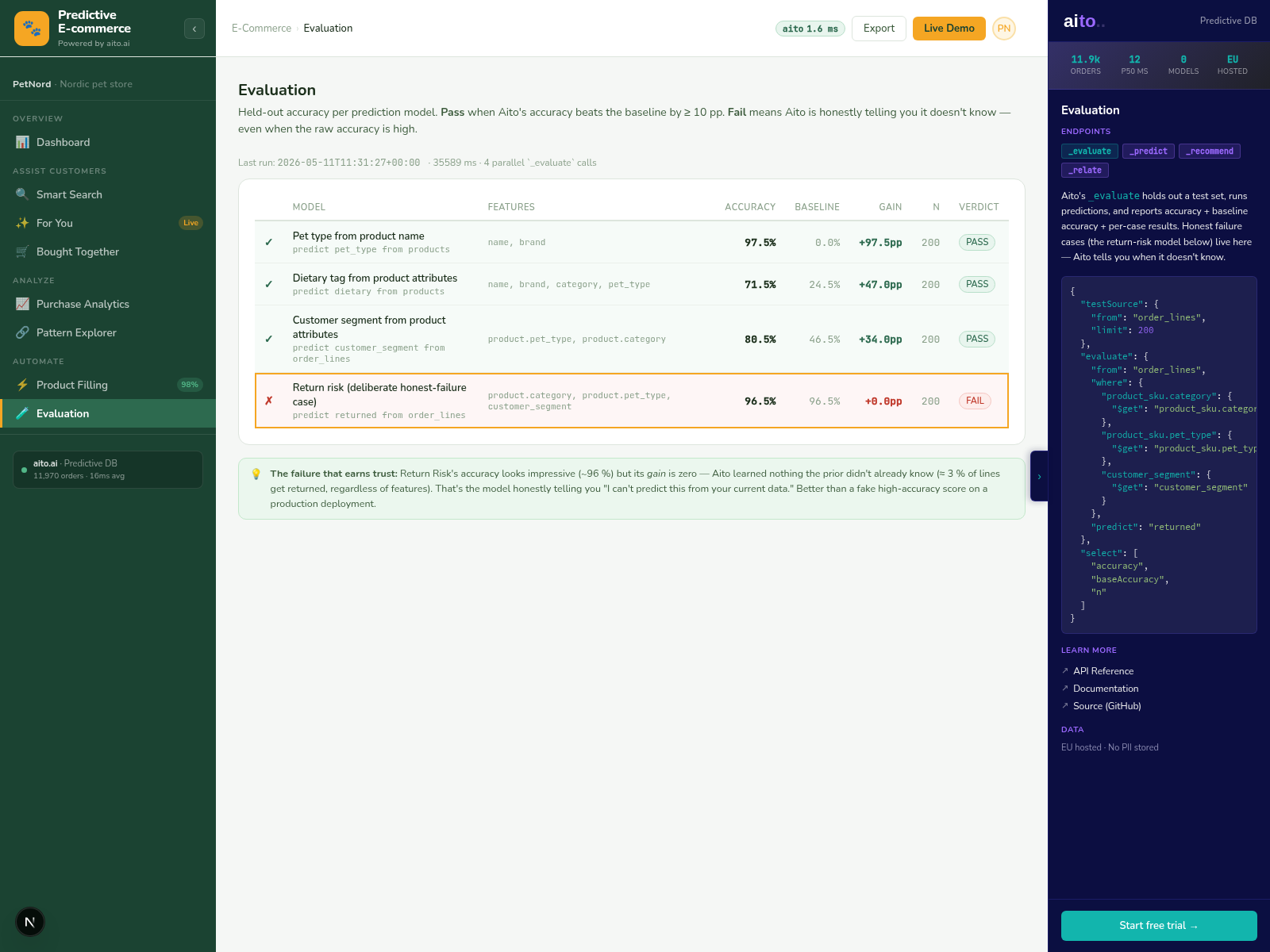
Honest Evaluation
System scores its own predictions on held-out data. Return Risk reports +0.0 pp gain over baseline and renders as a red row — the system says when it cannot help.
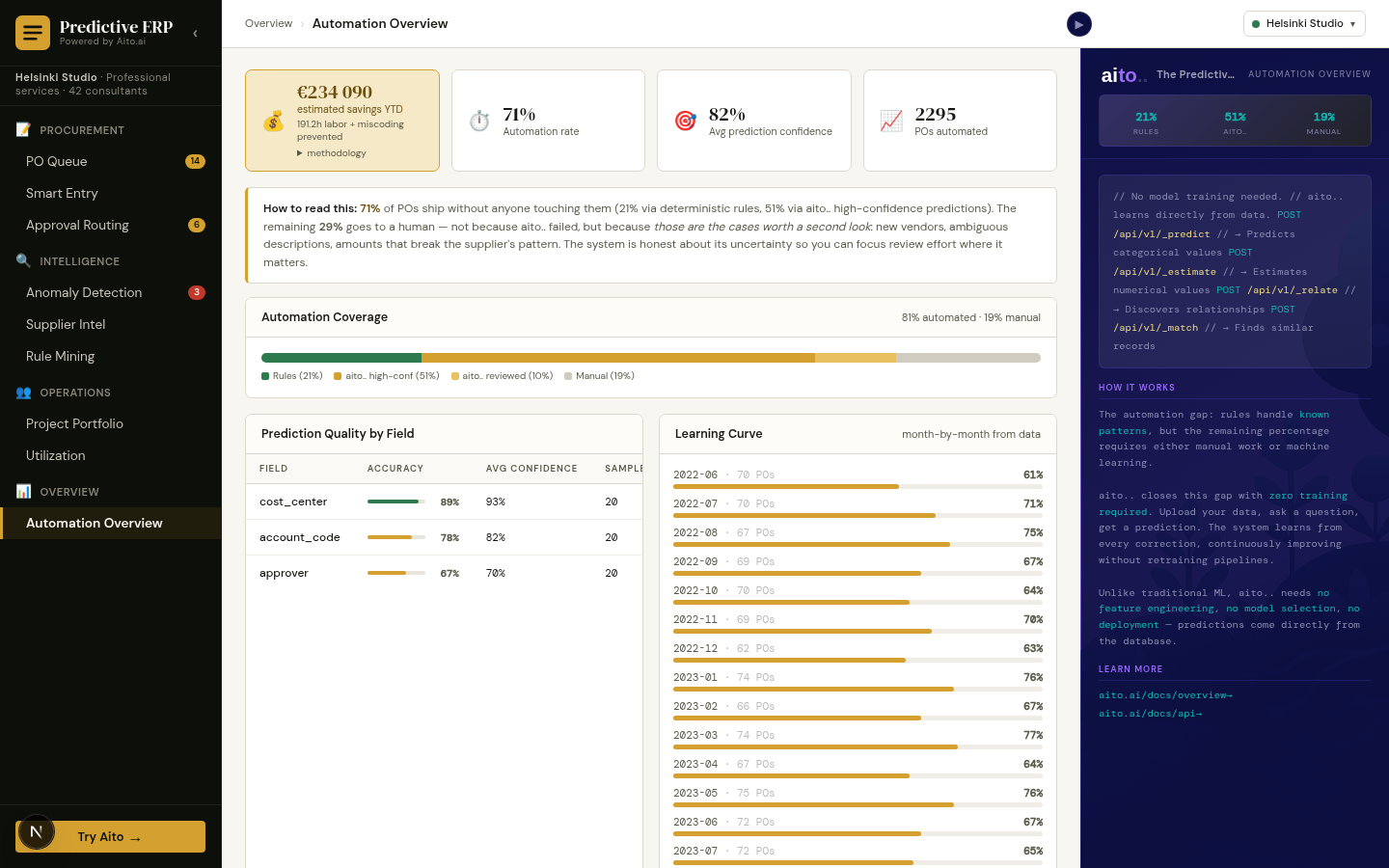
Quality Dashboard
Per-field accuracy and per-confidence-bucket calibration on held-out samples. Green/red diff vs. always-predict-majority baseline.
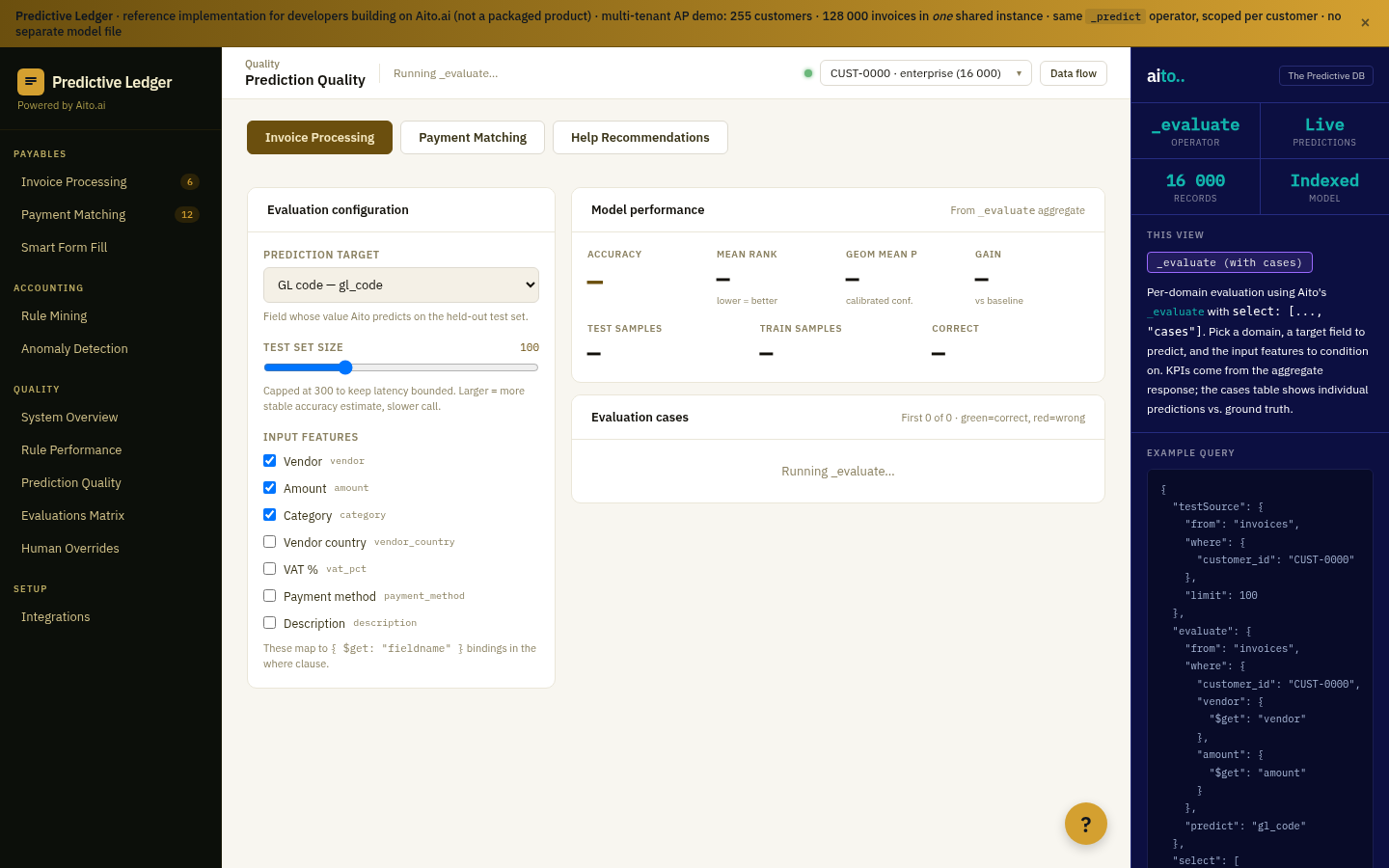
Calibration Check
Accuracy on held-out cases next to the model's own calibrated confidence, per field, with the individual cases behind each number. The snapshot a calibration monitor tracks over time.
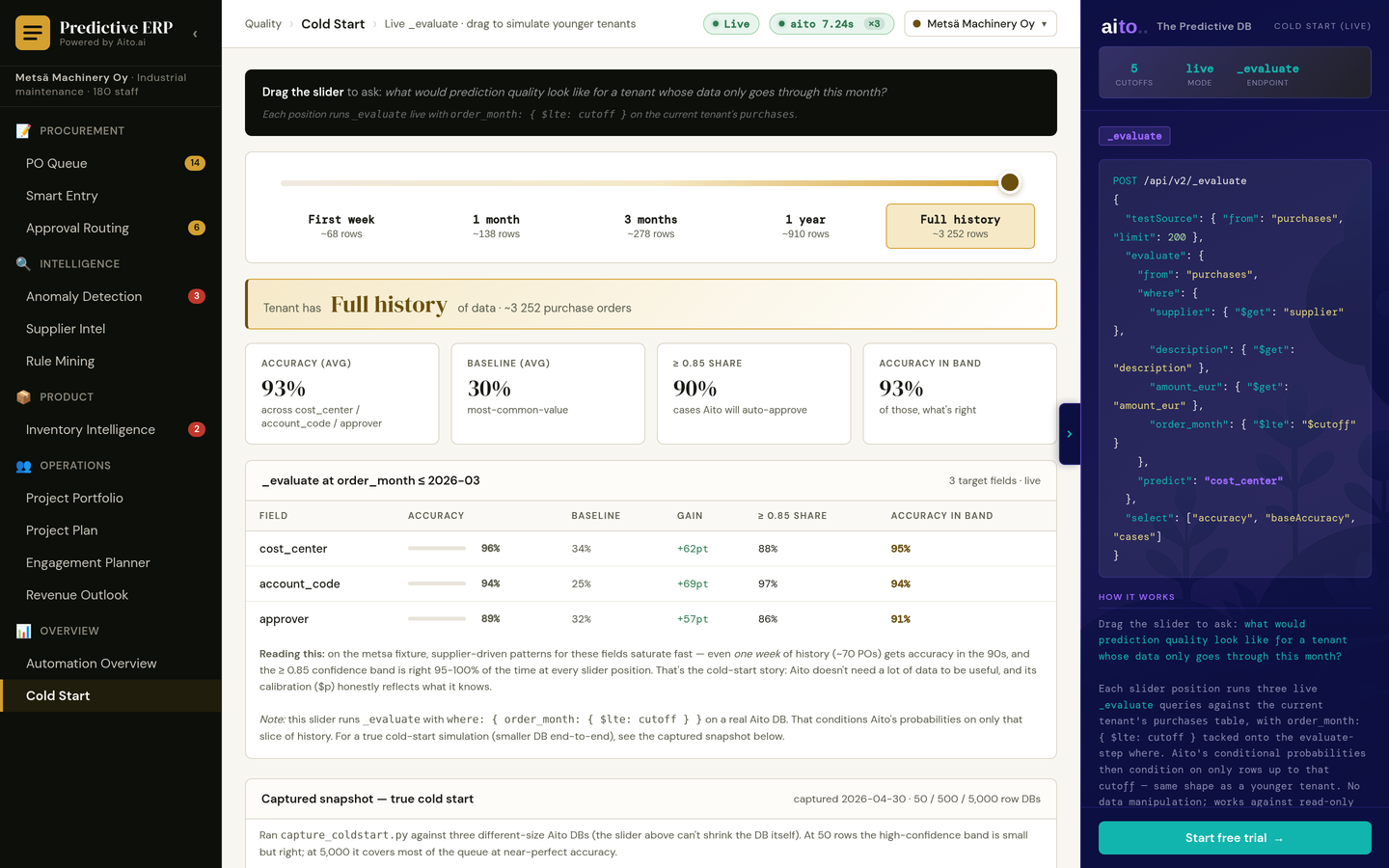
Cold-Start Check
Drag a slider to simulate a younger tenant, from a first week of history to the full record, and a live _evaluate shows how accuracy on cost center, account code, and approver holds up at each size.
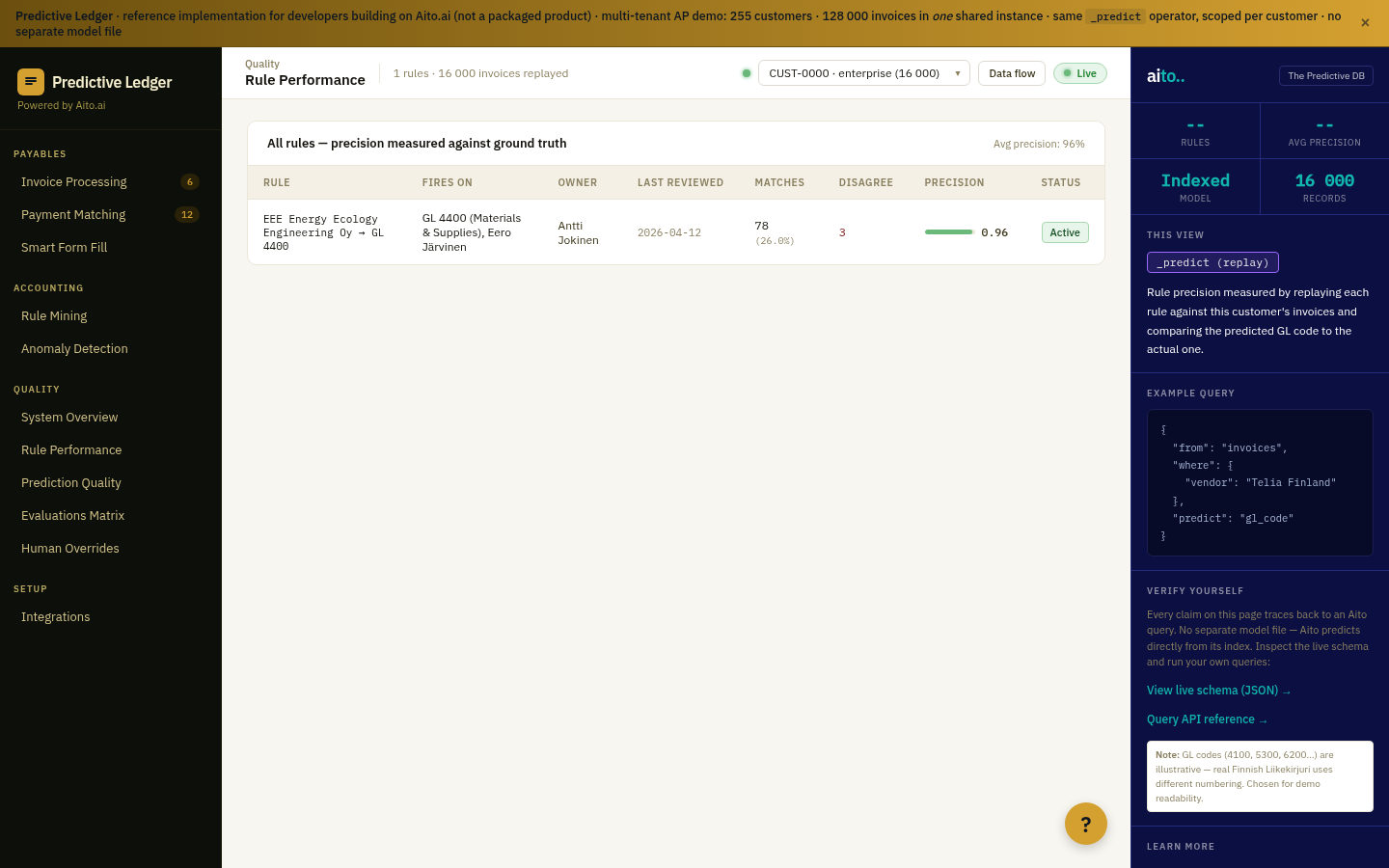
Rule Precision Replay
Every mined rule replayed against the tenant's invoices: how many invoices it matches, how often it disagrees with the posted value, and its precision against ground truth.
Forecasting
Predicted quantities at query time. No separate forecasting model to maintain.
Demand Forecast
ERP: _predict units_sold blended with seasonality factors from same-month historical data. E-commerce: _estimate of next month's units for the top movers, seasonal category peaks via _relate, and held-out accuracy via _evaluate. No separate forecasting model.
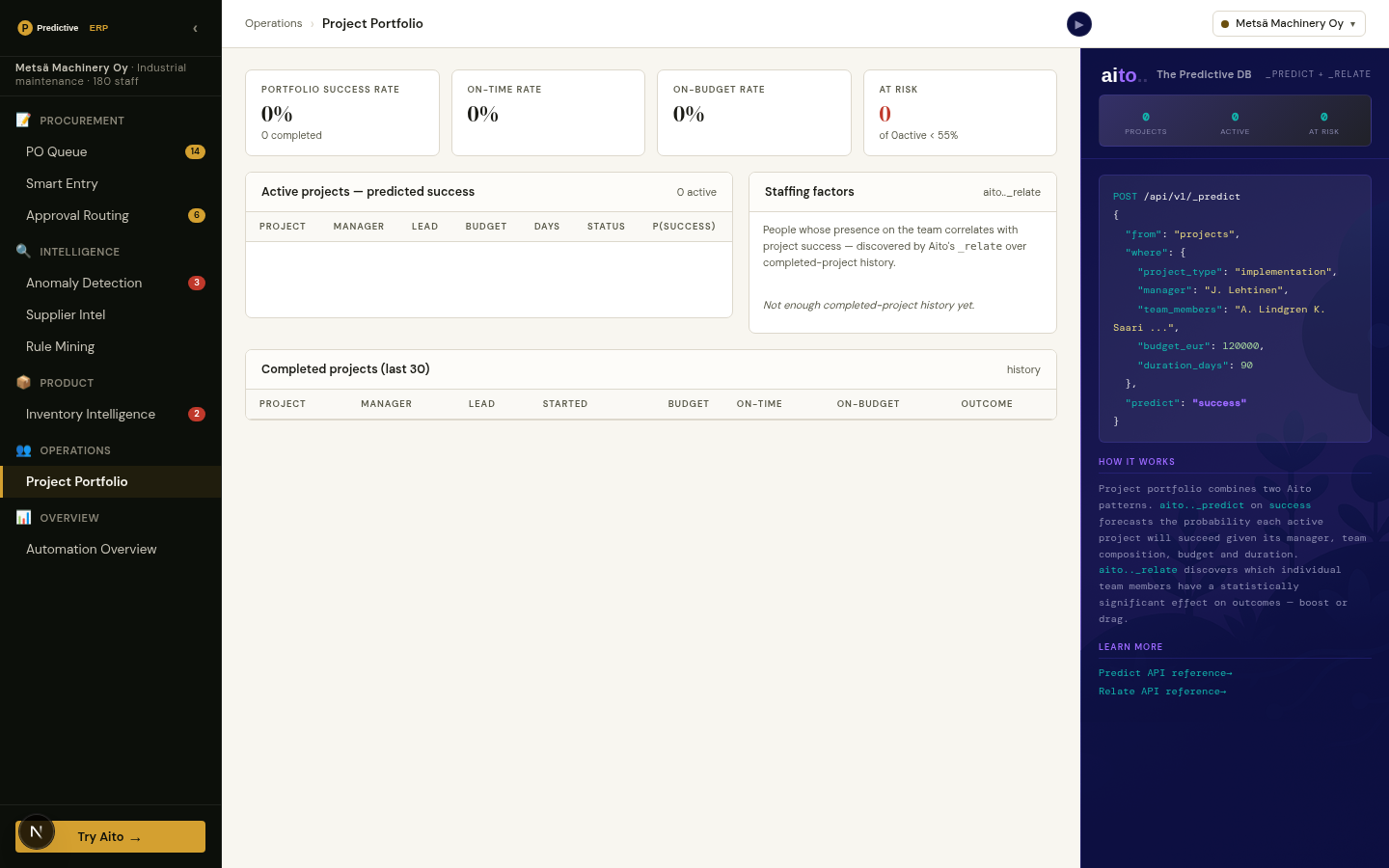
Project Success Probability
A calibrated P(success) for every active project from _predict, and the people and project fields that move the success rate across completed projects from _relate, so the portfolio review starts from the projects most at risk.
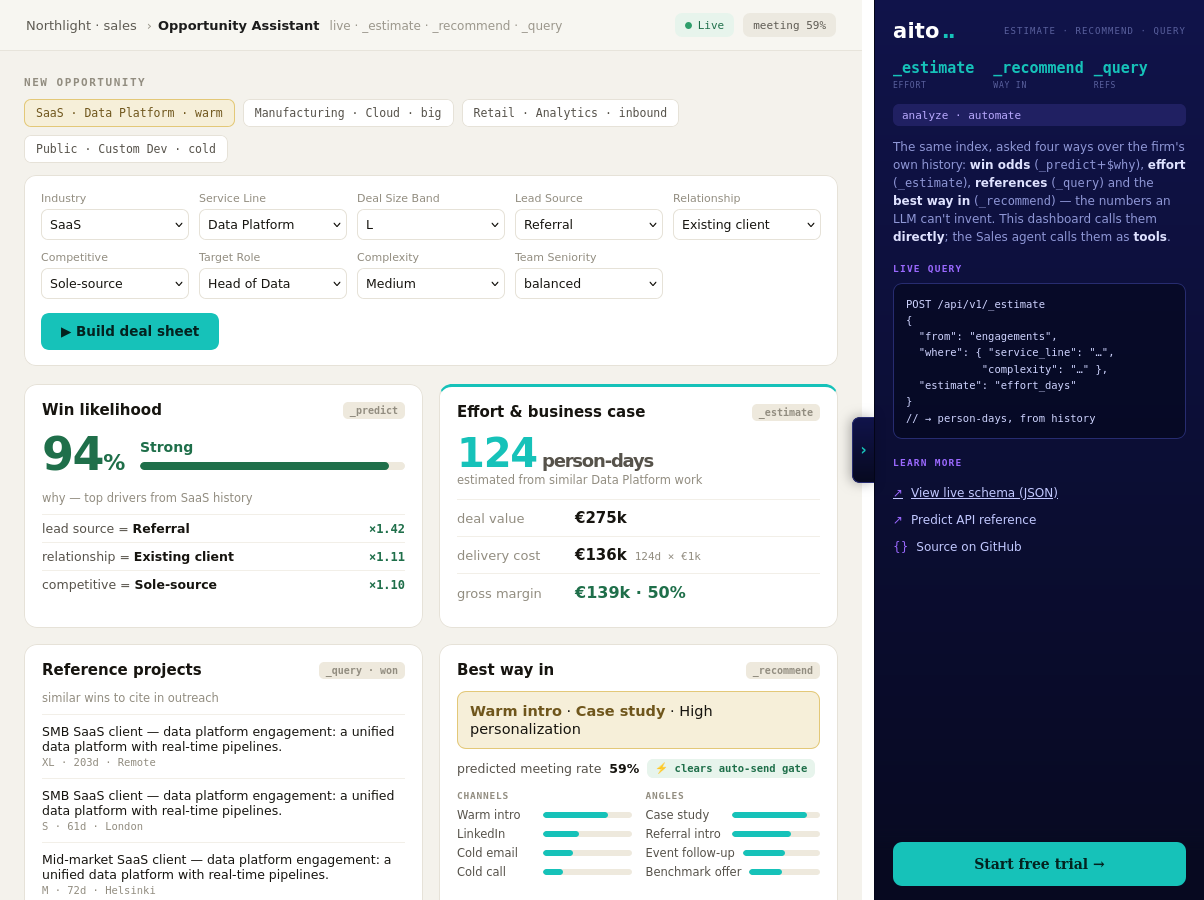
Opportunity Scoring
A deal sheet from your own history: win odds with $why, effort in person-days, and reference projects, the numbers an LLM or a gut call would otherwise invent.
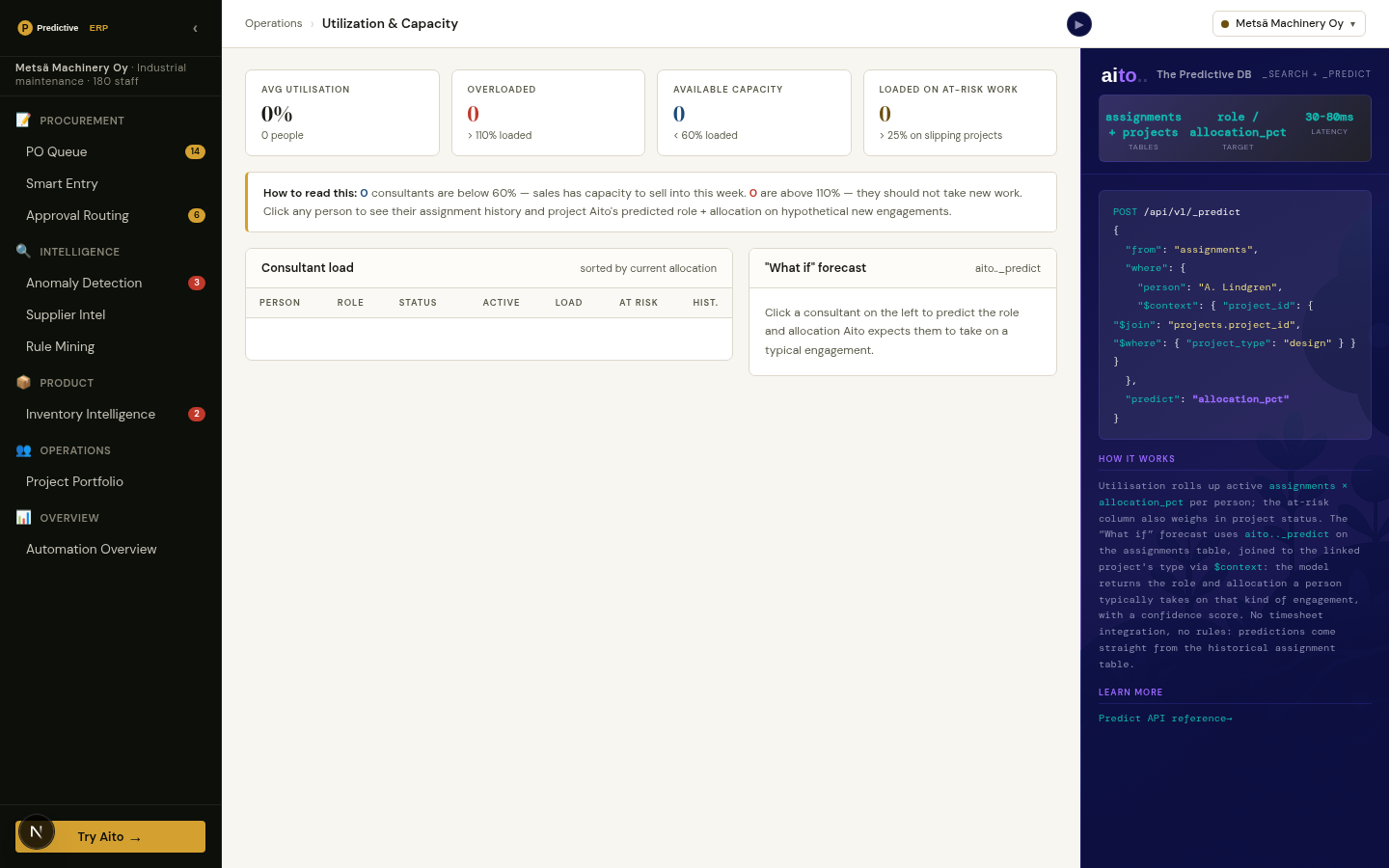
Utilization Forecast
Per-consultant load via _predict allocation_pct. Capacity planning that respects role and project mix without a separate forecasting model.
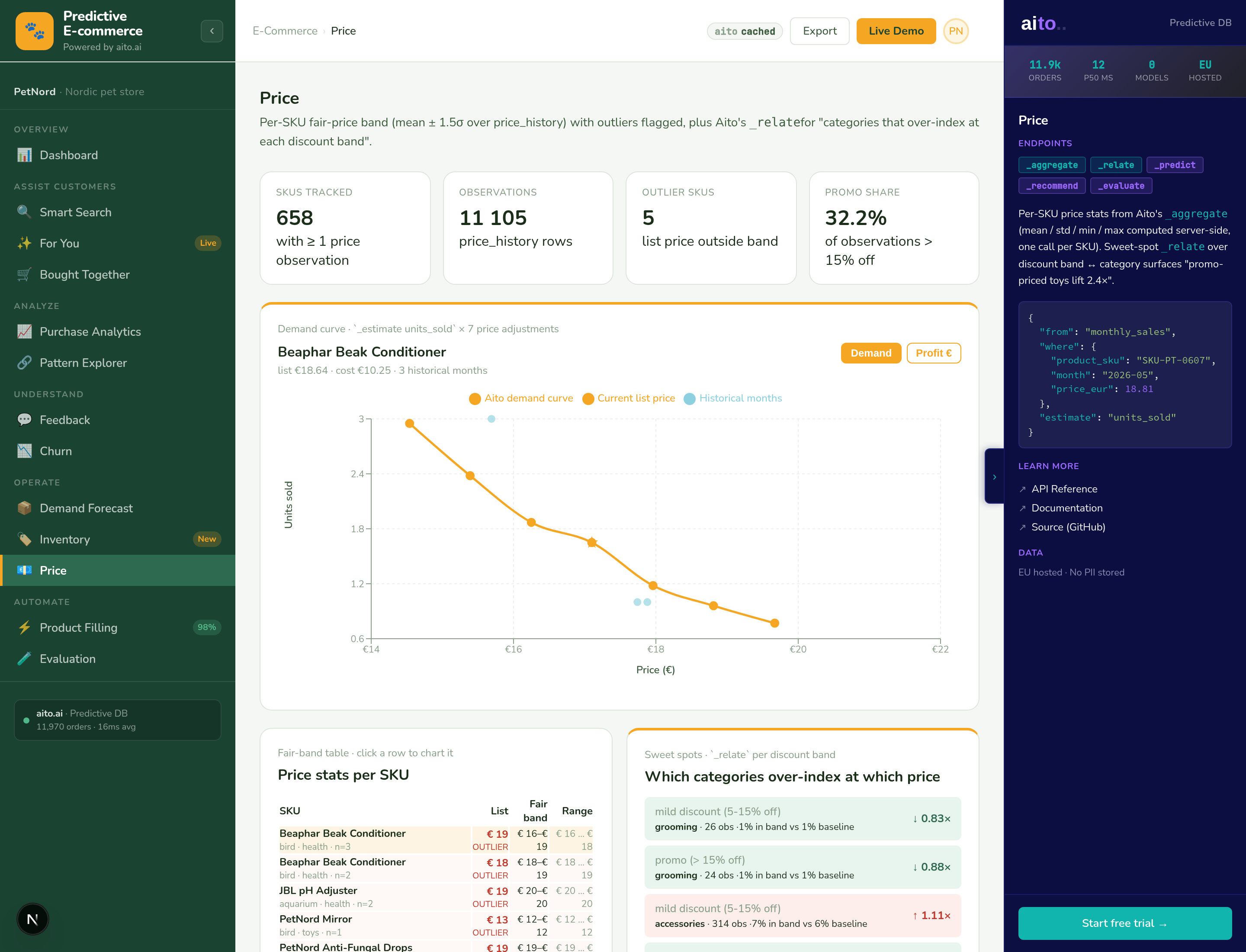
Price Estimation
Fair-price band per SKU from its price history with outliers flagged, and _estimate of units sold at a candidate price.
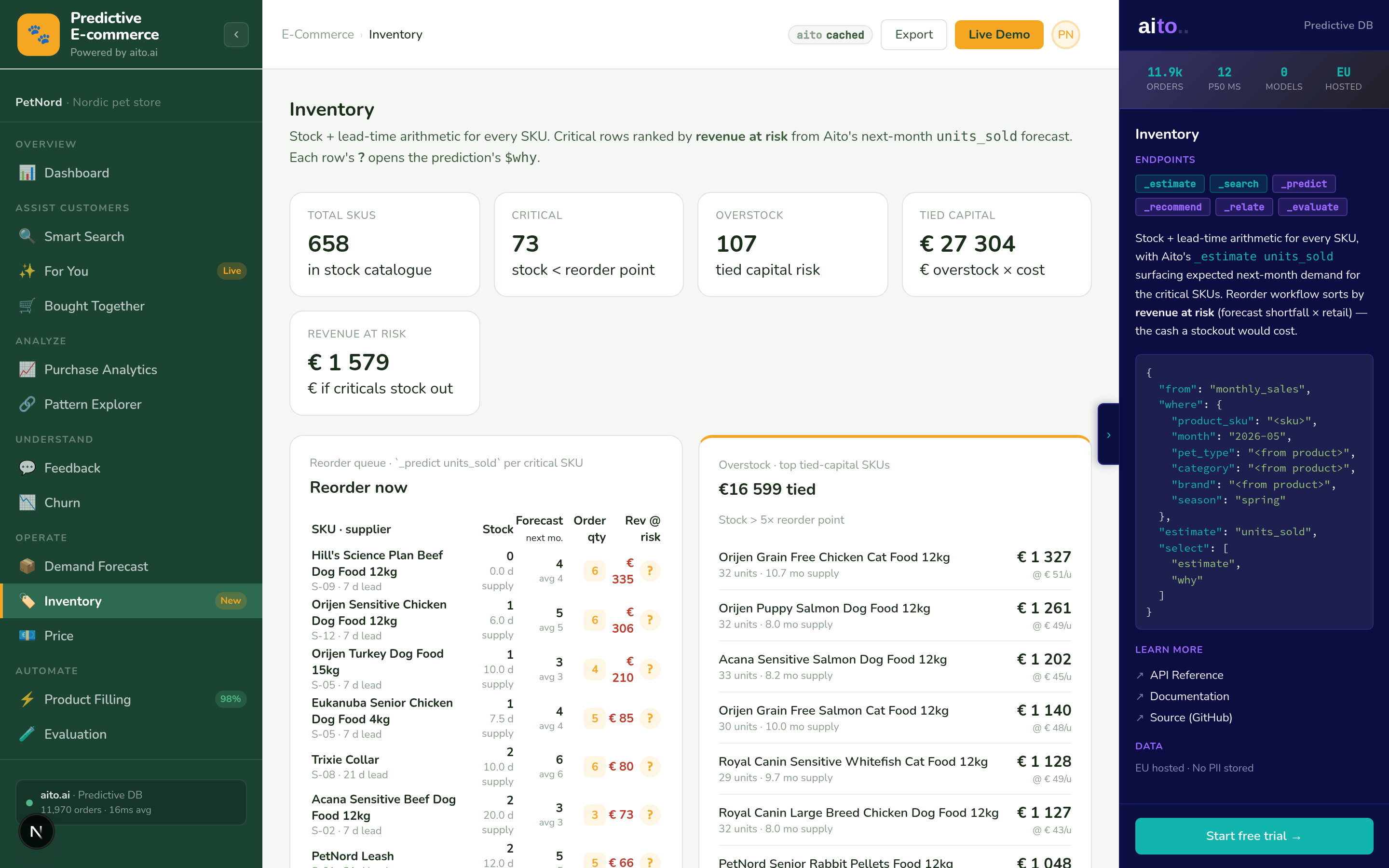
Stockout & Overstock Risk
Stock and lead times checked against next month's predicted demand for every SKU: a reorder queue ranked by revenue at risk, and the overstock that ties up capital.
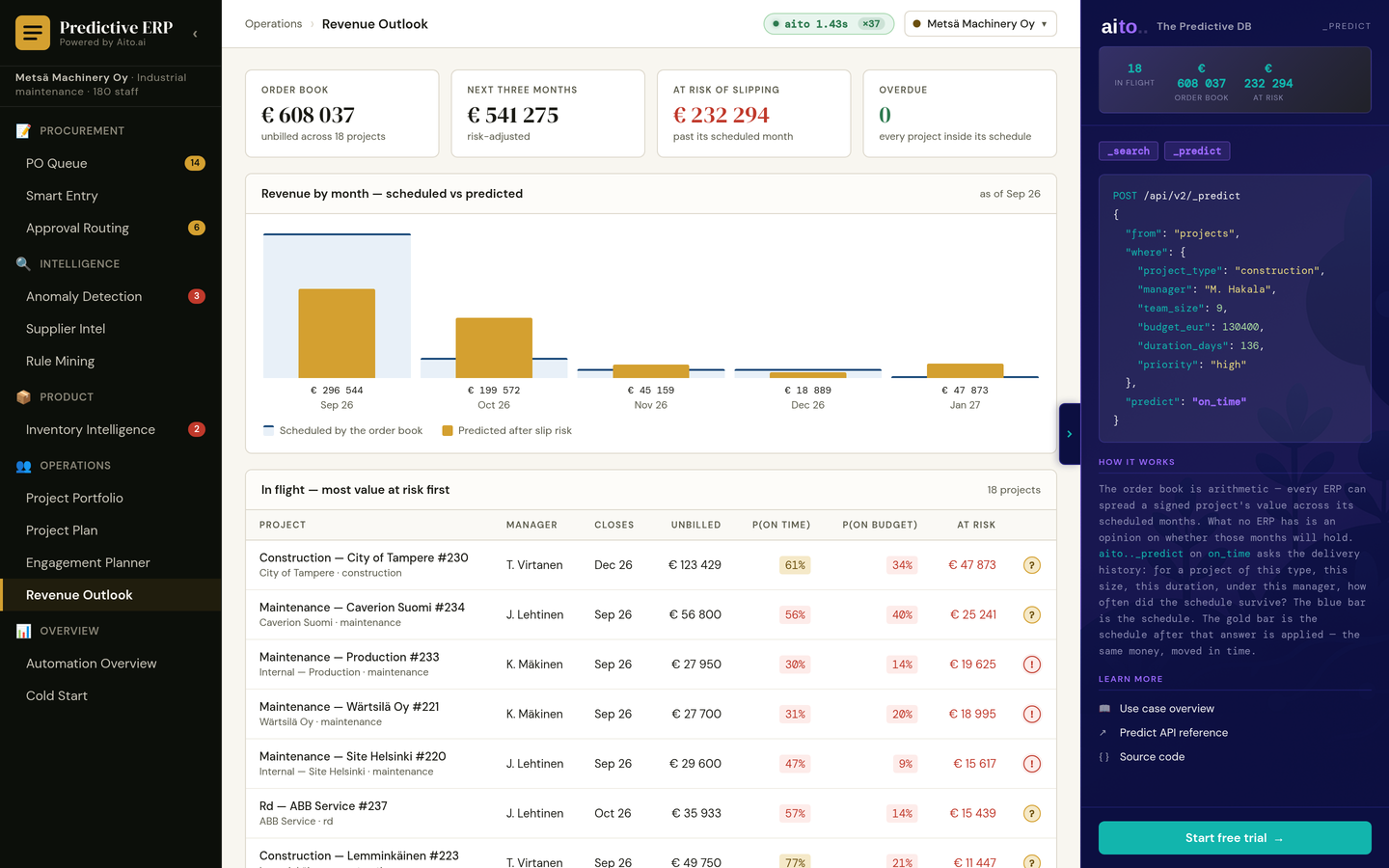
Revenue Outlook
Scheduled revenue per month next to predicted revenue, from _predict of on-time and on-budget delivery for every active project, with $why behind each.
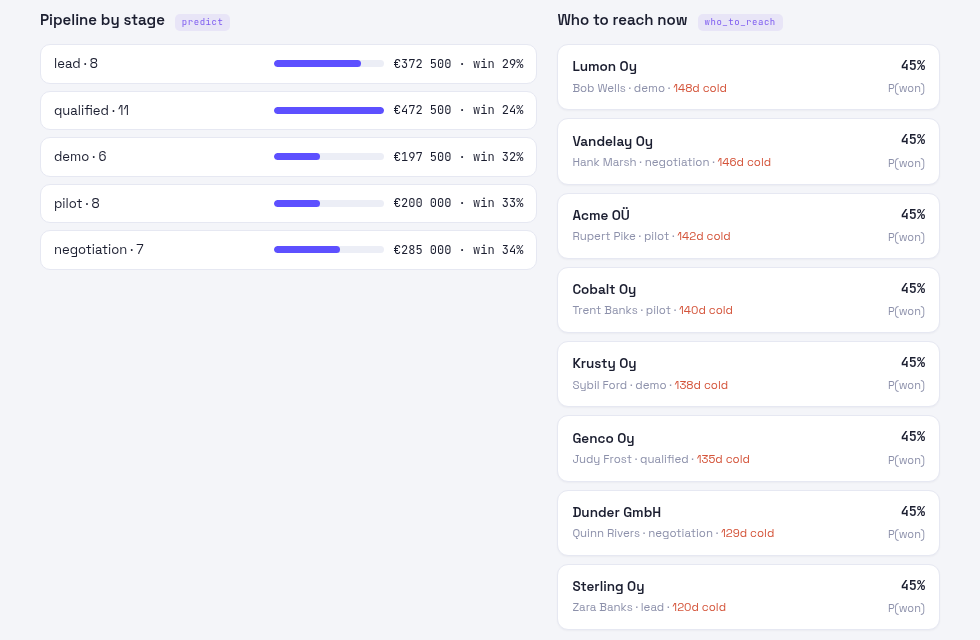
Pipeline Close Likelihood
Every open deal carries a calibrated probability of closing, so the pipeline is weighted by P(won) instead of summed and each stage shows its predicted win rate, learned from the deals that closed before.
Segmentation
Discover groupings from behavior, not from hard-coded rules.
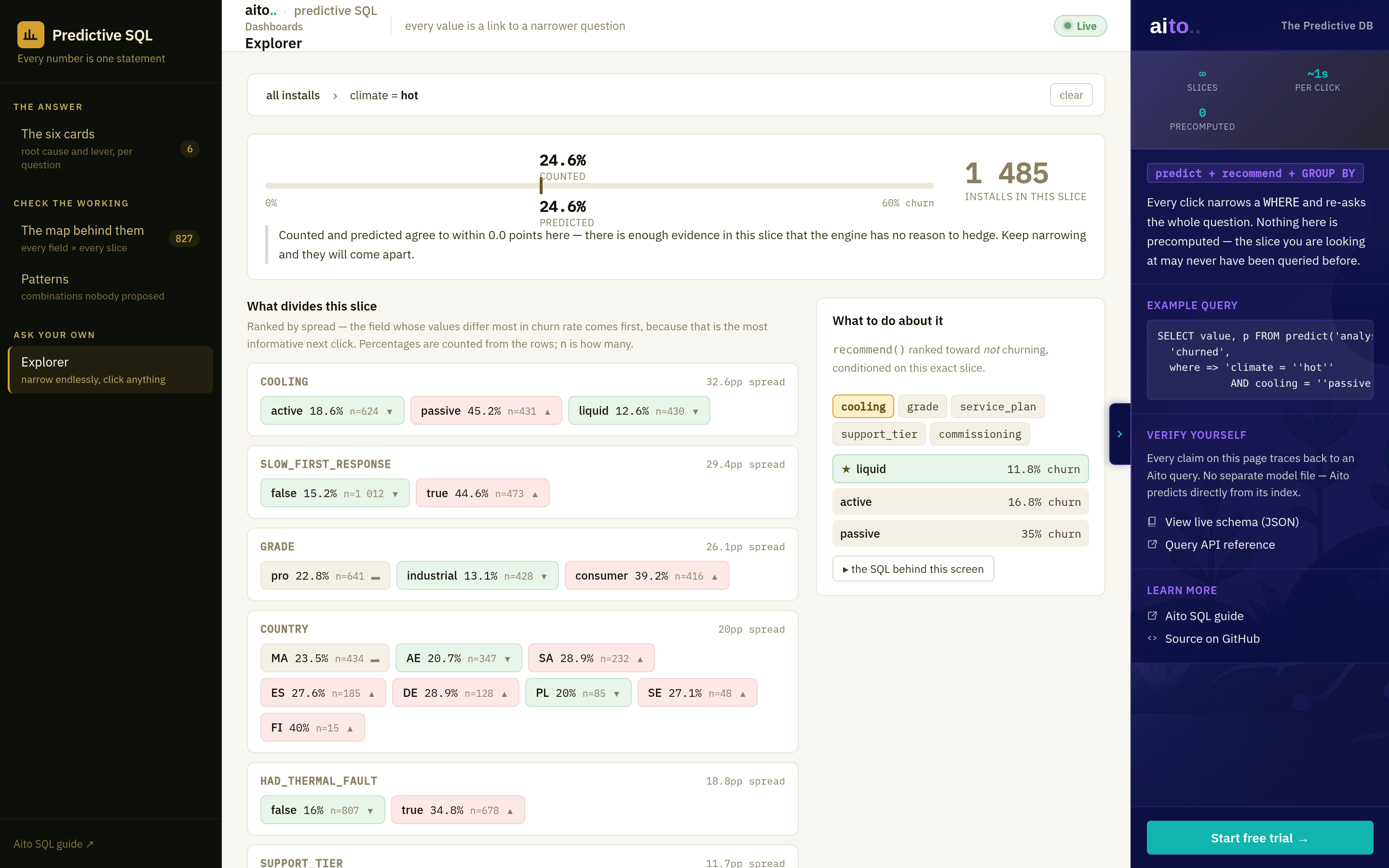
Customer Segmentation
Segments cut by the outcome you care about, not by similarity: rank the fields that split customers furthest apart on churn or conversion, step into a segment, and get its calibrated rate, what divides it further, and the lever that moves it.
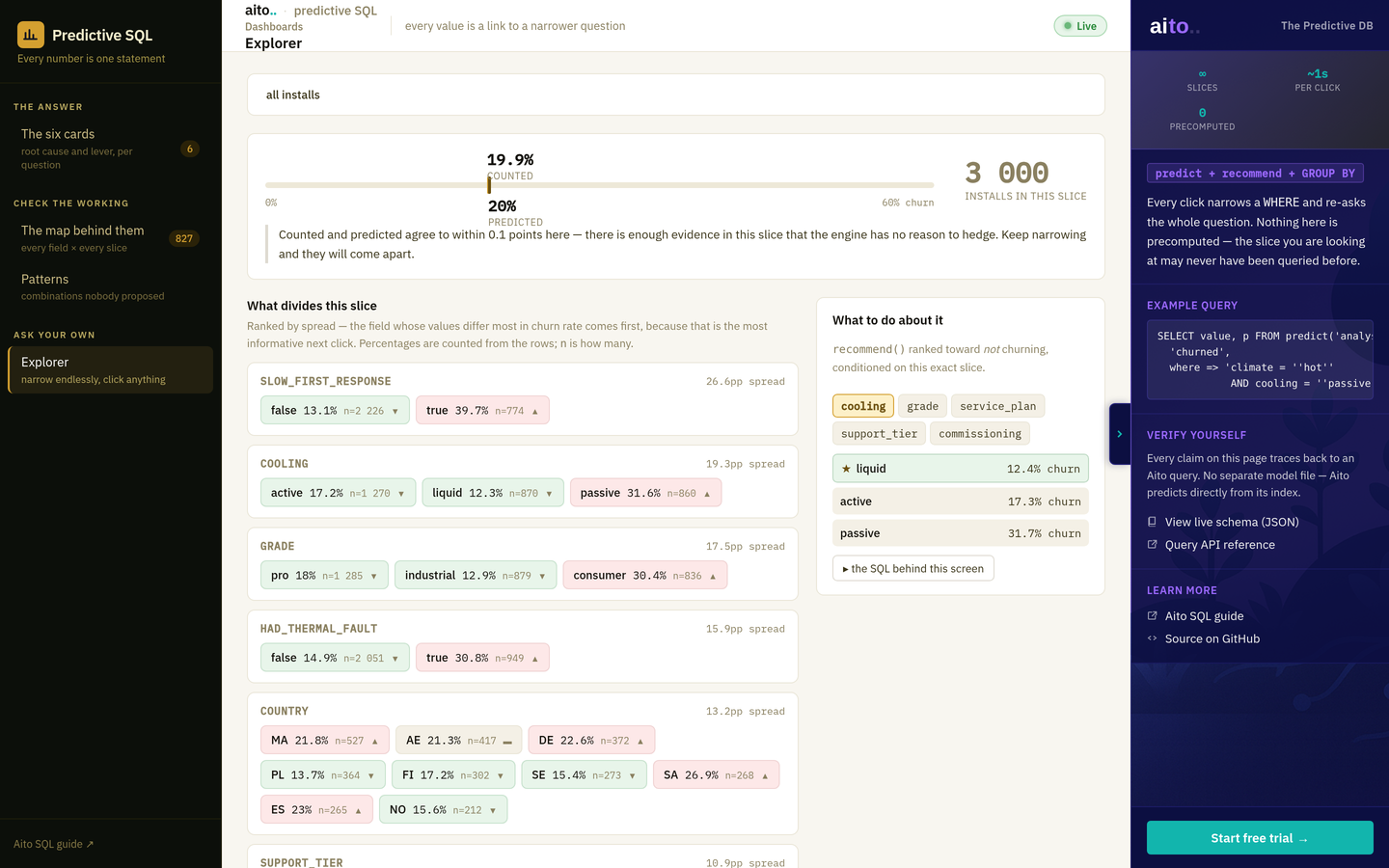
Click-to-Narrow Slice Explorer
Every value is a link: each click adds a condition to the WHERE and re-asks the question. predict() gives the calibrated churn rate for the slice, recommend() the levers, and GROUP BY counts show the raw rates beside them.
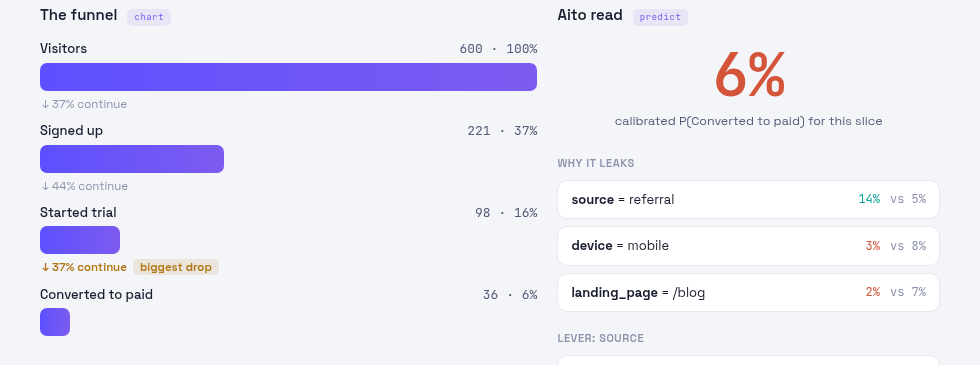
Funnel Leak Diagnosis
The funnel names its biggest drop, and for any slice (source, campaign, device, country, landing page) a calibrated conversion rate arrives with the conditions that pull it up or down and the lever that moves it.
Assist
Suggest the next best action — with calibrated confidence.
Search, recommendations, smart forms, conversational. The human stays in control; the system boosts speed and accuracy.
Search & Discovery
Personalized ranking. Match similar items. Find what the visitor is actually looking for.
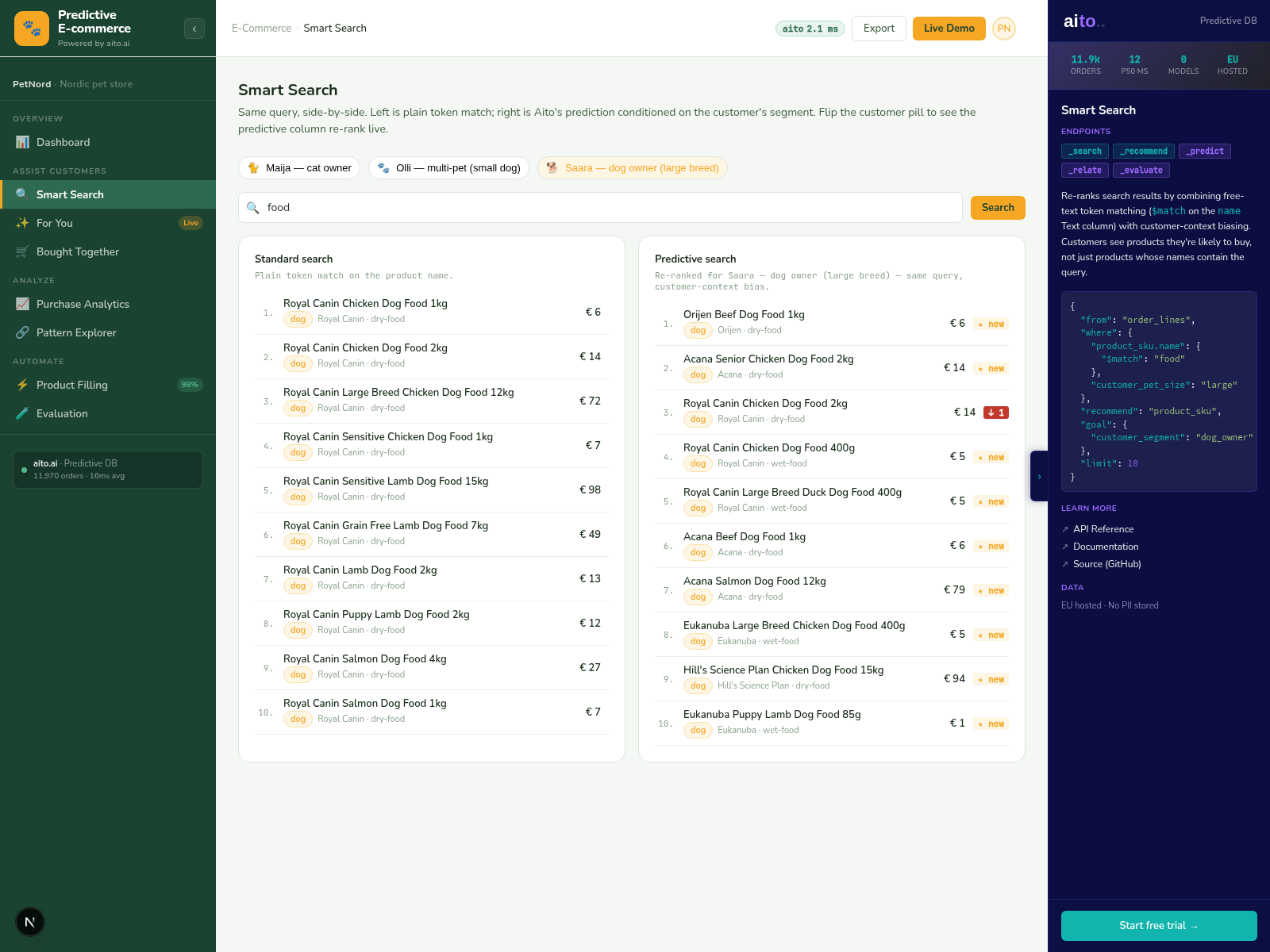
Smart Search
Persona-conditioned re-ranking. Same query returns different rankings for different shopper segments — derived from the data, not from a curated rule.
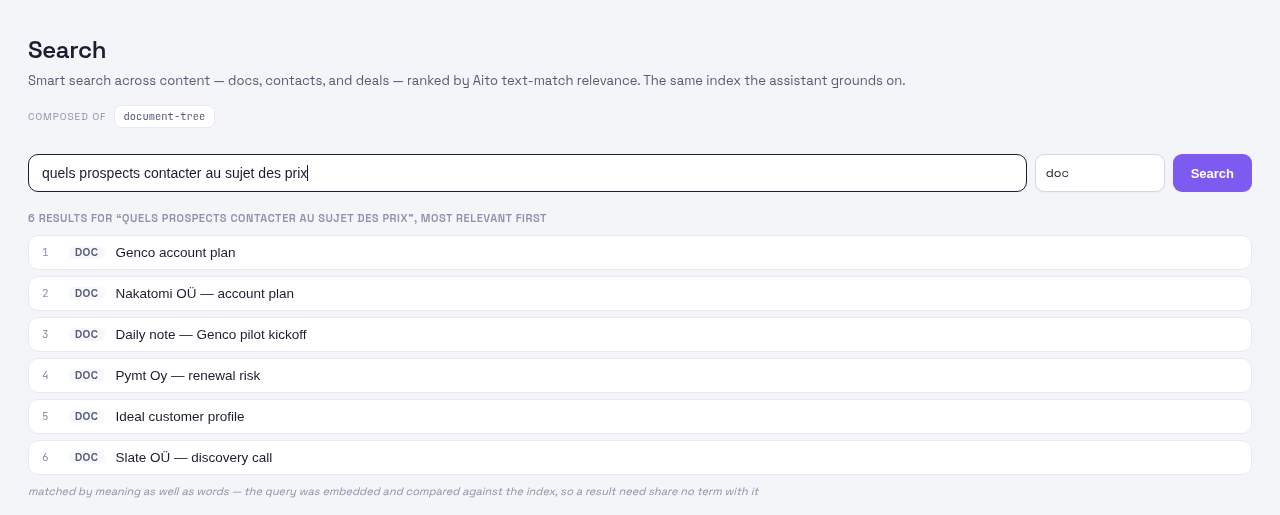
Cross-Lingual Semantic Search
A question in French over English notes finds the right documents although it shares no word with them: the text match returns nothing, nearest neighbours over the embeddings fill in, and an exact English query keeps its exact matches.
Recommendations
Cross-sell, similar items, bought-together, for-you. All from the same _recommend operator.
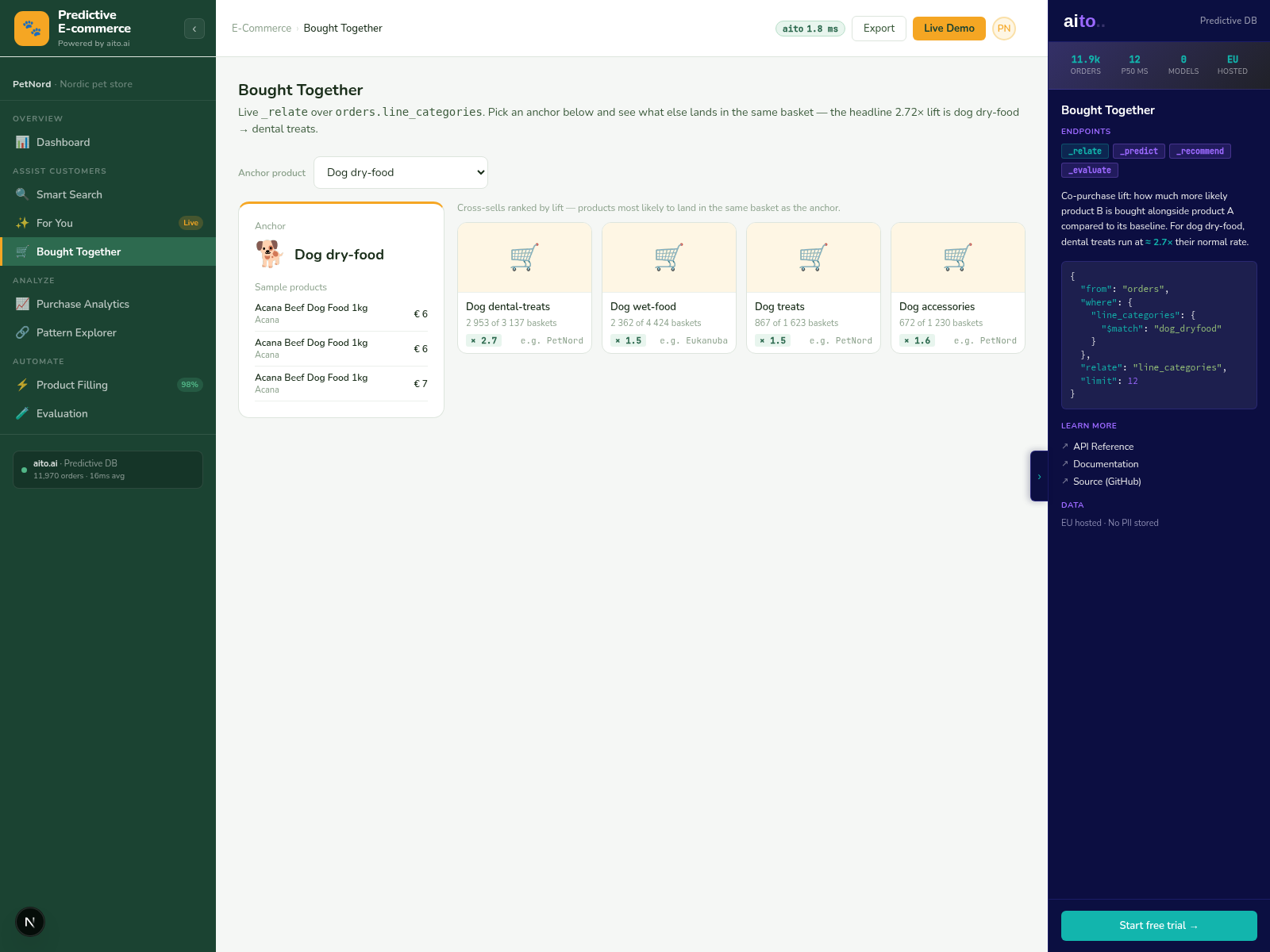
Bought Together
Cross-sell ranked by co-purchase lift. Mined live from order data — not from a curated rule.
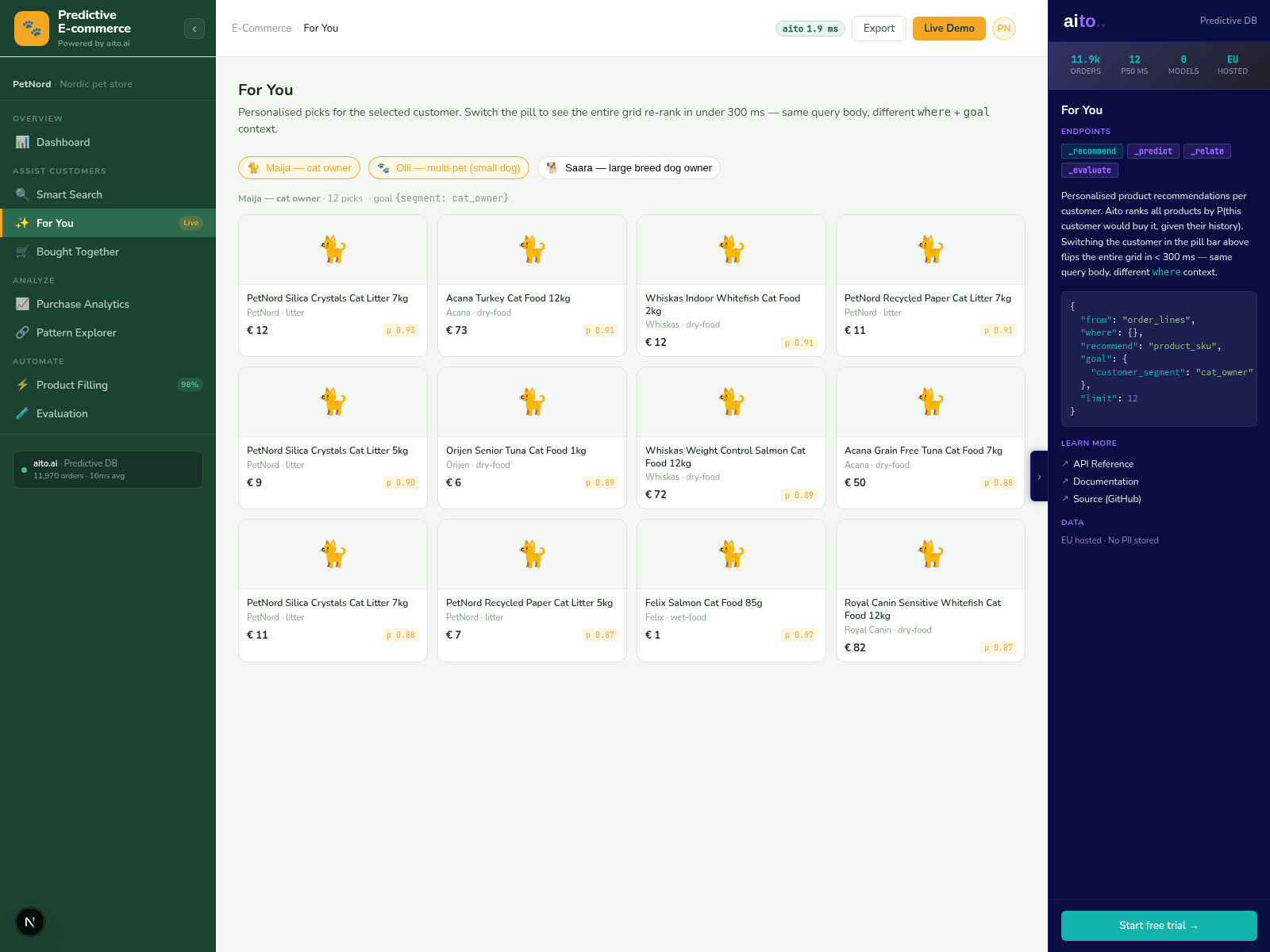
For You
Personalized tile rankings per shopper. Same query different per-customer; reranking from purchase, browse, and segment history.
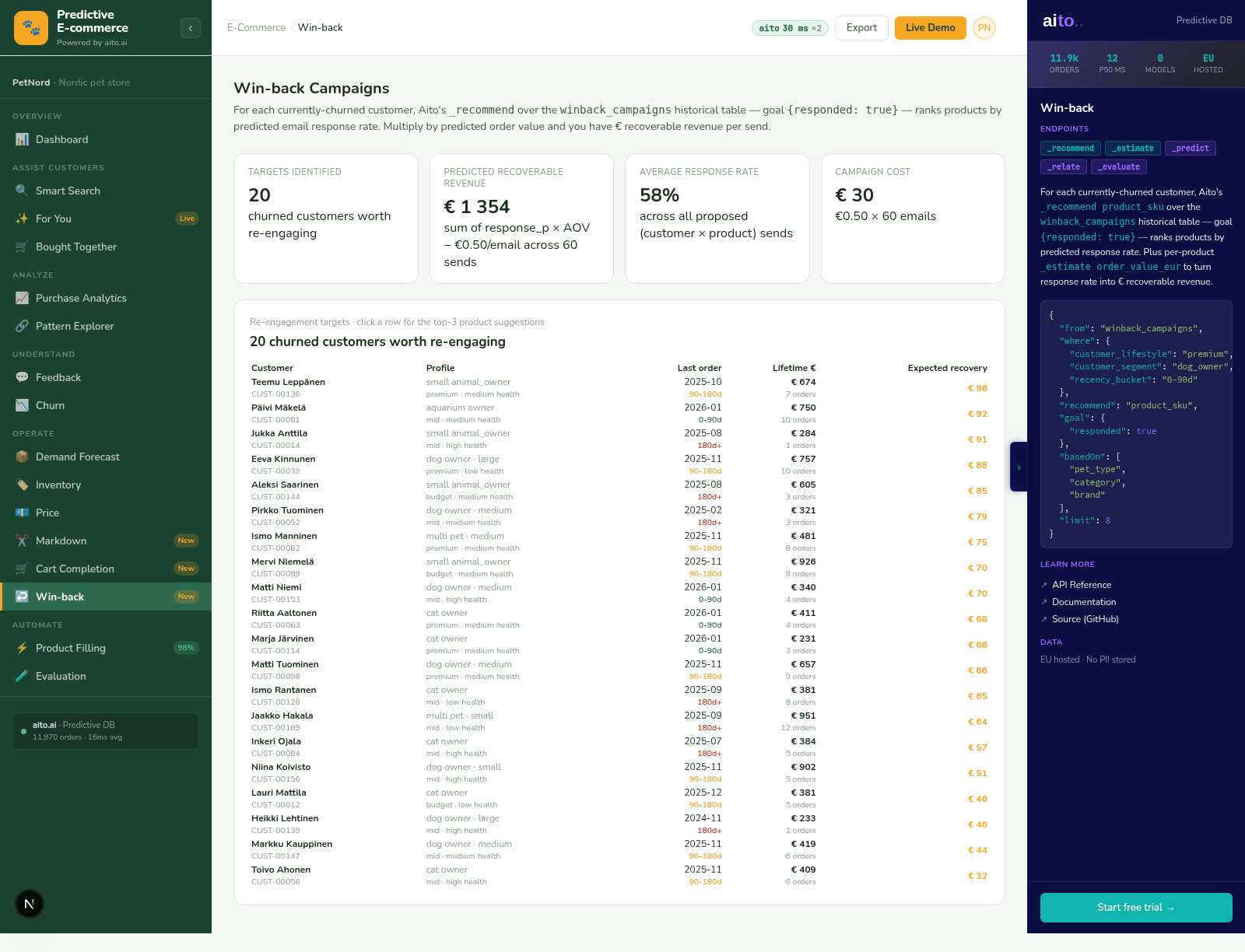
Win-back Ranking
Lapsed customers ranked by predicted recoverable revenue. Drives outreach prioritization with empirical ROI per cohort.
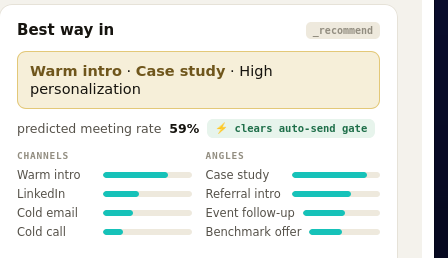
Next Best Outreach
_recommend the channel and angle that most likely books the meeting for this buyer, with the predicted meeting rate attached. Optimisation, not description.
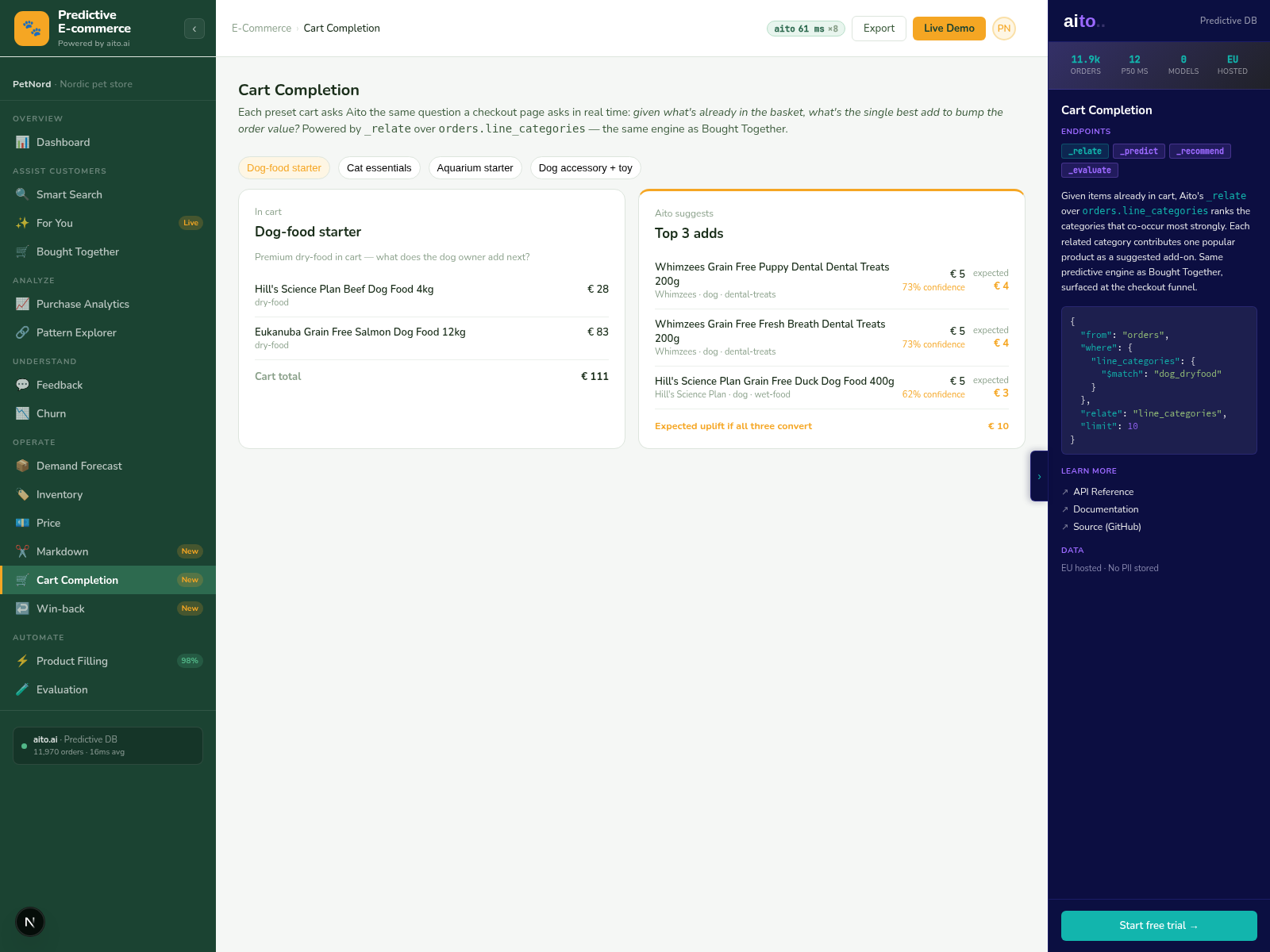
Cart Completion
Given what is already in the basket, the best add-on to raise the order value: _relate over past baskets finds the category that co-occurs most strongly, and a product from it is suggested with its expected uplift.
B2B Cross-Sell
Pick a product and get what is bought with it: _relate over past order baskets ranks the products that co-occur with it by lift, with the counts behind each pair.
Smart Forms
Multi-field prediction wired into input UI. One field in, the rest predict.
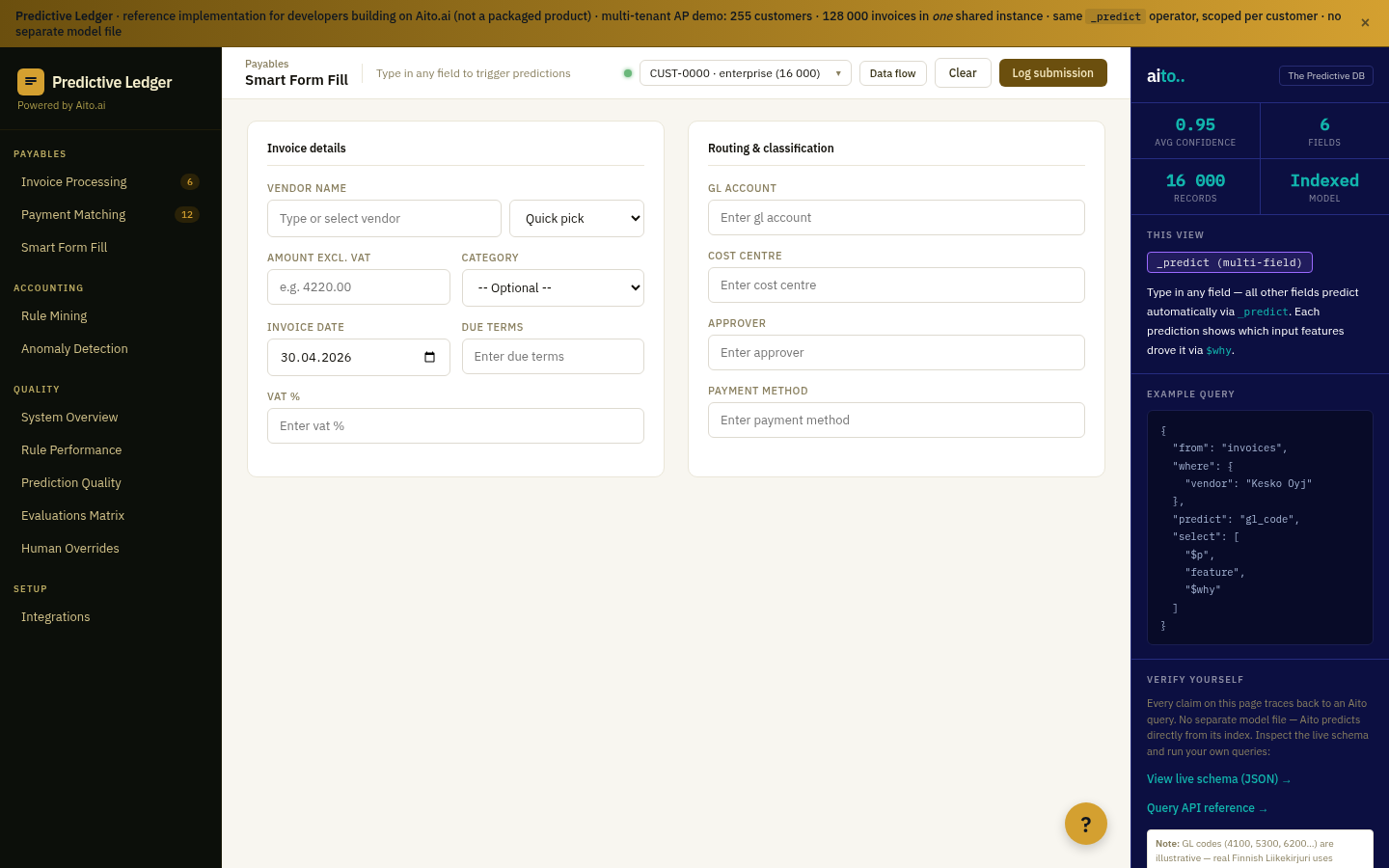
Smart Form Fill
Type any field, the rest predict. Vendor → fills GL, approver, cost centre, VAT %. The form does the thinking, the user confirms.
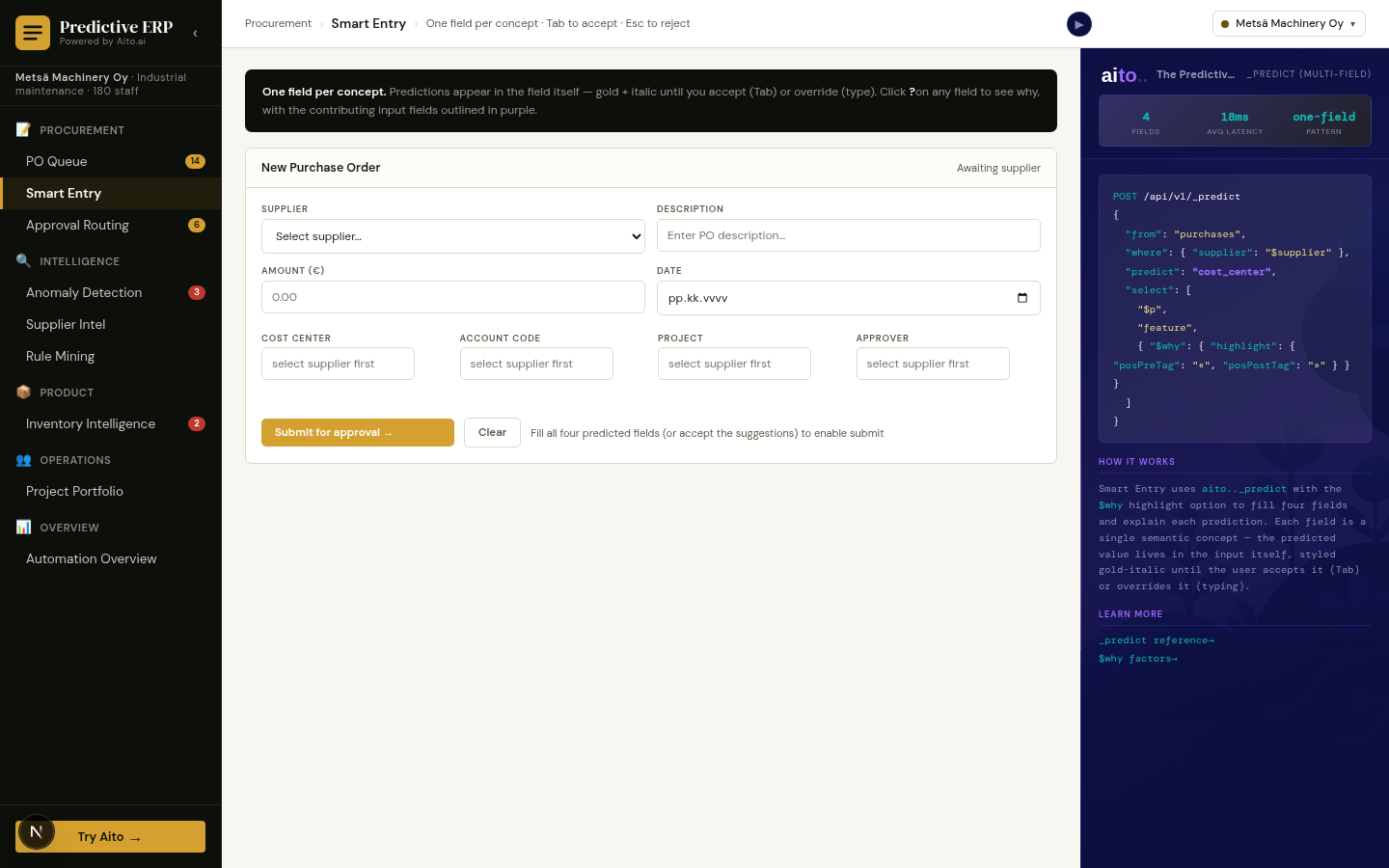
Smart Entry
Pick a supplier and four fields predict in parallel — cost center, account code, project, approver. Tab to accept, Esc to reject.
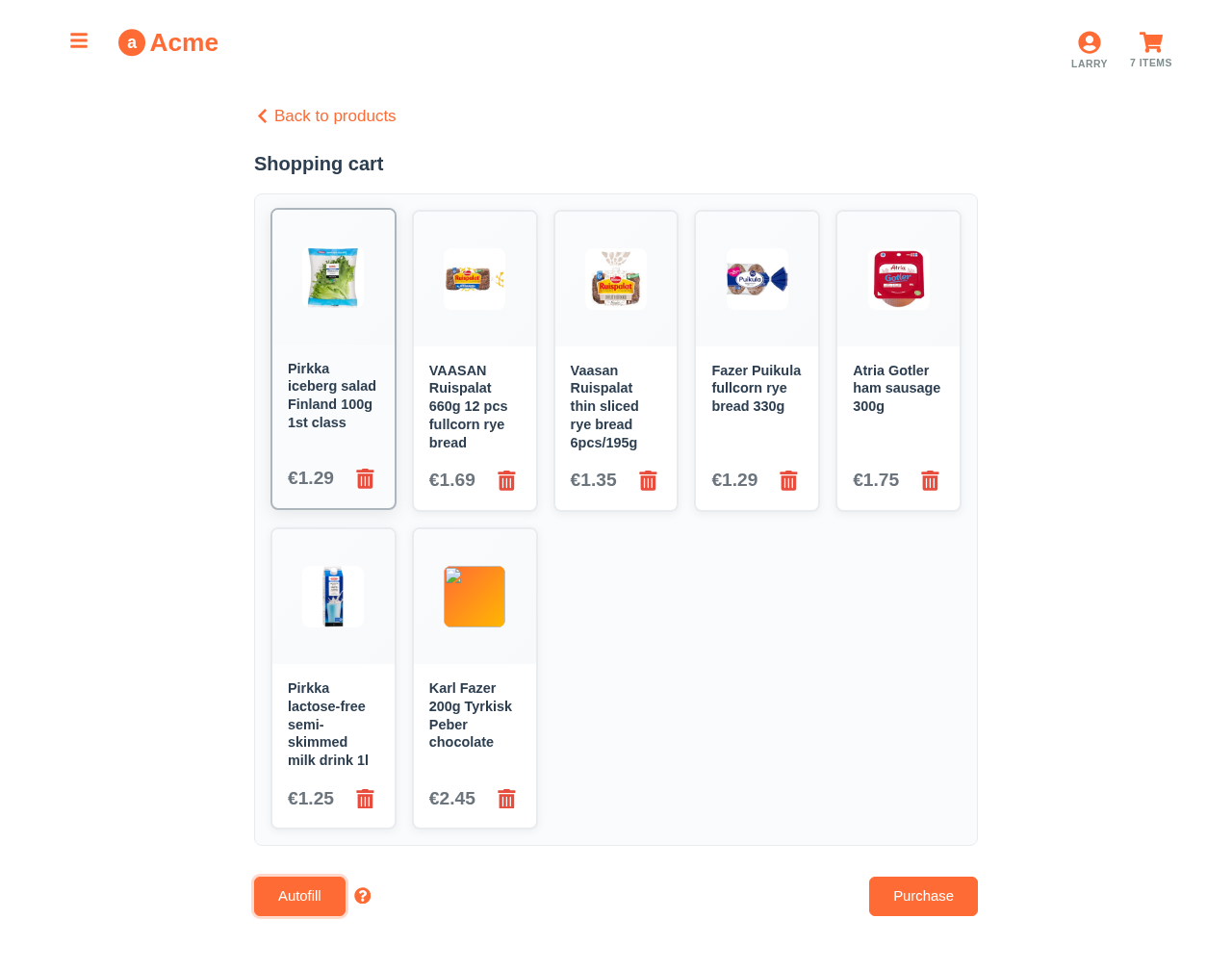
Cart Autofill
One click prefills the basket with the customer's predicted weekly purchases. Used in grocery; same pattern works for B2B reorder flows.
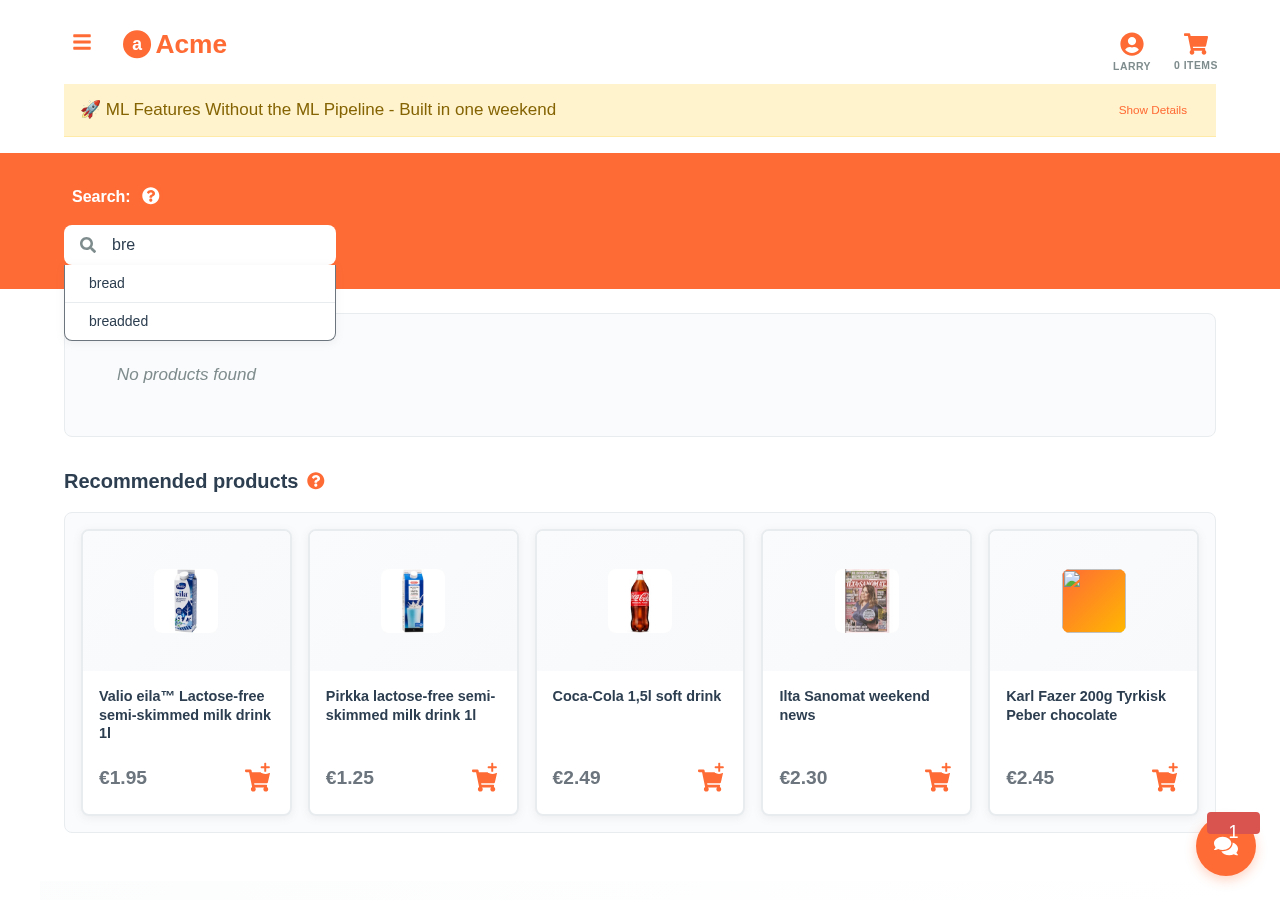
Smart Autocomplete
Predict text completions from user history and corpus patterns. Lower-cost than an LLM and conditioned on actual usage.
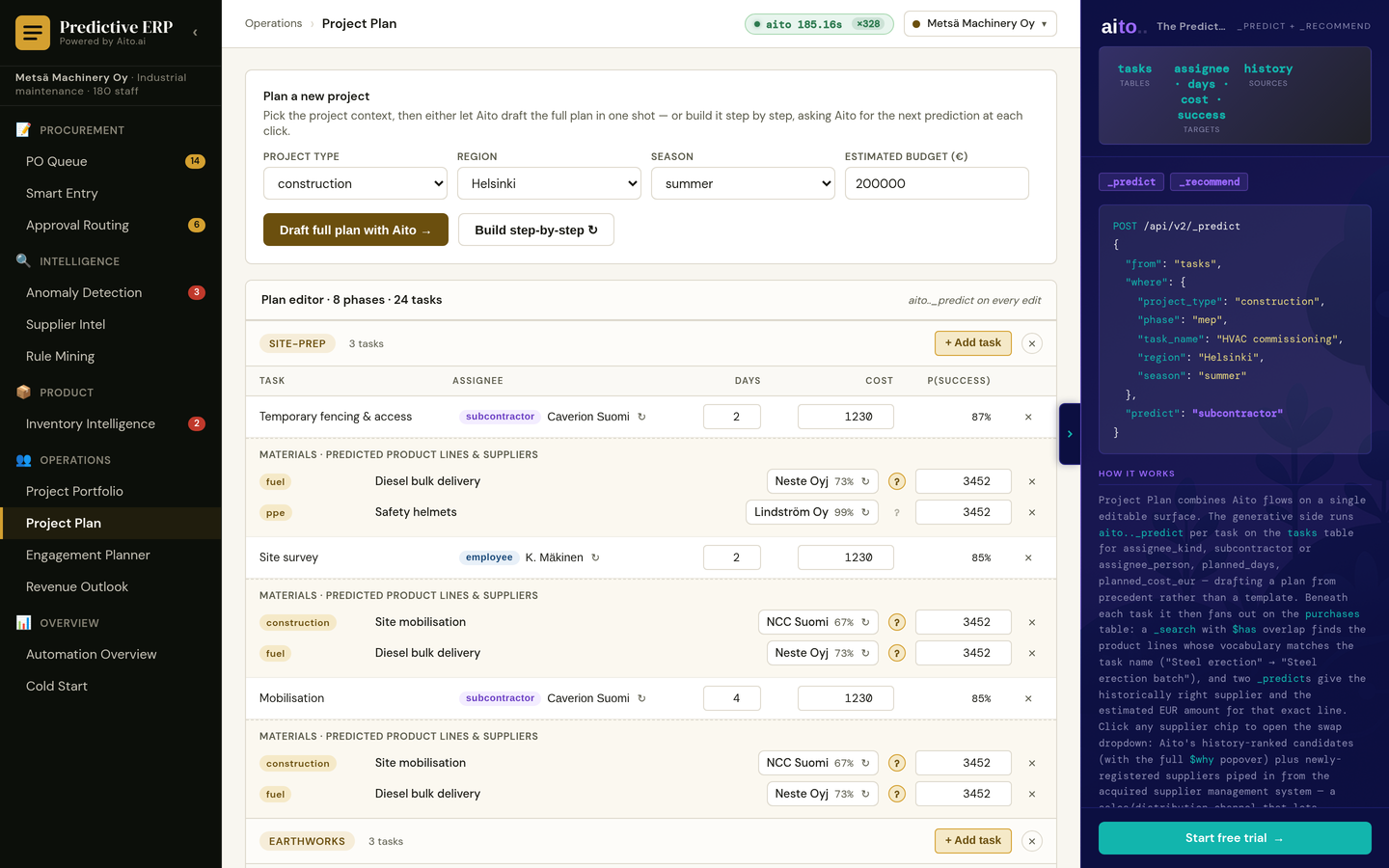
Project Plan Drafting
Start a project and the plan drafts itself step by step: the next phase, its tasks, who should do them, and the materials and suppliers, each a _predict with $why that you accept or swap.
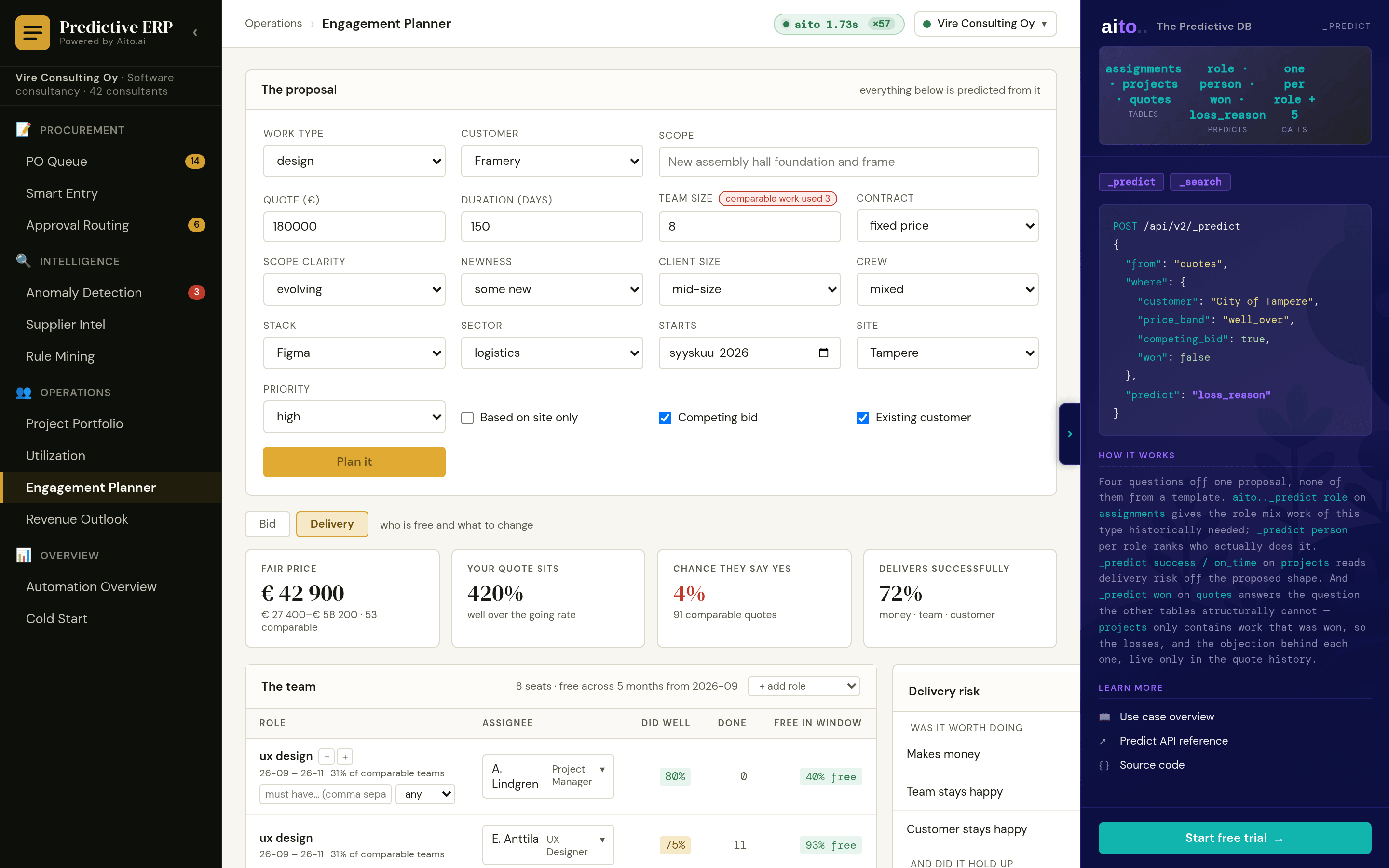
Engagement Planner
For a new engagement, a proposed team, the predicted team size, and the odds of delivery success and of winning the deal, from _predict over past assignments, projects, and quotes, plus a price check against history.
Conversational
Natural language interfaces and agent stacks backed by predictions, not by an LLM-only stack.

Agent Toolbox
Give an LLM agent Aito ops as tools: it predicts win odds, estimates effort, queries references, recommends the outreach that books the meeting, then drafts a confidence-gated action. Grounded numbers an LLM can't invent.
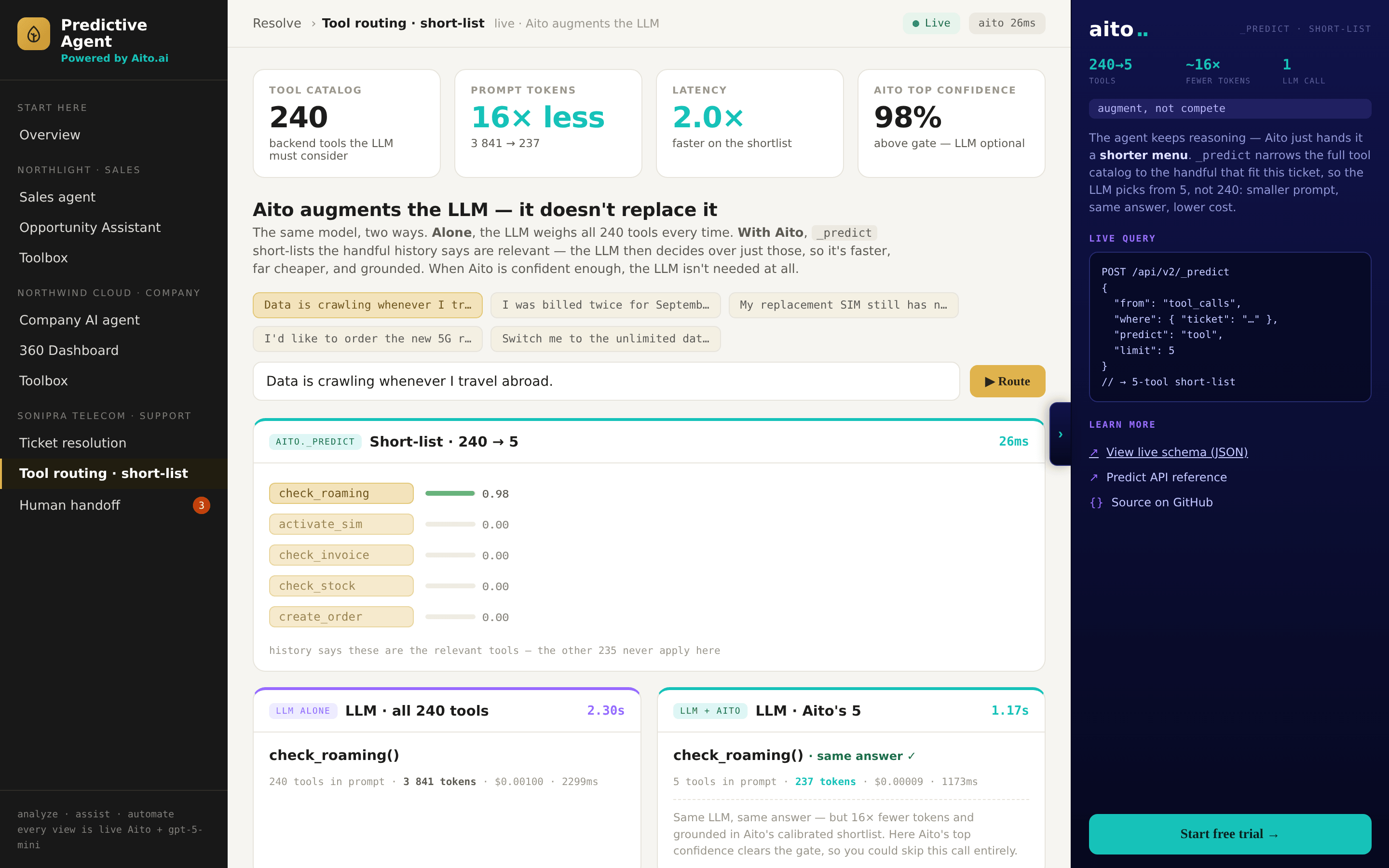
Agent Tool Shortlisting
Shortlist the tools an agent should consider with one calibrated _predict over its own call history. Holds as the catalog grows, and hands the LLM ~16× fewer tokens for the same pick.
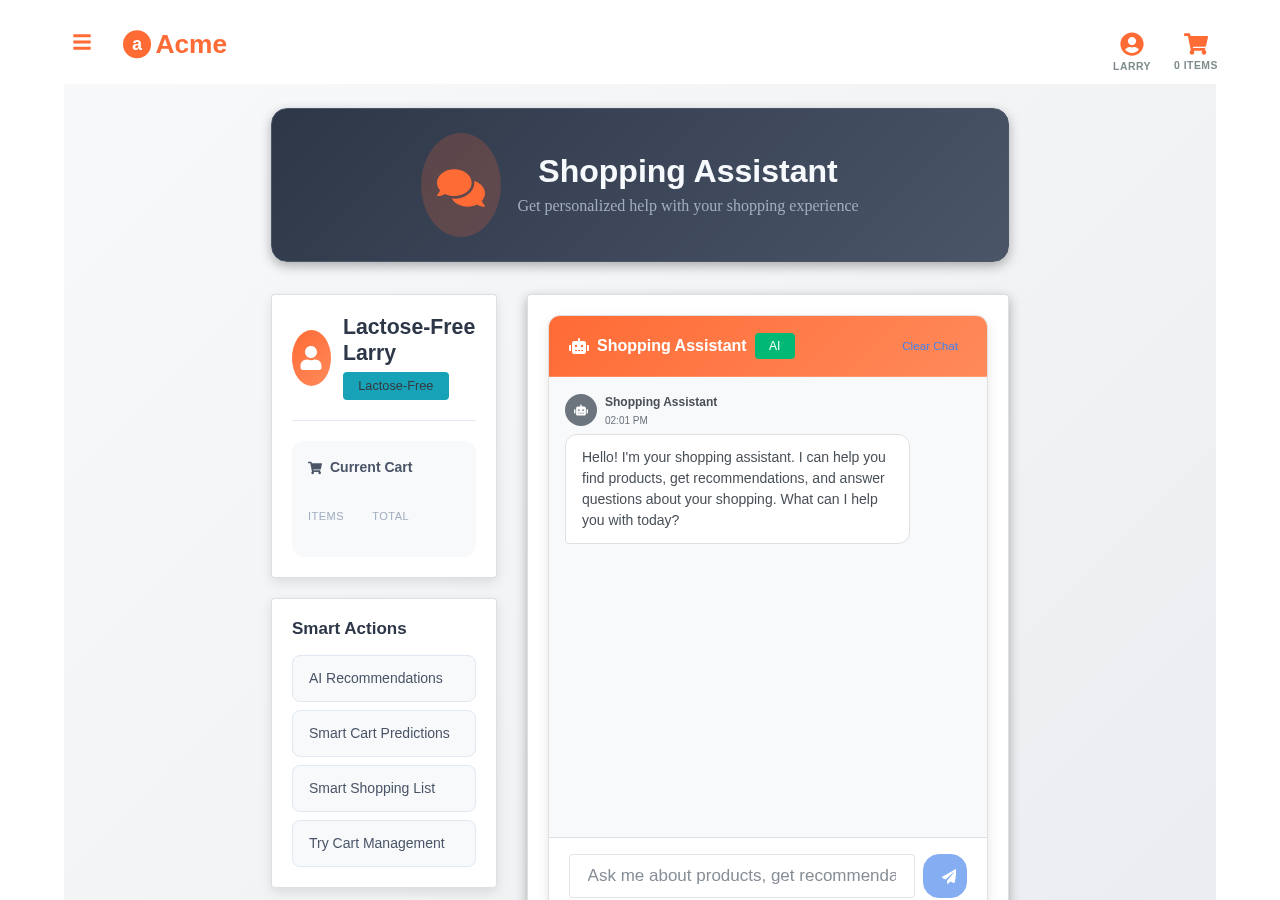
AI Assistant
Conversational shopping or support interface backed by predicted product/answer rankings. The LLM frames; the predictive database decides.
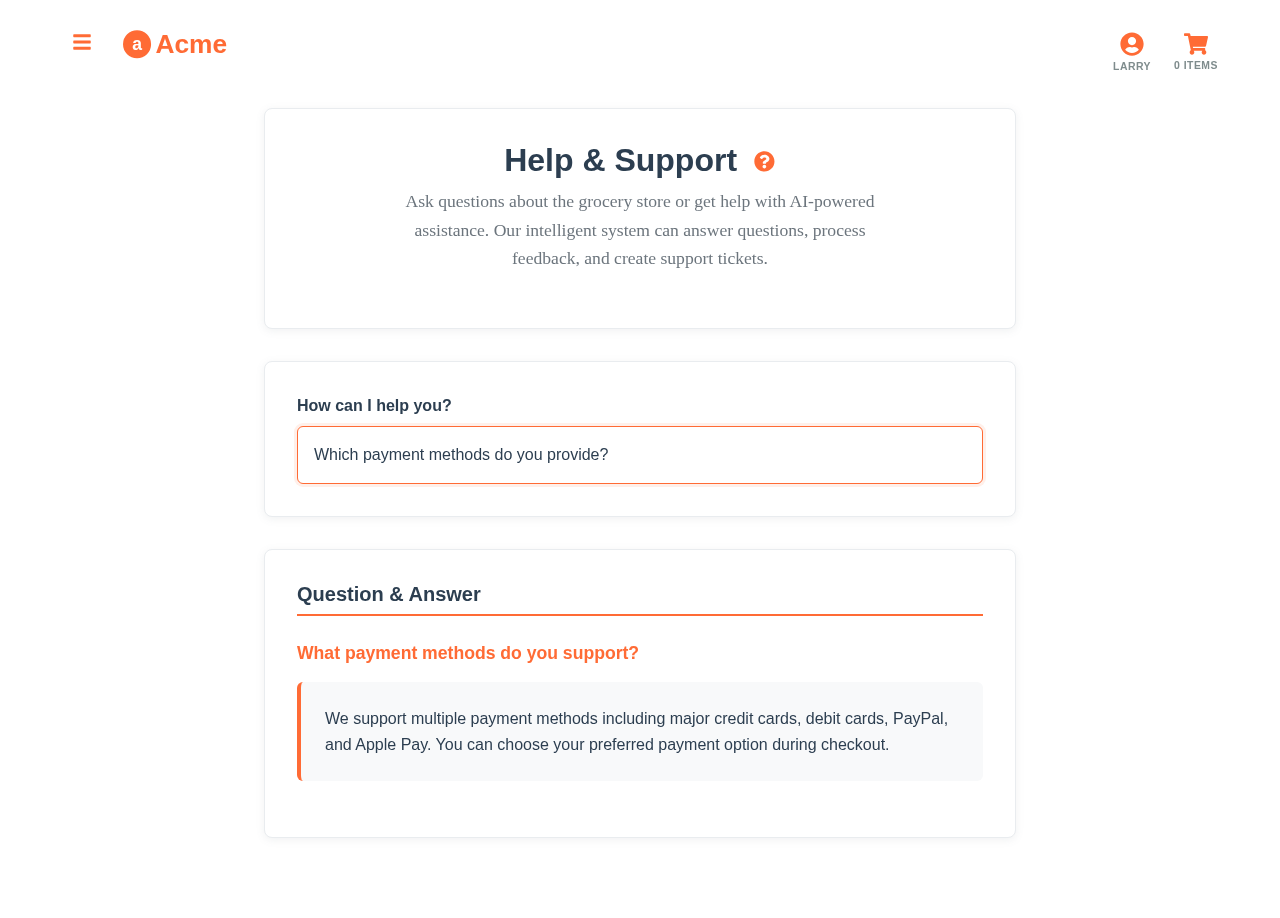
Question Answering
Predict canonical answers from a prompt corpus. Question-shaped input, predicted-answer output, calibrated confidence to decide auto-vs-route-to-human.
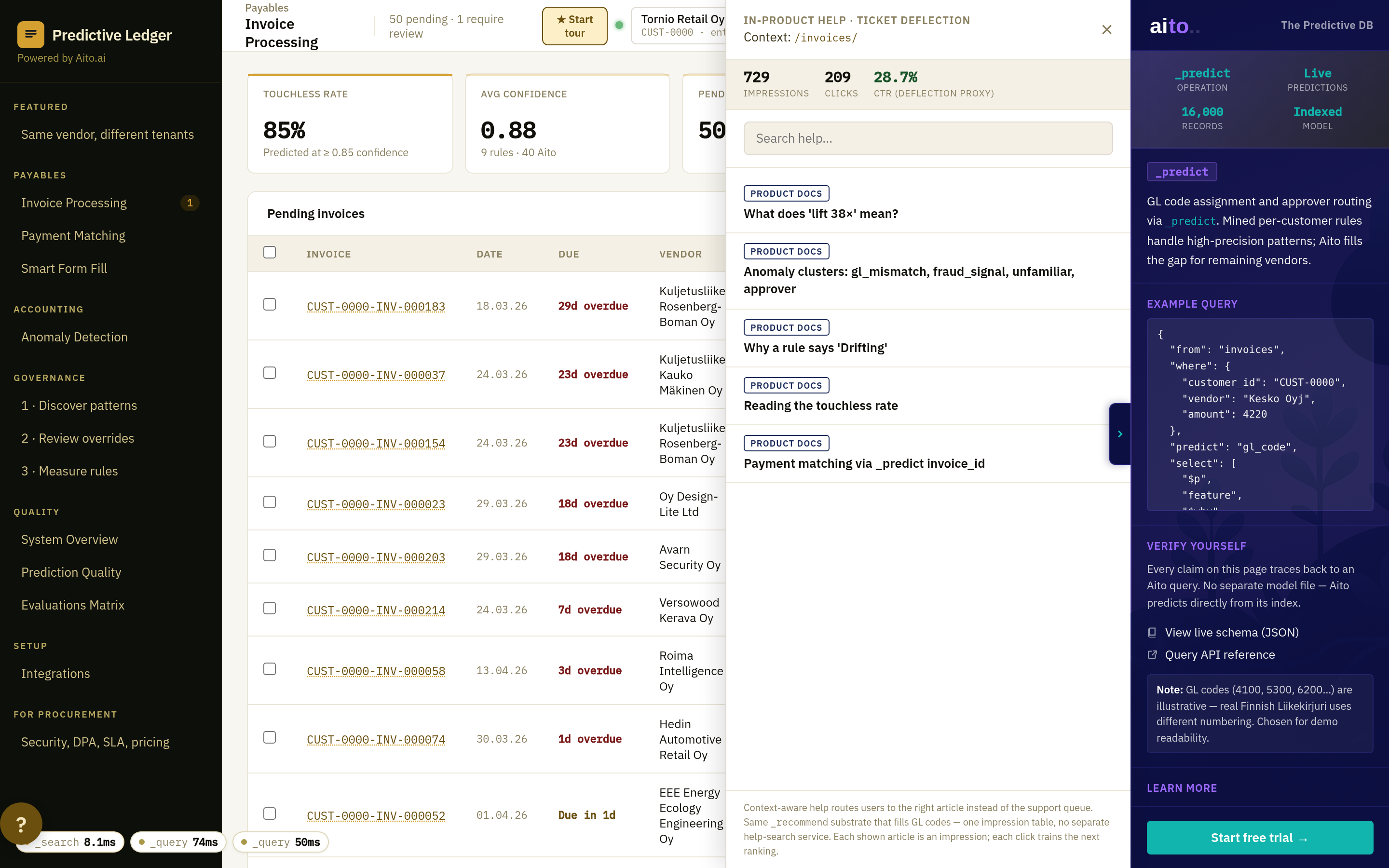
Help Drawer
In-app help articles ranked by _recommend against click history (CTR-ranked, like product recommendations). Users read what other users with similar queries clicked.
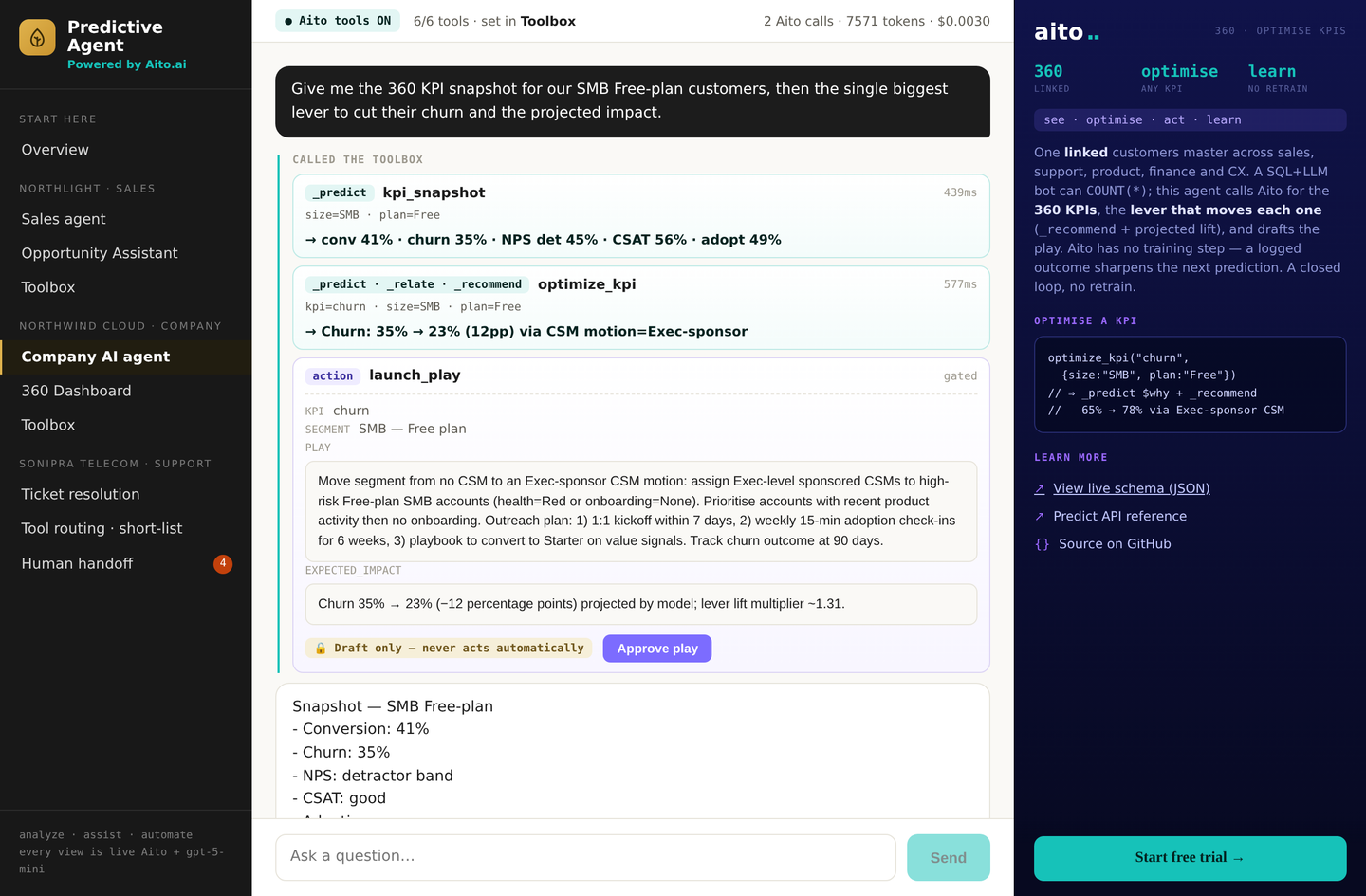
Company AI Copilot
A chat agent over one linked customer view: it reads KPIs, diagnoses them with $why and _relate, recommends the lever, and drafts a play that waits for a human to approve it.
Automate
Put predictions into the workflow — auto, review, manual tiers.
Categorization, routing, anomaly detection, multi-field prediction, optimization. Calibrated confidence decides what auto-processes and what routes to human review.
Categorization & Routing
The decisions where the user picks from a menu and the right pick is statistically determined by surrounding fields.
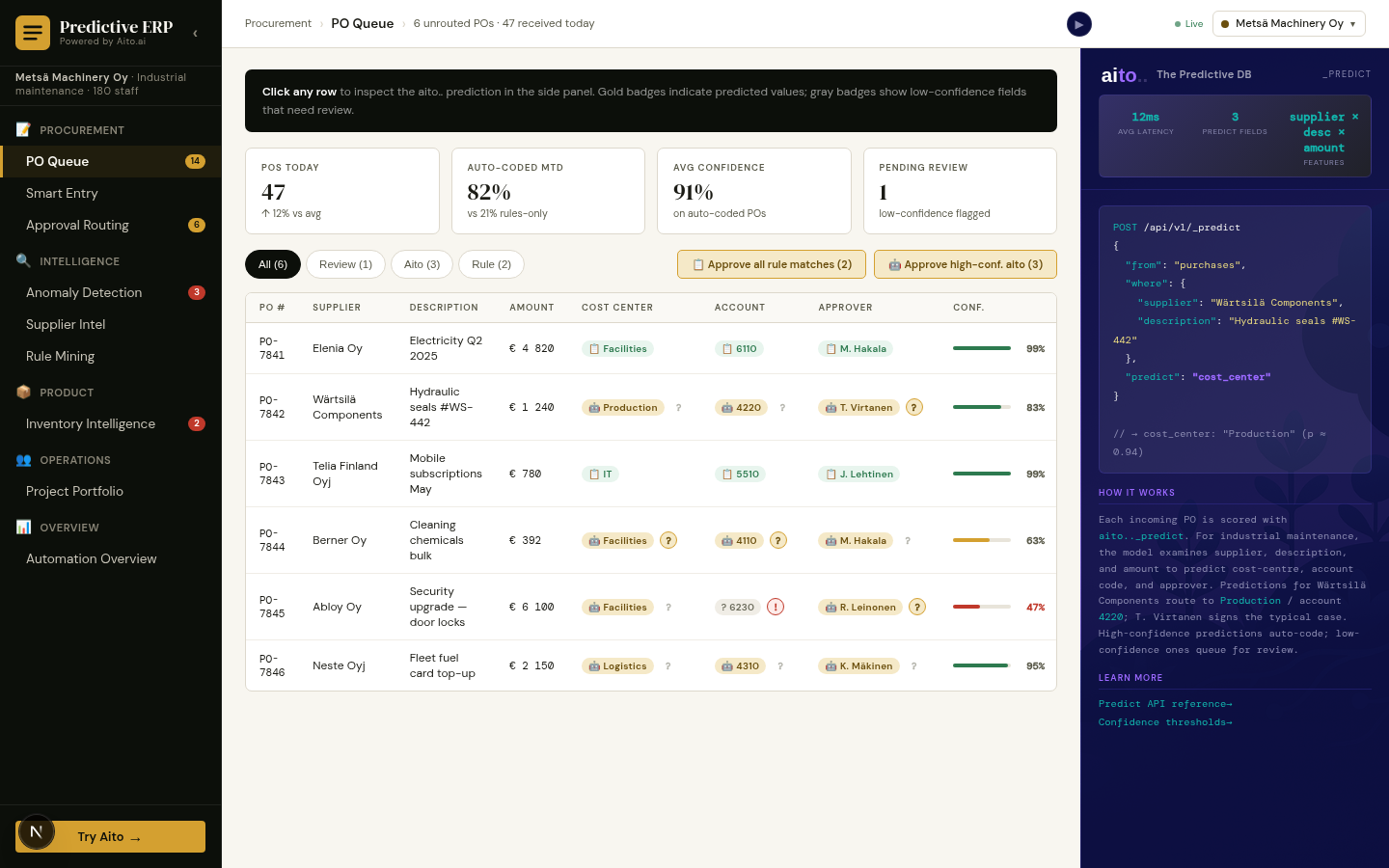
PO Queue Routing
Every purchase order arrives with predicted account code, cost center, and approver — three confidence tiers, bulk-approve for rule-matched rows.
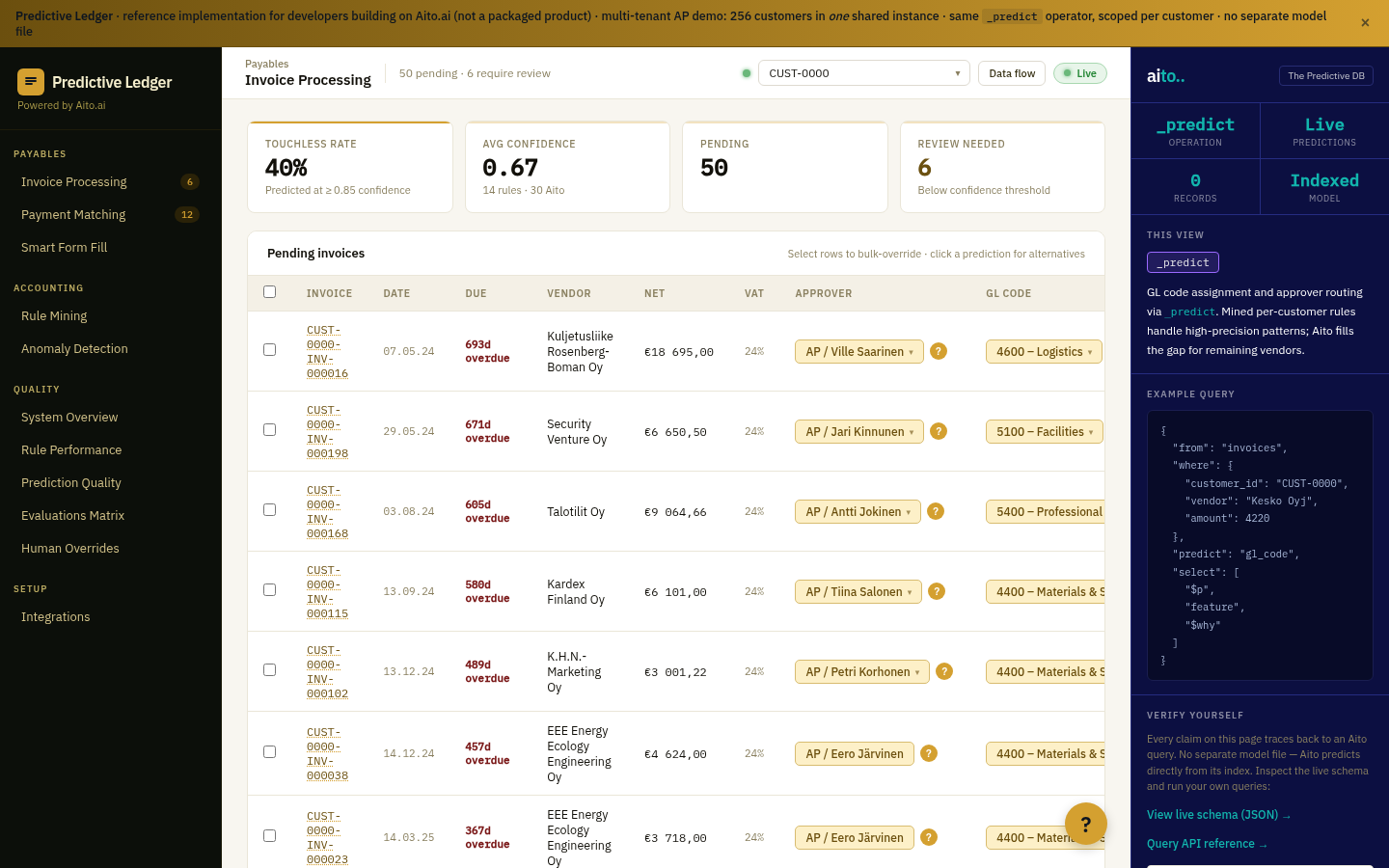
GL Coding
Predicted GL code, approver, payment method, cost center per invoice with $why factor decomposition. The core of predictive AP.
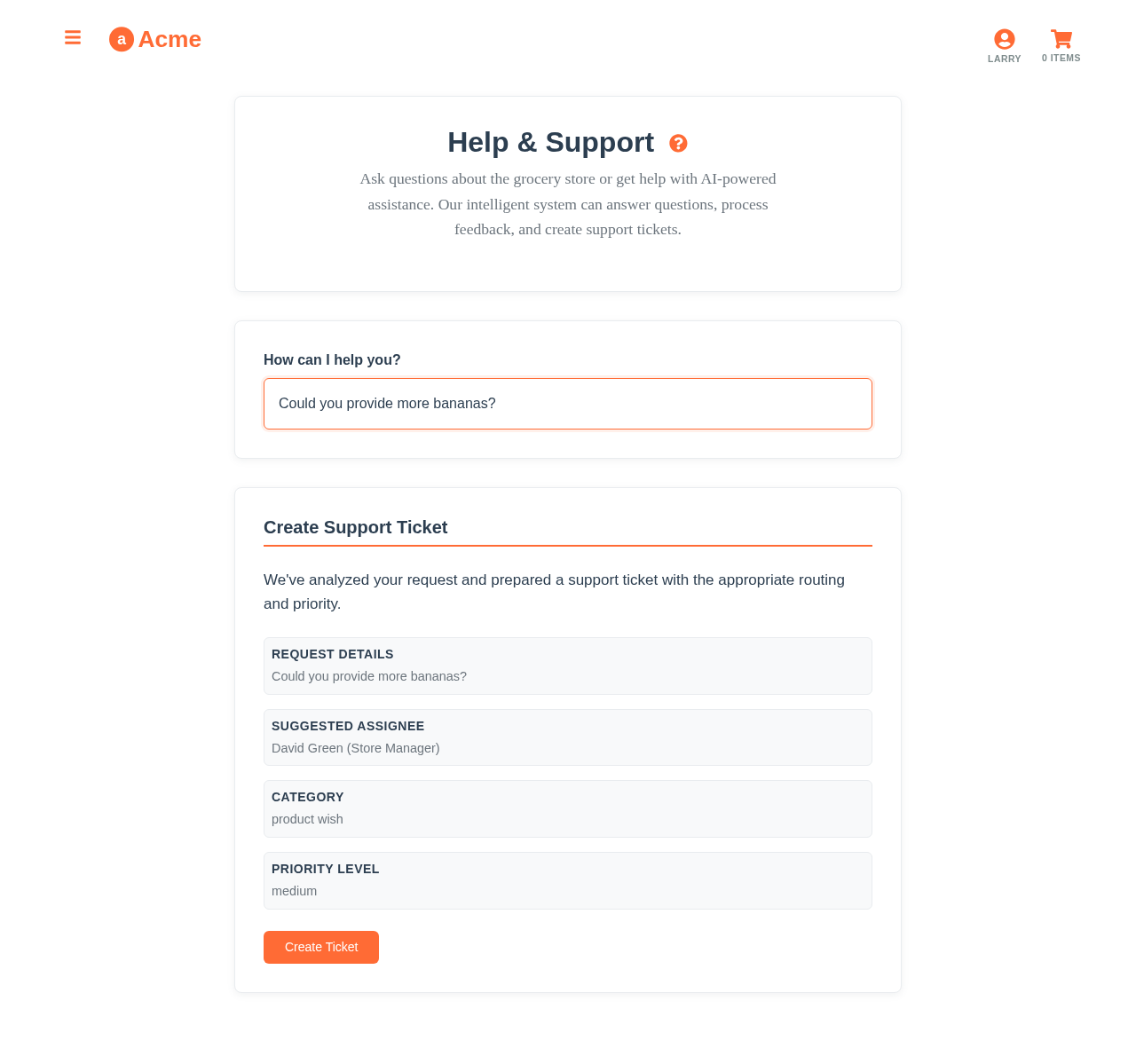
Ticket Classification
Auto-route tickets via _predict on description. Confidence-tiered — high auto-routes, mid suggests, low routes to manual.
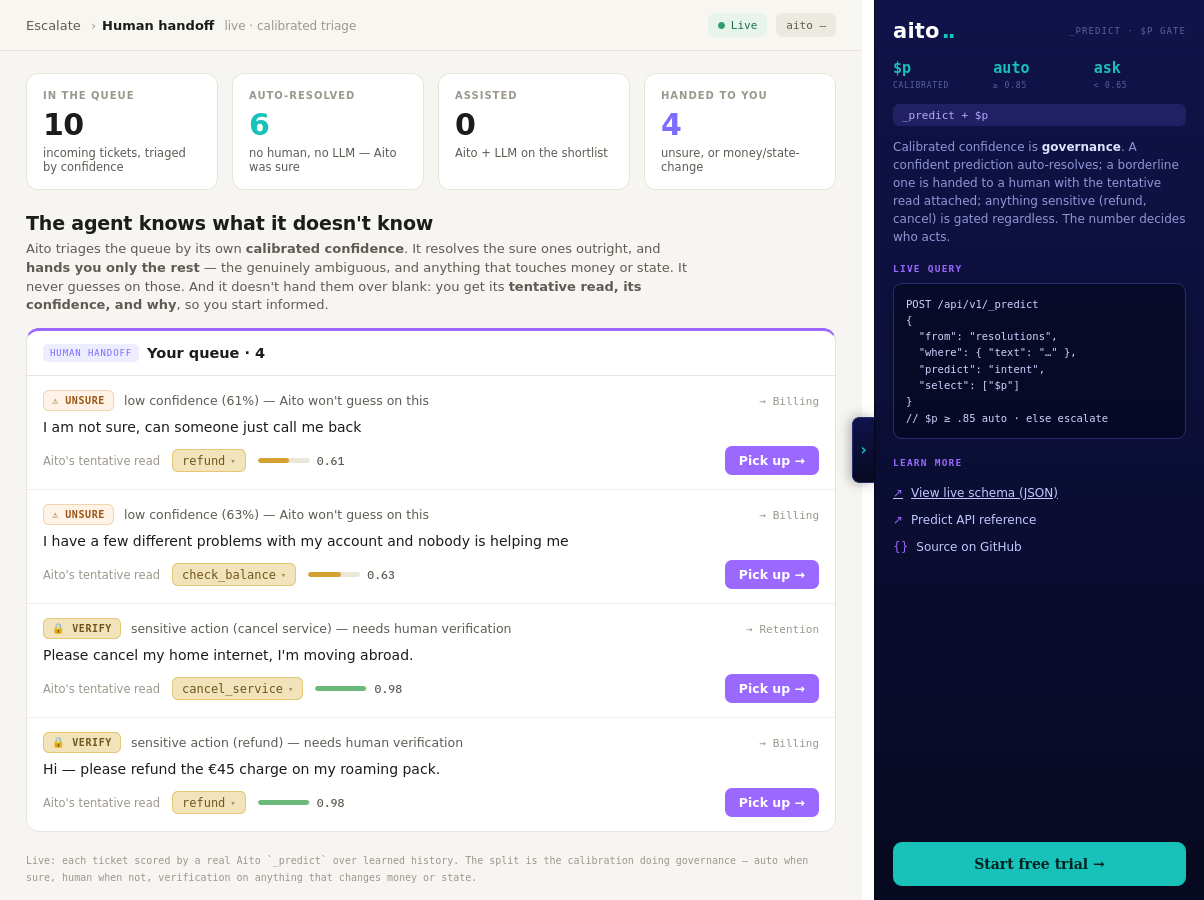
Confidence-Gated Handoff
Calibrated confidence as governance: high $p auto-resolves, a borderline read is handed to a human with the tentative answer attached, and sensitive intents are gated regardless. The number decides who acts.
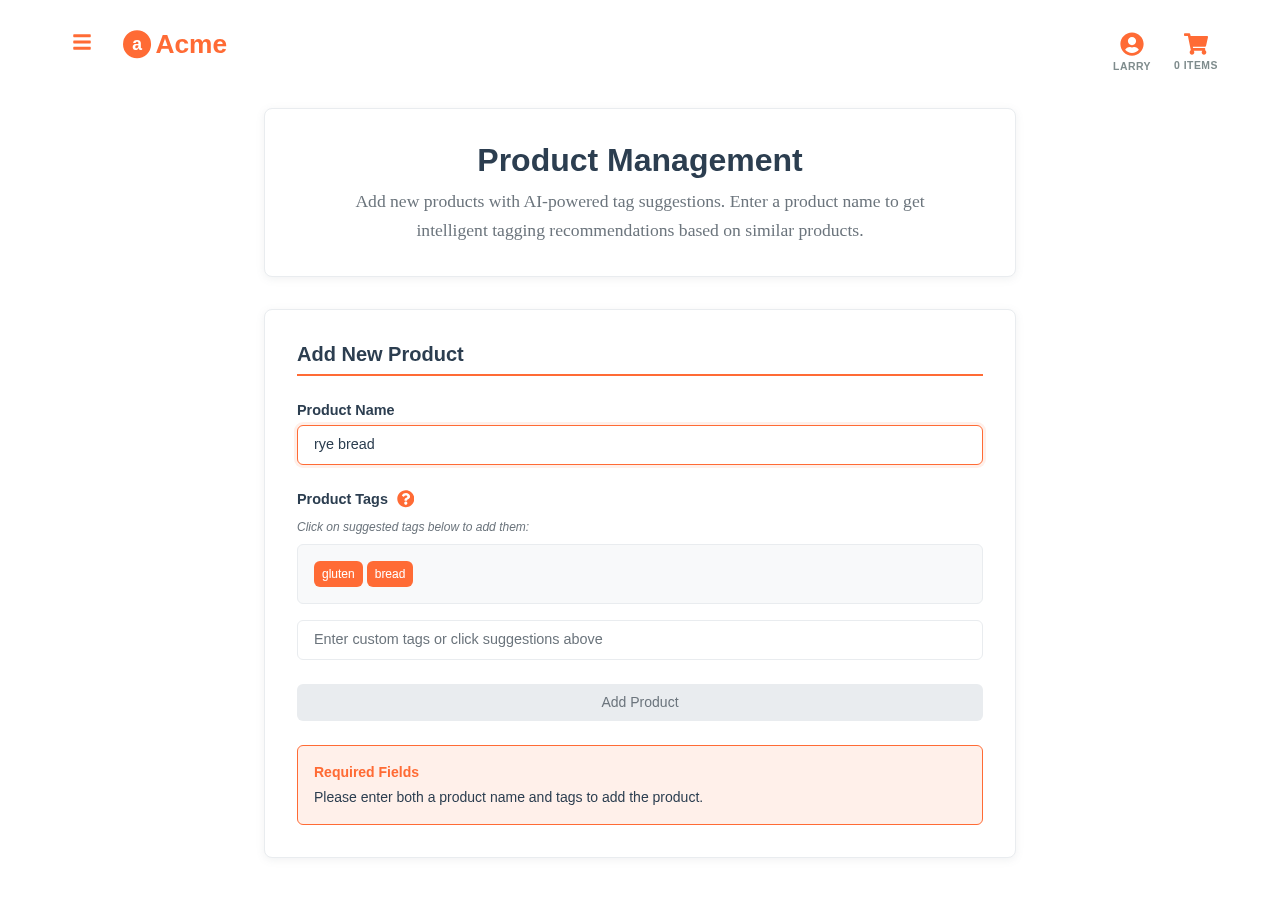
Tag Prediction
Auto-classify content (products, tickets, documents) into a multi-label taxonomy. Saves manual labeling effort with calibrated confidence per tag.
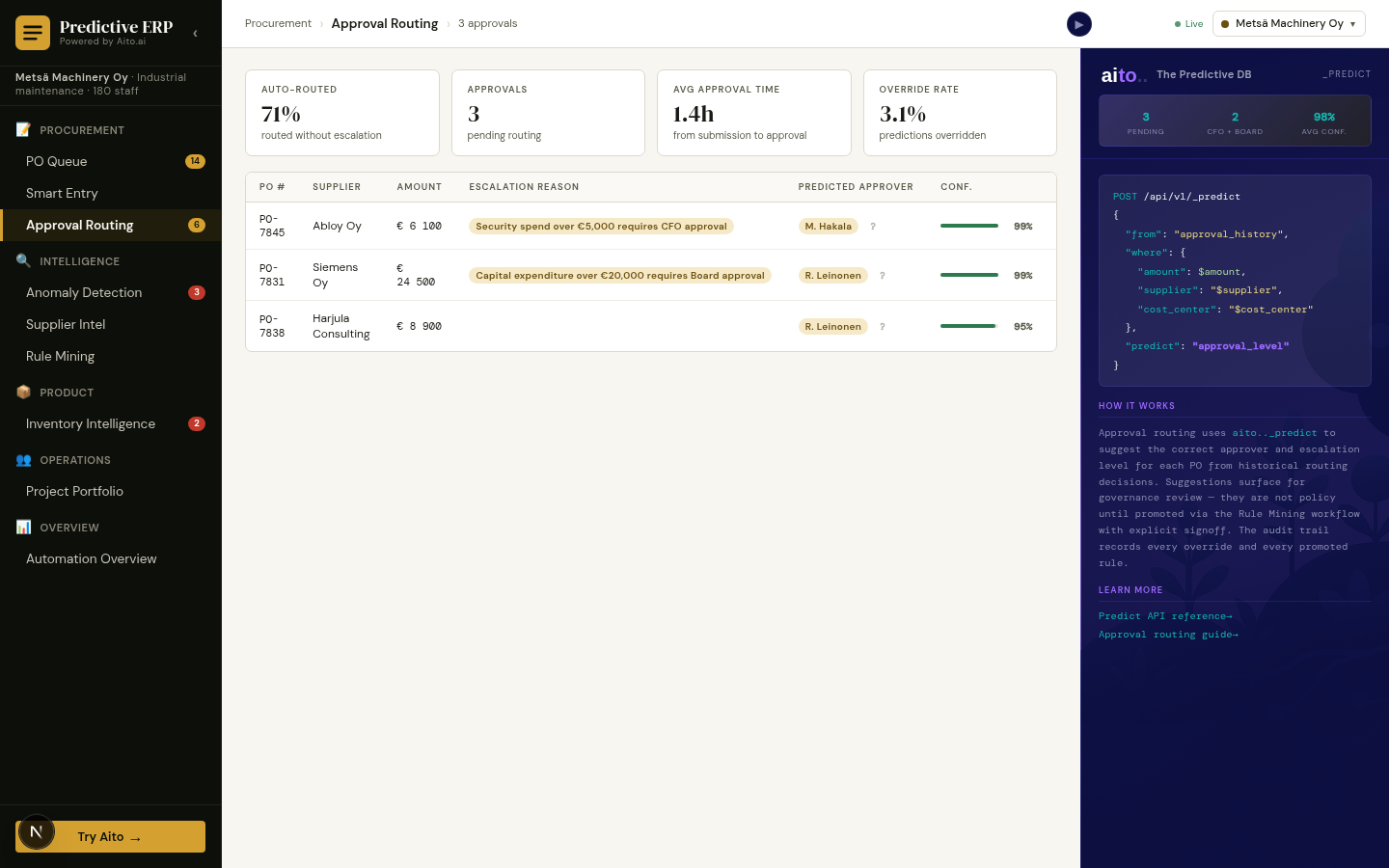
Approver Routing
Predict the right approver from invoice or PO content. Same pattern as GL coding, applied to the person dimension instead of the account dimension.
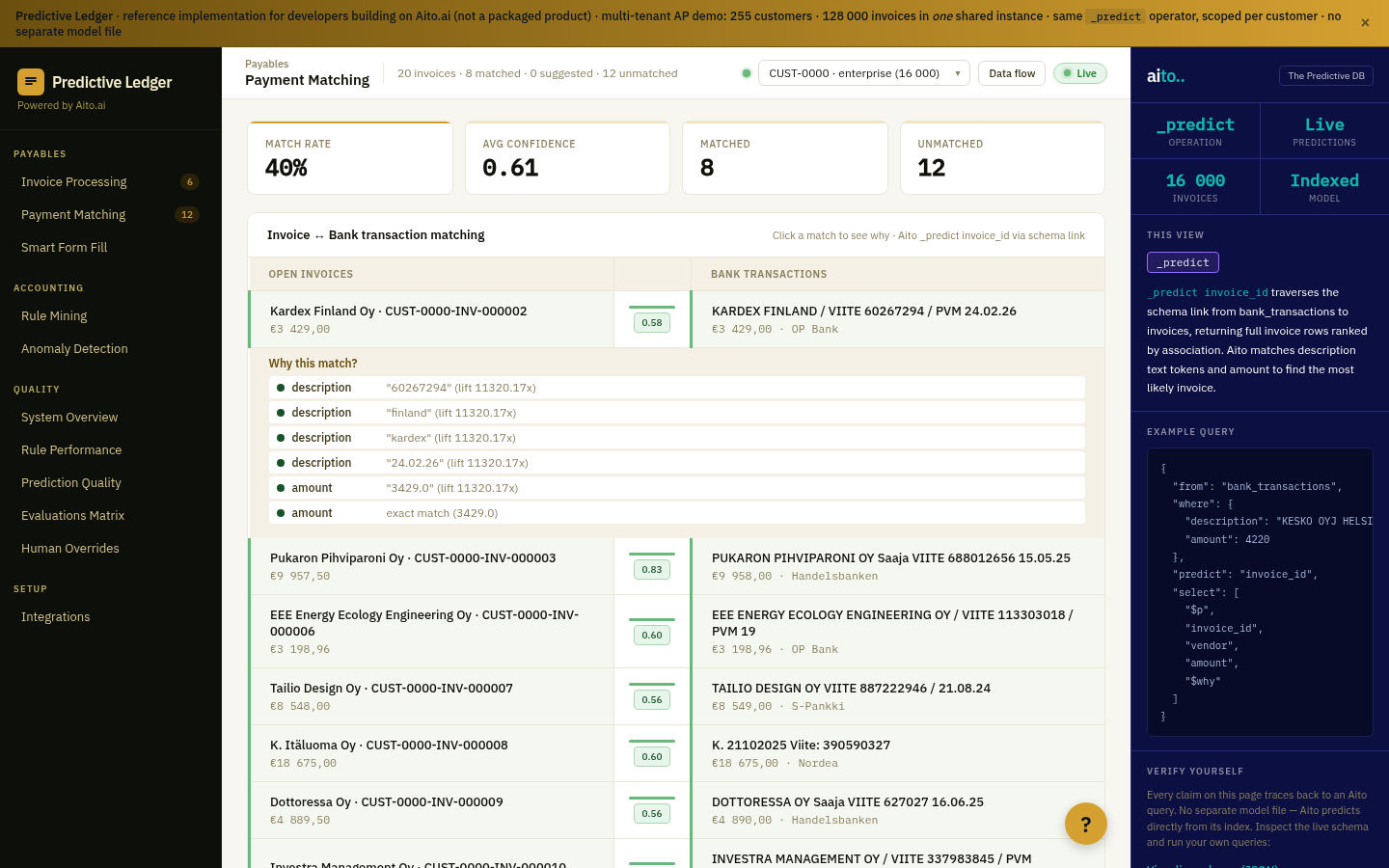
Payment Matching
Each bank transaction matched to the open invoice it pays: _predict of invoice_id across the link from bank transactions to invoices, with $why showing which reference, name, and amount tokens carried the match.
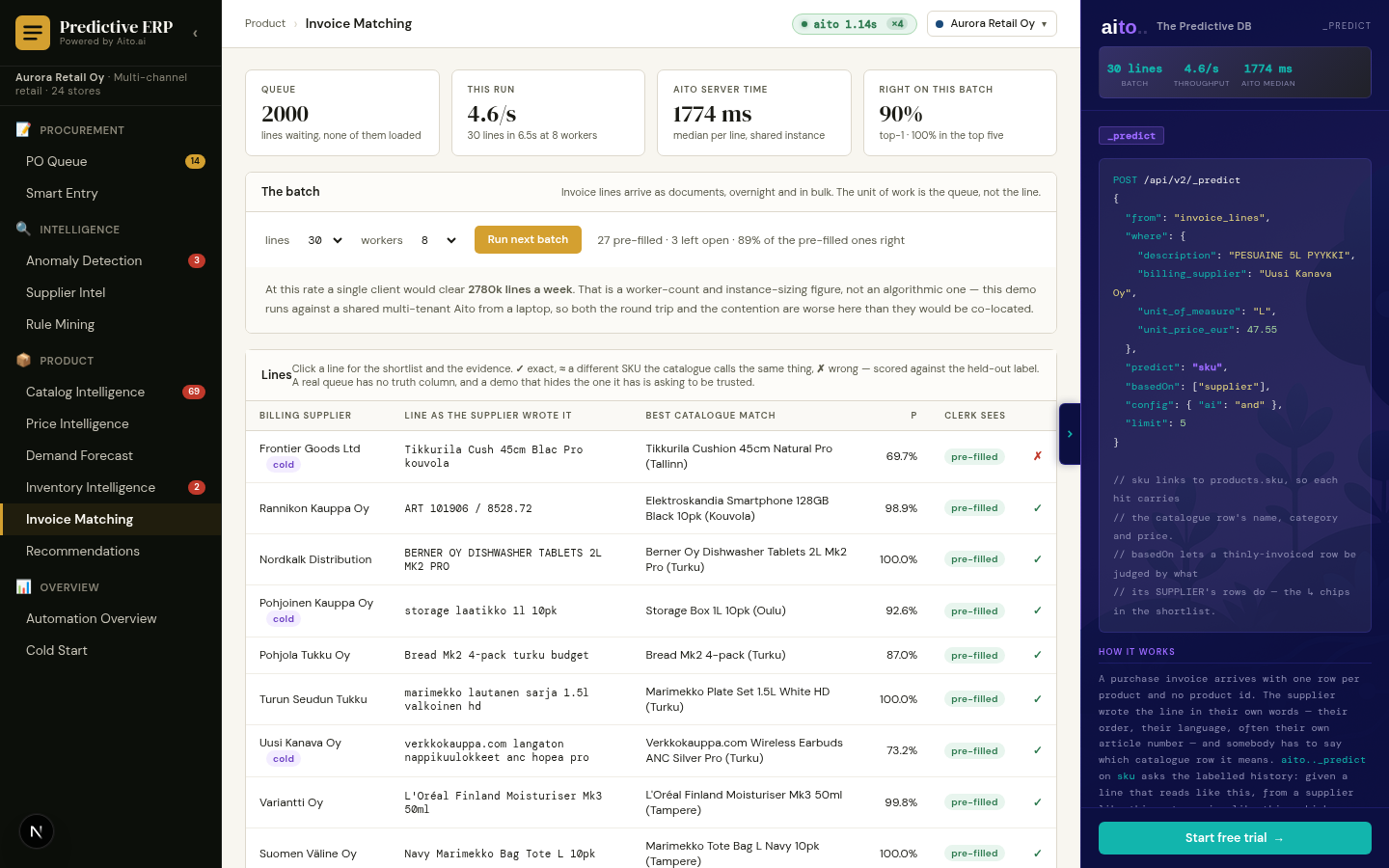
Invoice Line Matching
Supplier invoice lines matched to the catalog SKU they refer to: _predict of sku across the link to products returns a ranked shortlist with reasons, scored live against held-out truth.
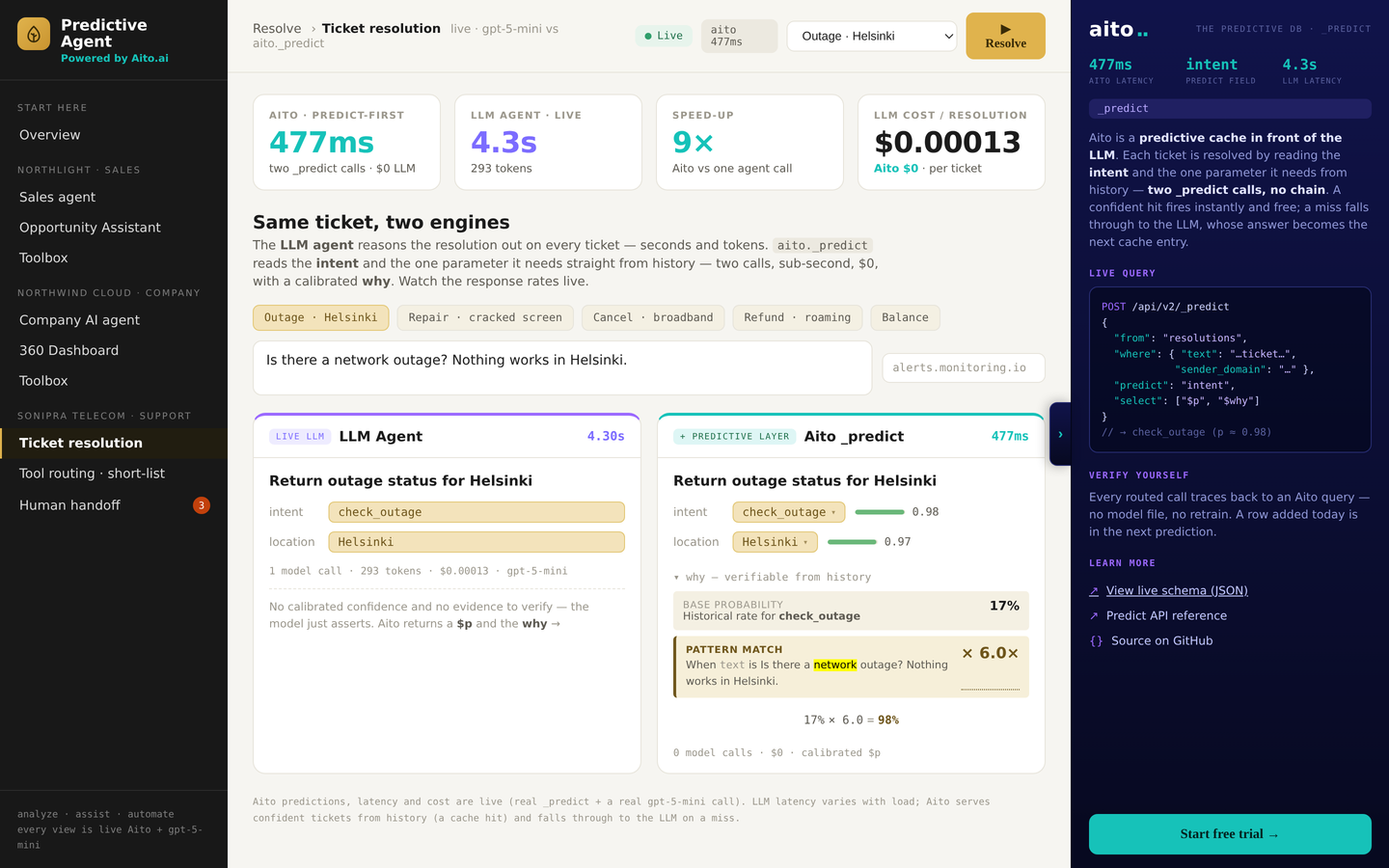
Ticket Resolution: Predict vs LLM
The same support ticket resolved by two engines side by side: two _predict calls for the intent and its parameter, with $p and $why, against a live LLM call, with latency and tokens measured on every run.
Anomaly Detection
Inverse prediction — low confidence on a normally-predictable field is the anomaly.
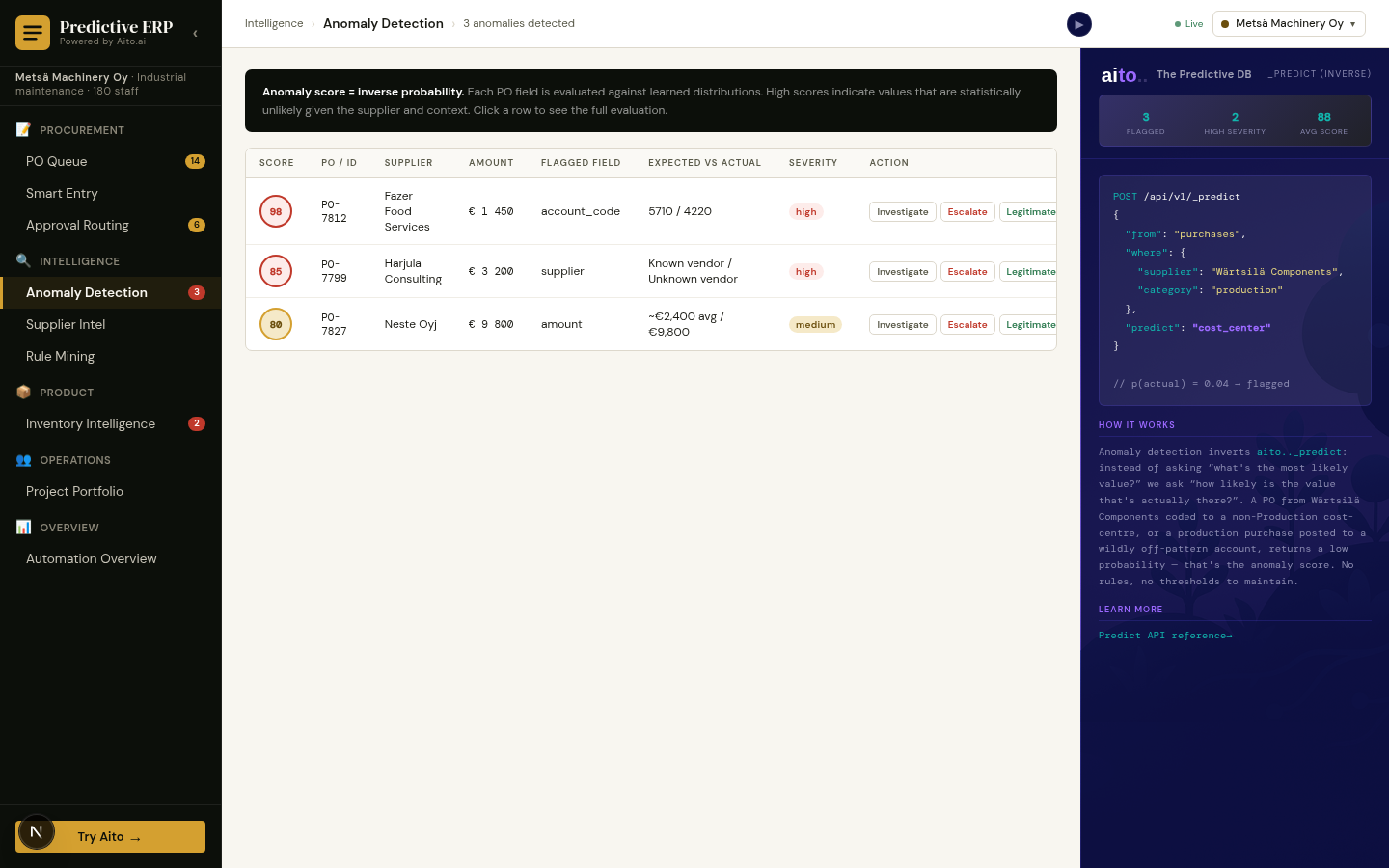
Inverse Prediction Anomaly
If the actual GL or routing isn't in the predicted top-3, the row is flagged for review. The system surfaces what it didn't expect.
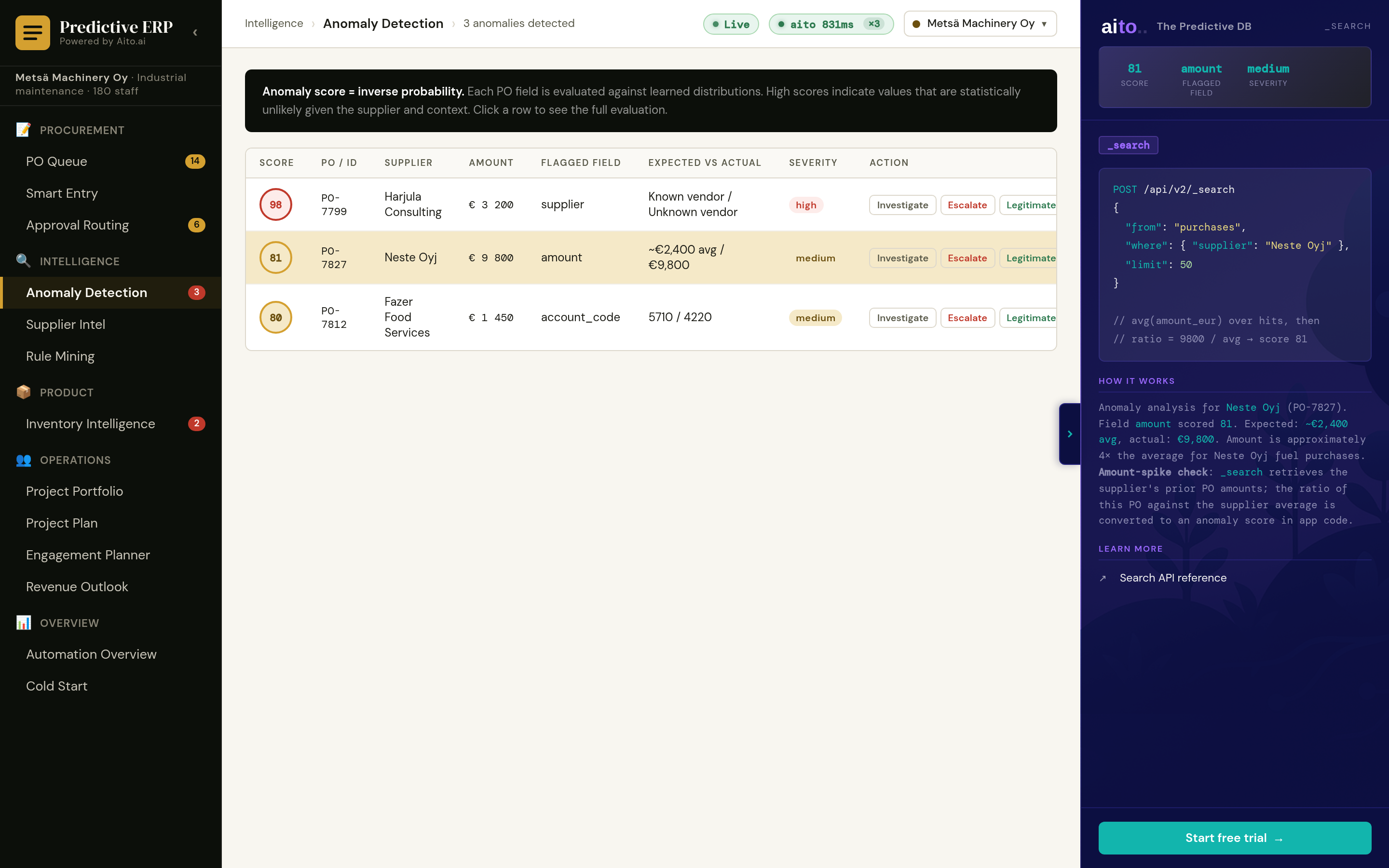
Amount-Spike Detection
An invoice or PO amount far above the supplier's historical average. Surfaced before posting.
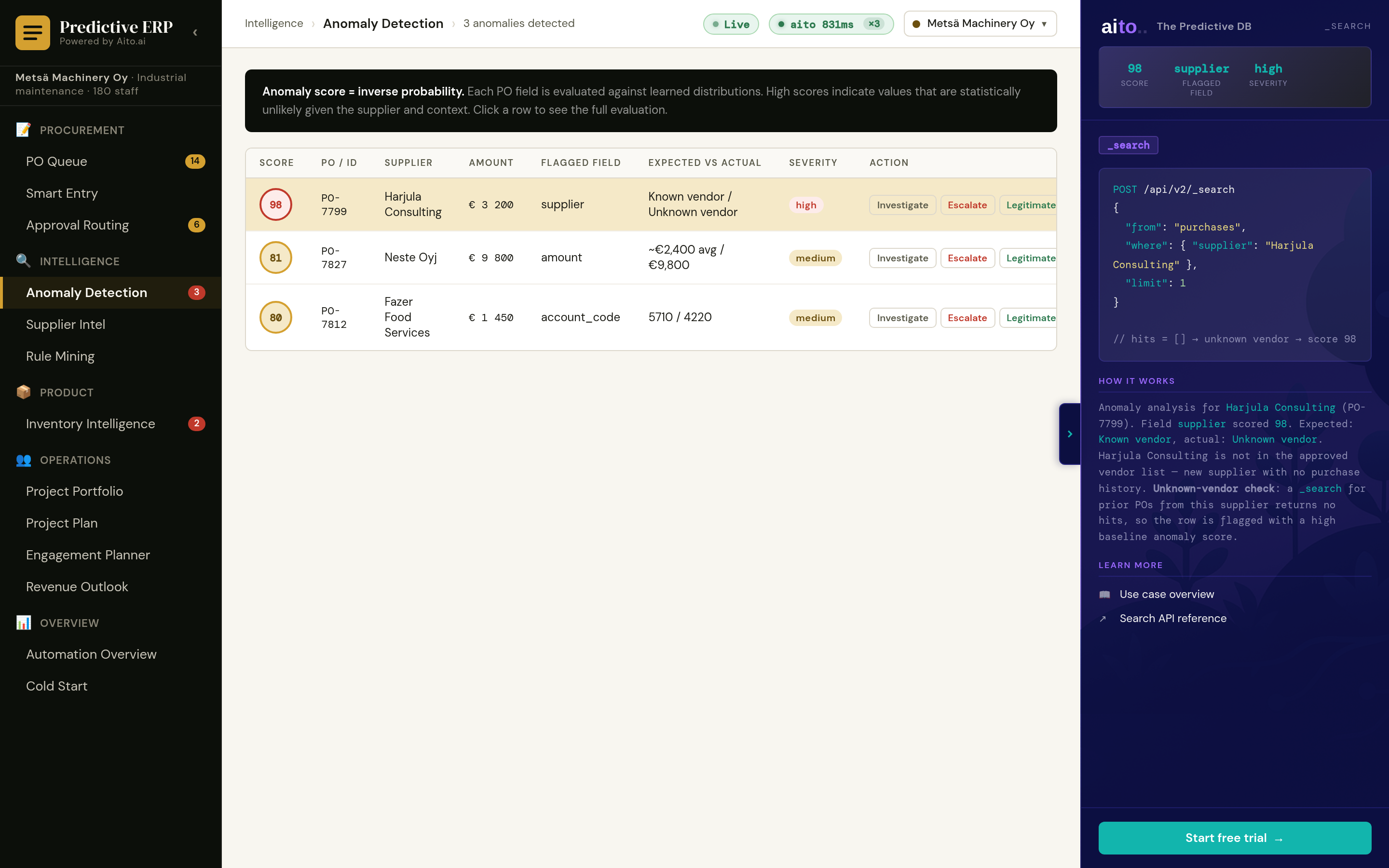
Unknown-Vendor Detection
A vendor without prior history triggers the no-prediction-yet path. Visible flag at the PO entry point.
Multi-field Prediction
One query, several predicted fields. The same pattern that powers smart forms, applied to bulk data fill.
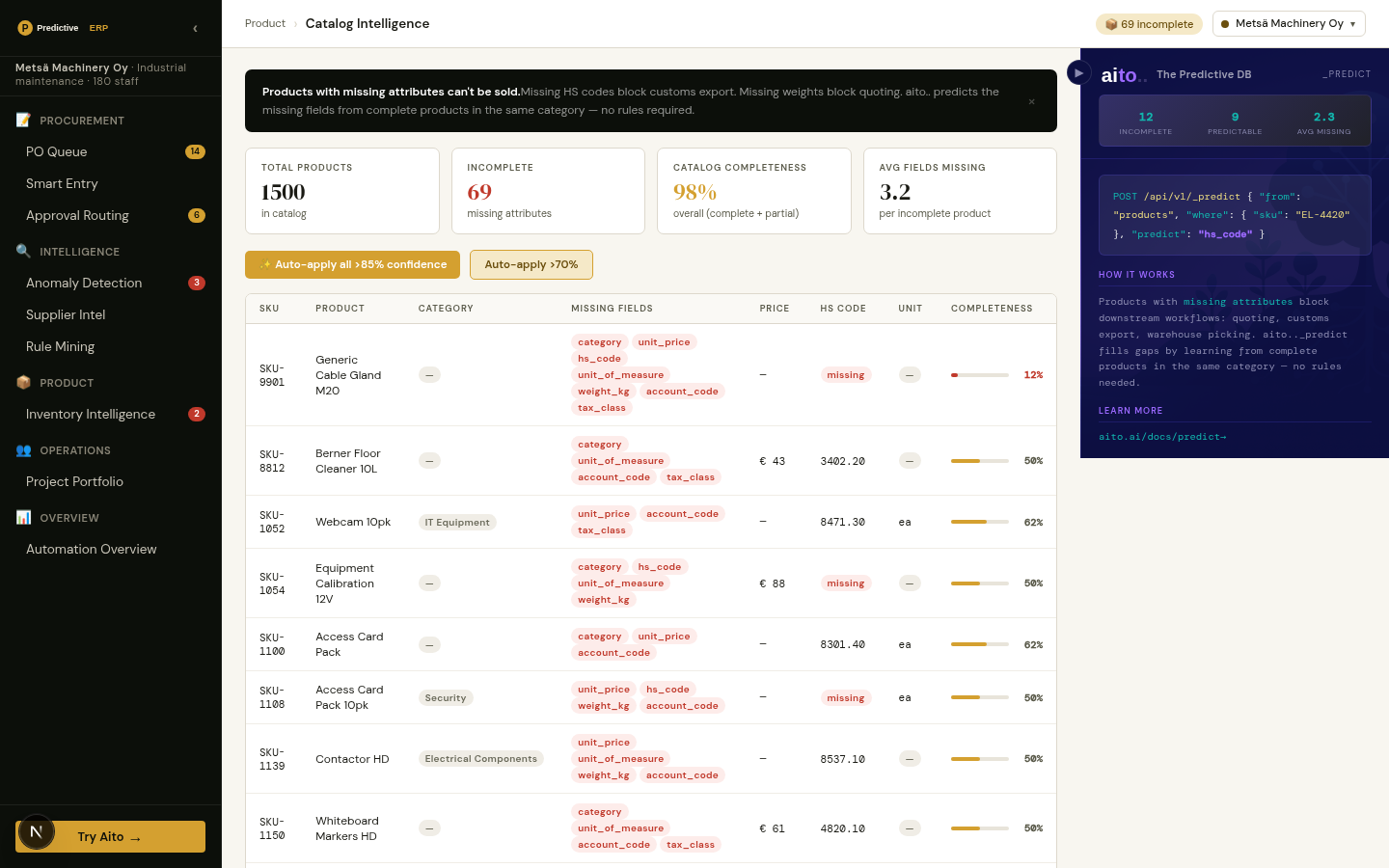
Catalog Gap Fill
Predict category, HS code, unit price one-shot across workflow-blocking products. Smart-forms pattern applied to data instead of input UI.
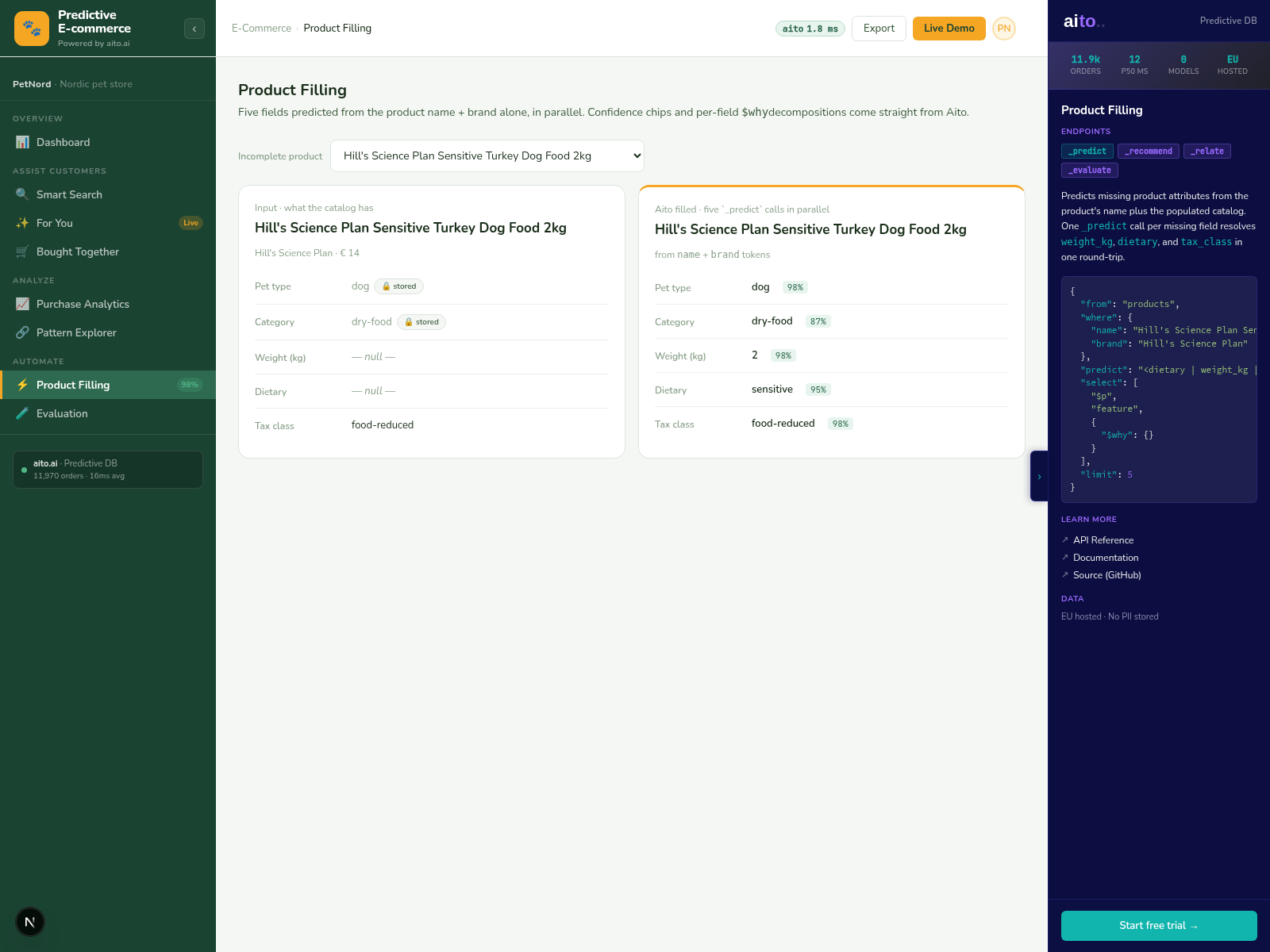
Product Filling
Predicted product attributes — title, category, weight, dietary tags — for new SKUs entering the catalog. Multi-field, multi-output.
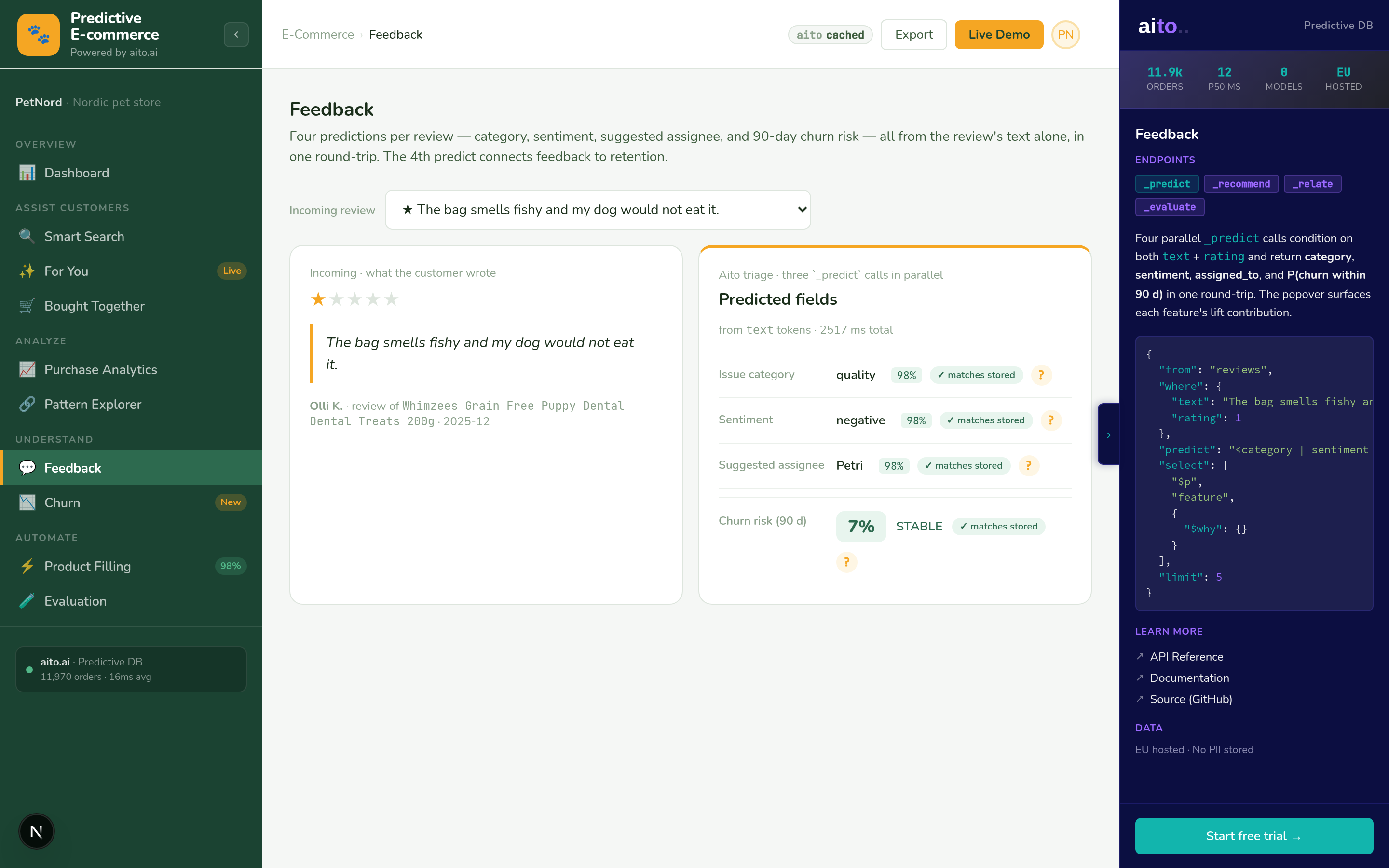
Feedback Triage
Four predictions per customer review in one round-trip: issue category, sentiment, suggested assignee, and 90-day churn risk, from the review's text and rating.
Optimization & Triggers
Predicted thresholds that drive auto-action. Predicted ranking that drives outreach order.
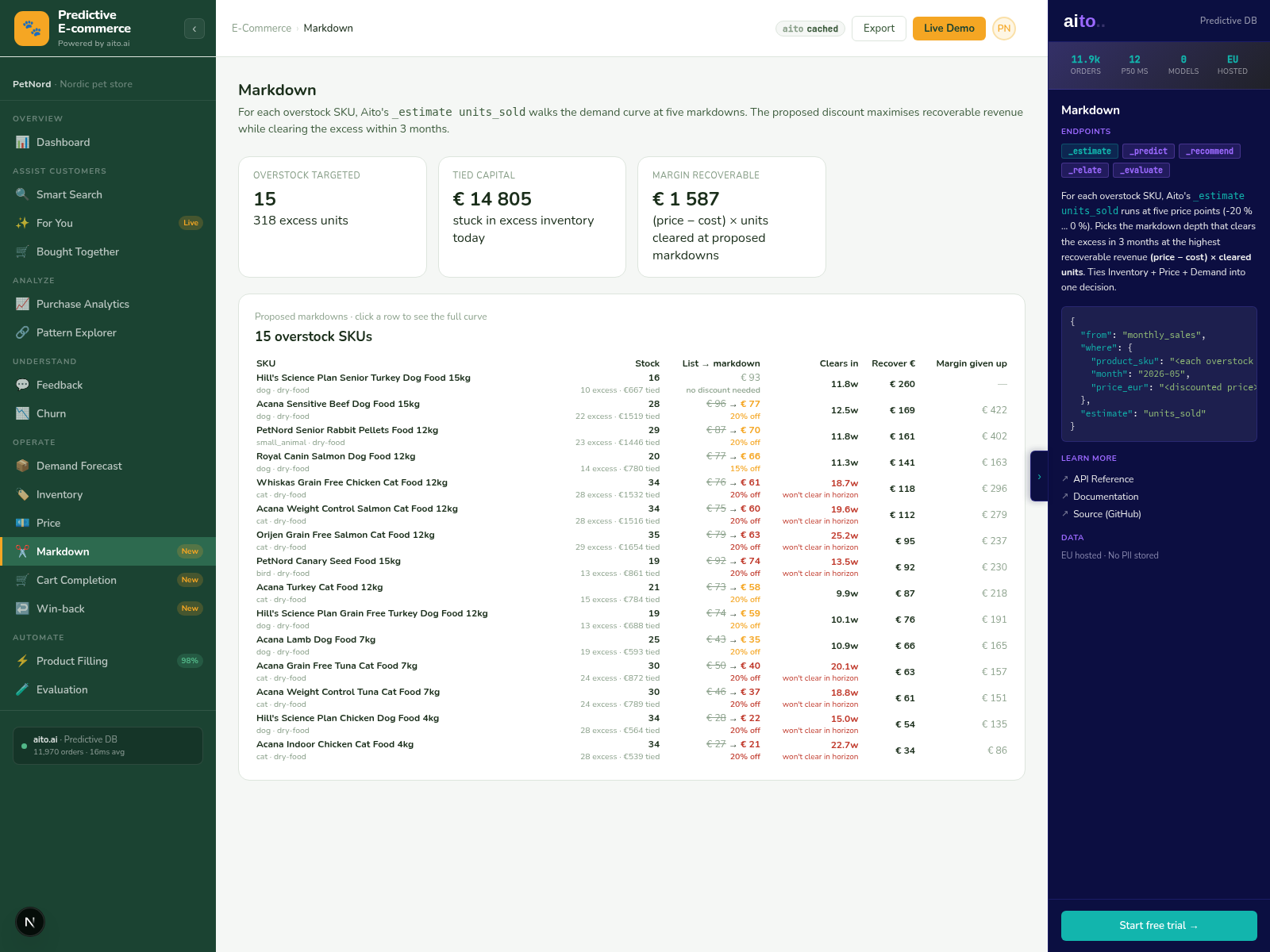
Markdown Decisions
_estimate across discount levels picks the level where predicted demand recovers cost. Auto-trigger above a confidence threshold.
Win-back Triggers
Fire a win-back only where predicted recoverable revenue exceeds the outreach cost. Combines _recommend and _estimate.
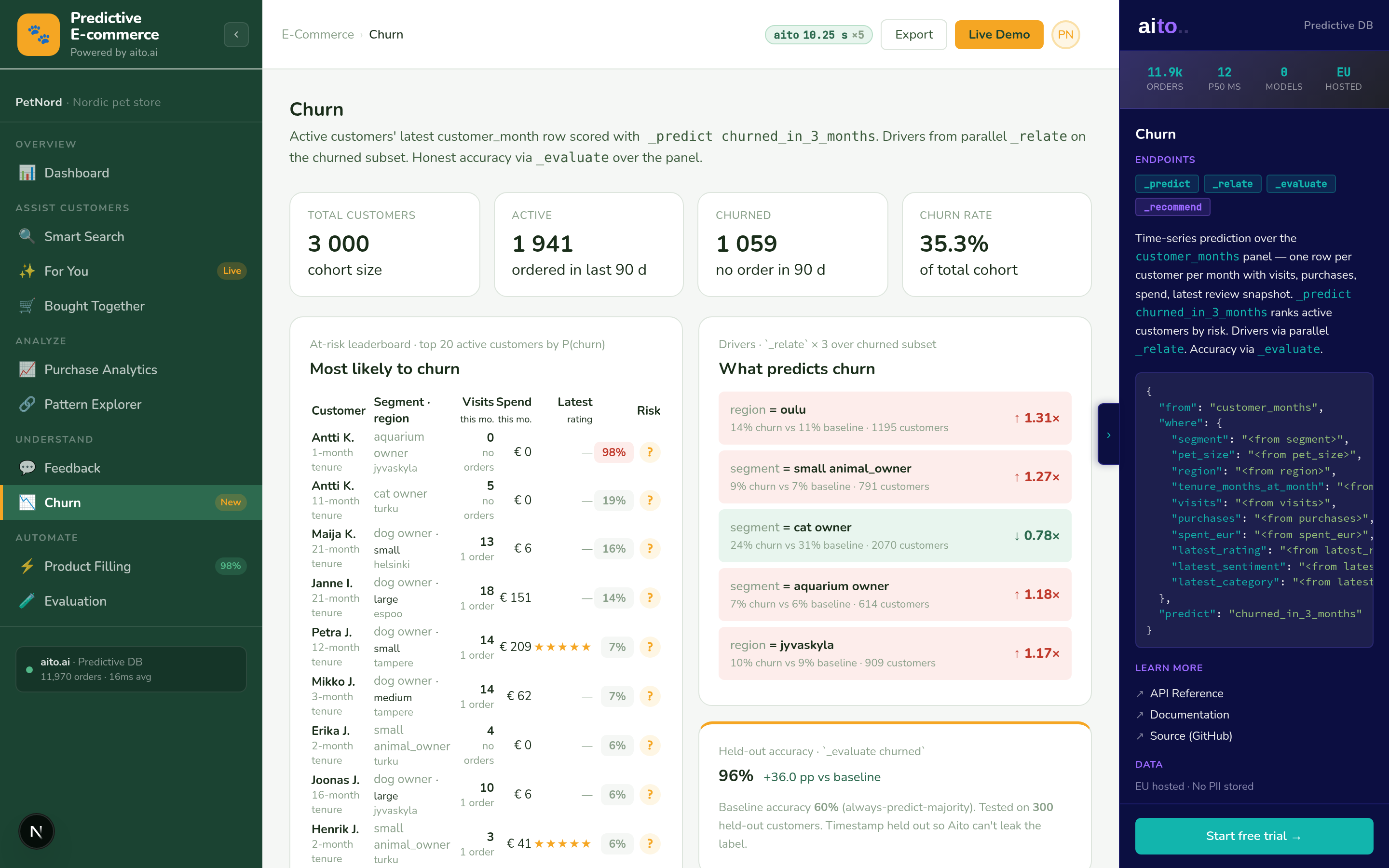
Churn-ranked Outreach
Predict churn probability, route the top-N to retention. The retention team works the highest-leverage queue first.
Address
Episto Oy
Putouskuja 6 a 2
01600 Vantaa
Finland
VAT ID FI34337429


