Build a Predictive Application on Aito

Build a Predictive Application on Aito
Turn Your SaaS into a Predictive Application
A predictive application is a SaaS product designed around the premise that the user should never make a decision the data has already made for them. Every form field, every routing choice, every category, every approval — backed by live predictions instead of the user doing the thinking. Errors that would have stayed hidden surface as anomalies. Decisions that used to require expertise become defaults that the user accepts or overrides.
Predictive accounting, predictive ERP, and predictive e-commerce are not three product launches. They are three instances of the same pattern. The engine underneath, in every case, is the same predictive database. Aito. No model training, no MLOps, no retraining schedule. Add a row, the next prediction reflects it.
Three live references, one architecture
The pattern is documented end-to-end in three open-source reference applications. Different verticals, different data structures, different personas. Same predictive operators (_predict, _relate, _search, _recommend, _evaluate) across all three. The breadth of the pattern is the proof.
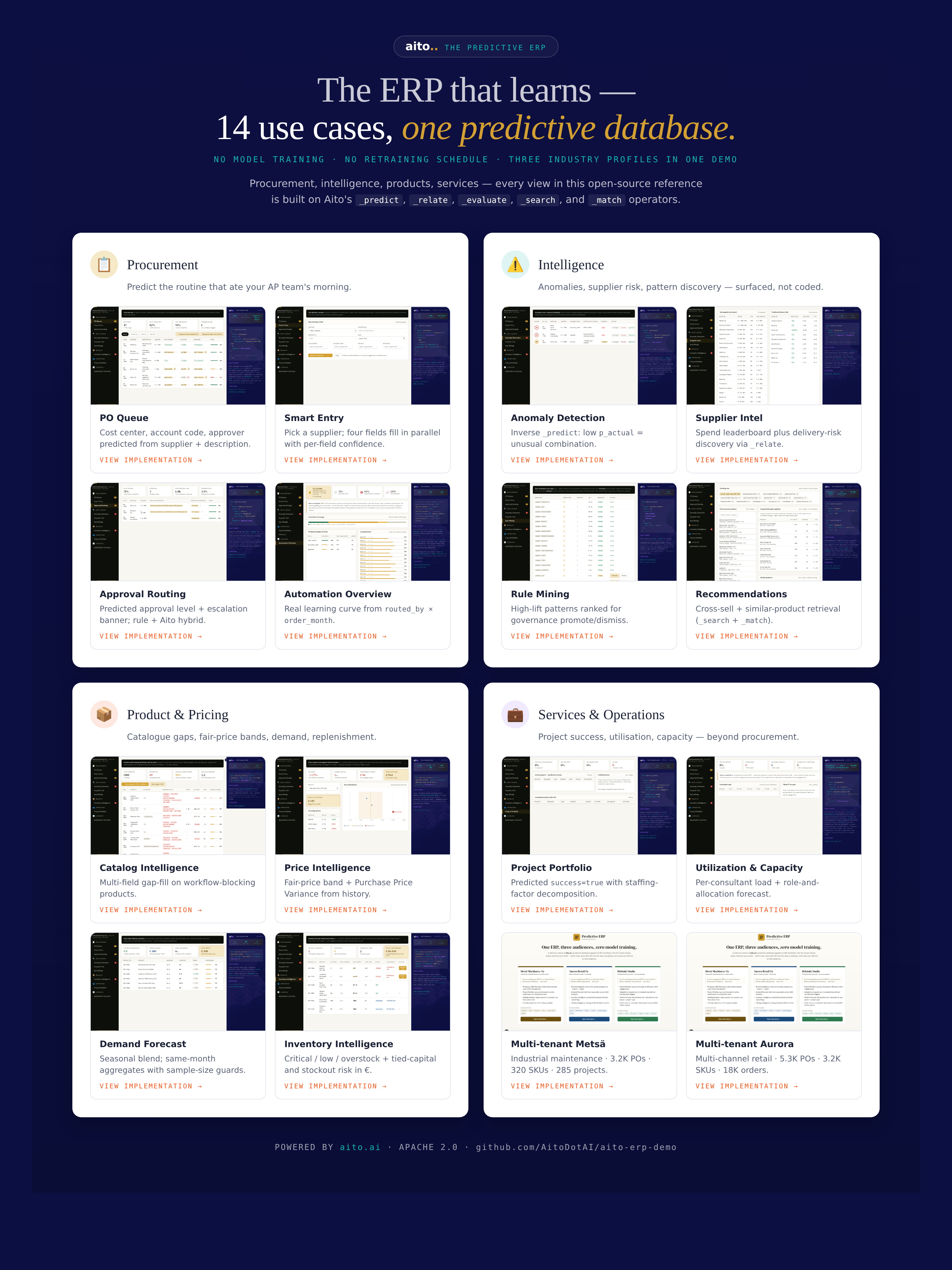
Predictive ERP
Three industry profiles (industrial maintenance, multi-channel retail, professional services) in one codebase. 14 production-ready features. Aggregate automation rate across the mixed profile sits at 72%. erp.aito.ai → · Source · Solution page
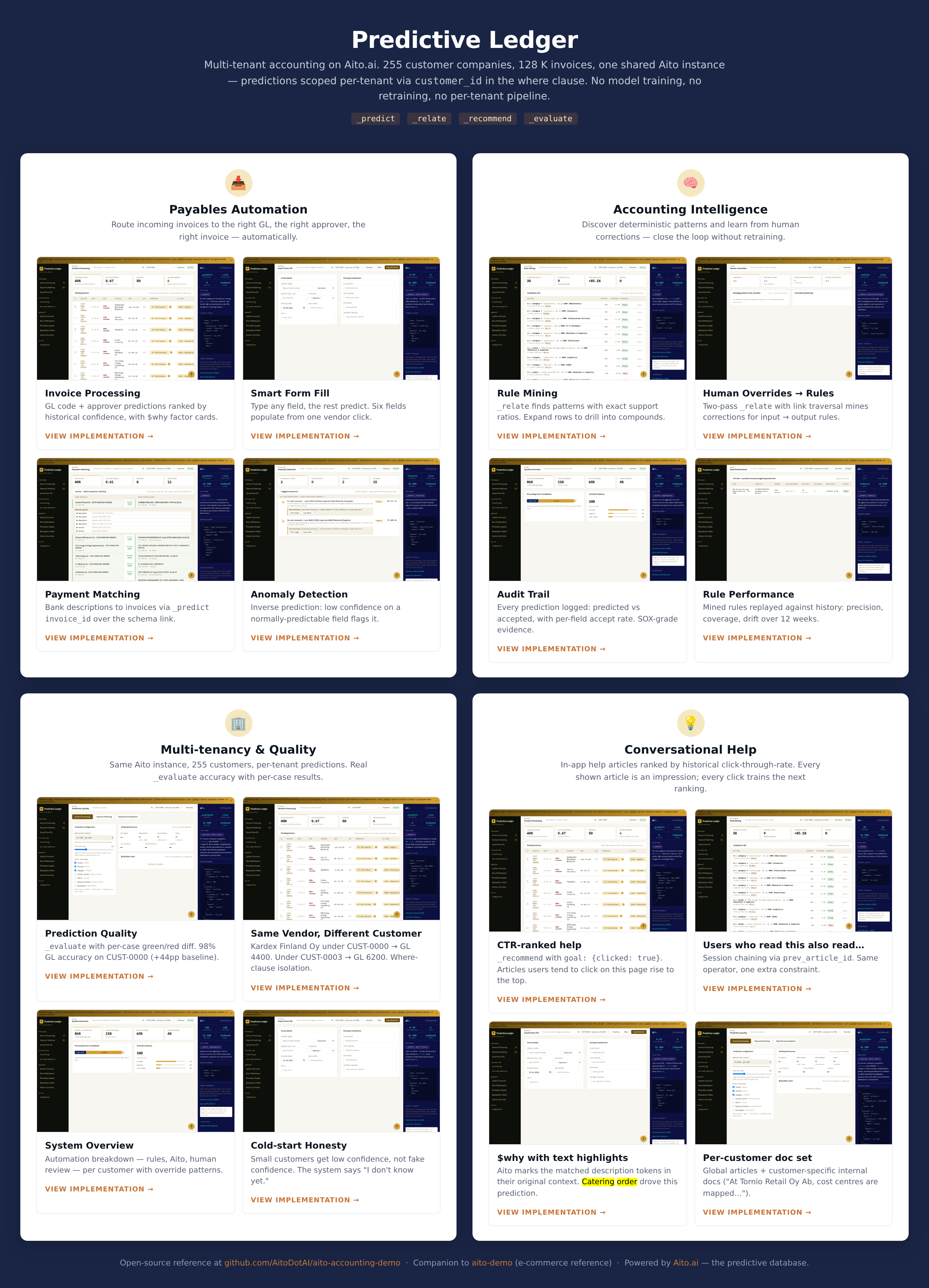
Predictive Accounting
Multi-tenant by construction. 255 customer companies, 128K invoices, one shared Aito instance with customer_id in the where clause. Same operators that Posti runs in production for AP at 95% accuracy on 3,000+ invoices/month. accounting.aito.ai → · Source · Solution page
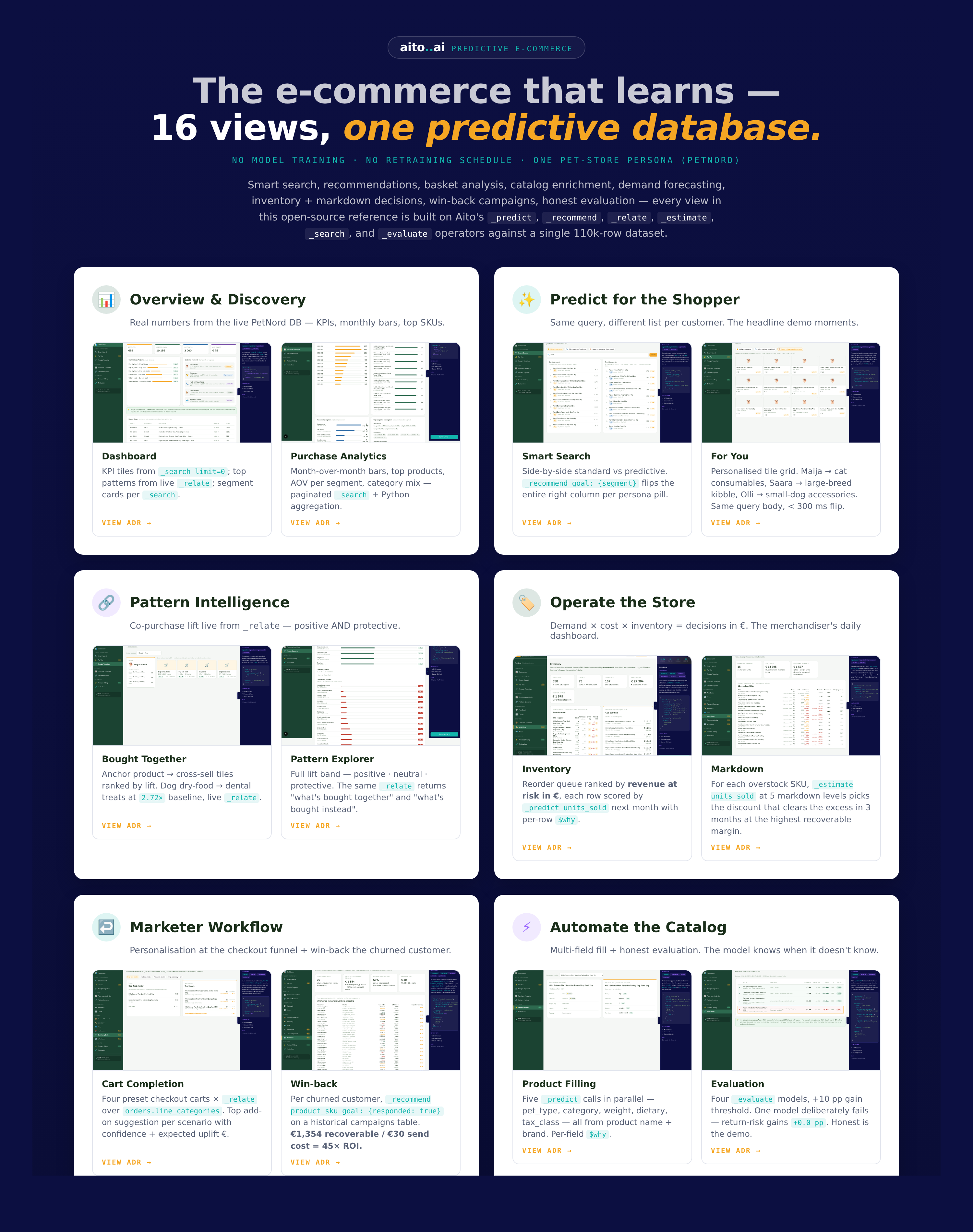
Predictive E-commerce
16 views on a 110K-row pet-store dataset including a deliberately honest failure case. Return Risk yields zero improvement over baseline, and the demo renders it as a red row — the calibration story made visible. Bought Together surfaces dog dry-food cross-selling to dental treats at 2.72× baseline lift, mined from the data, not a hand-curated rule. ecommerce.aito.ai → · Source · Solution page
Does the pattern apply to your application?
Three questions. If the answer to any of them is yes, your application is a predictive-application candidate.
Are your users currently making decisions the data already contains?
Categorization, routing, approval, allocation, classification, prioritization, escalation, recommendation, assignment — anywhere the user picks from a menu and the right pick is statistically determined by the surrounding fields, prediction earns its place. Most enterprise SaaS is a layered stack of such decisions wearing UI clothing.
Is per-prediction cost the thing keeping the application from being smart everywhere?
Patchwork intelligence — clever in two or three spots, manual everywhere else — is what high per-prediction cost produces. Every machine-learning prediction carries a pipeline, a model, a training set, monitoring, retraining, and an on-call rotation. The rational response is to cherry-pick the two or three highest-ROI use cases and leave the rest manual. Bring the per-prediction cost to near-zero per query and the rationing stops. Every field becomes a candidate.
Does the application have enough data density to learn from?
Predictive databases don't need millions of rows to be useful. Three observations of a stable pattern produces ~90% confidence with realized error around 1% on regular operational data. ERP, accounting, e-commerce, support workflows, HR, logistics, field service, partner ops — all run on the kind of conditional structure where predictions converge fast. The data density question is rarely the blocker; the question is usually whether the team has tried.
How a predictive application works
There is a predictive database underneath. No model training step. No retraining schedule. No data scientist required to maintain it. Predictions are computed at query time over a columnar index built at ingest, using lazy Bayesian inference that selects features and weighs evidence per query. Every prediction returns a calibrated probability and a $why factor decomposition showing which input features carried the signal.
The application uses the probability to set automation tiers without ever asking the user to trust a guess:
- Above 95% confidence → auto-process.
- Between 50% and 90% → pre-fill and route to human review.
- Below 50% → leave the field empty; the system says honestly when it does not know.
Calibration is what makes the tiering safe. When Aito says 95% confident, the realized error rate matches. The same property is what lets a predictive application collapse user effort without inheriting the failure modes of overconfident classifiers.
For the architectural detail, see aito.ai/technology/. For the full narrative across the three reference applications, see The Predictive Application.
Proven in production
Aito runs in production today. Not pilots. Paying customers, real data, real transactions.
- Posti — 3,000+ AP invoices/month at 95% accuracy on a SAP + UiPath + Aito stack. The public anchor for what a mature predictive-accounting deployment looks like.
- Tilisi — predictive ticket routing for an accounting and payroll services provider. Eliminated manual routing rules, recovered 4 hours of CEO time per week.
- Jokiväri, Fennoa, Q-Automate, Lastbot — predictive accounting, predictive ERP, and conversational predictive workflows in production today, each running on the same Aito engine that powers the reference demos above.
Get Started
Ready to evaluate whether the predictive-application pattern fits your SaaS?
Try the demo closest to your domain → · erp.aito.ai · accounting.aito.ai · ecommerce.aito.ai — see what a predictive application looks like end-to-end before building one.
Read more about the Predictive Application → — the pattern, the demos, and the architectural shift in one read.
Browse the use case catalog → — 39 use cases organized by capability (Analyze, Assist, Automate). Filter by vertical, by operator, or search for what your application actually does.
Read the source on GitHub → — three Apache 2.0 reference applications, fully documented use-case guides, the exact code that powers the demos.
Schedule a Technical Review → — walk through your specific application with our team. If the pattern fits, we'll tell you. If it doesn't, we'll tell you that too.
Start Free Trial → — point Aito at your own data in our sandbox environment.
Address
Episto Oy
Putouskuja 6 a 2
01600 Vantaa
Finland
VAT ID FI34337429


