The problem
Bought-together recommendations are the load-bearing cross-sell pattern in e-commerce. Show the buyer of dog food the dental treats; show the buyer of running shoes the moisture-wicking socks; show the buyer of the SaaS subscription the integration add-ons. The cross-sell decision has been made millions of times across e-commerce history; what is missing in most catalog tools is a system that finds the actual statistical co-occurrence in the data rather than relying on hand-curated cross-sell rules.
Hand-curated rules are fragile. They reflect the merchandiser's best guess at launch; they do not update as buying patterns shift; they miss the long-tail patterns no one thought to encode. The data has the answer — millions of orders show which products actually co-occur — but the data has been silent because there is no easy way to query the answer.
How it works
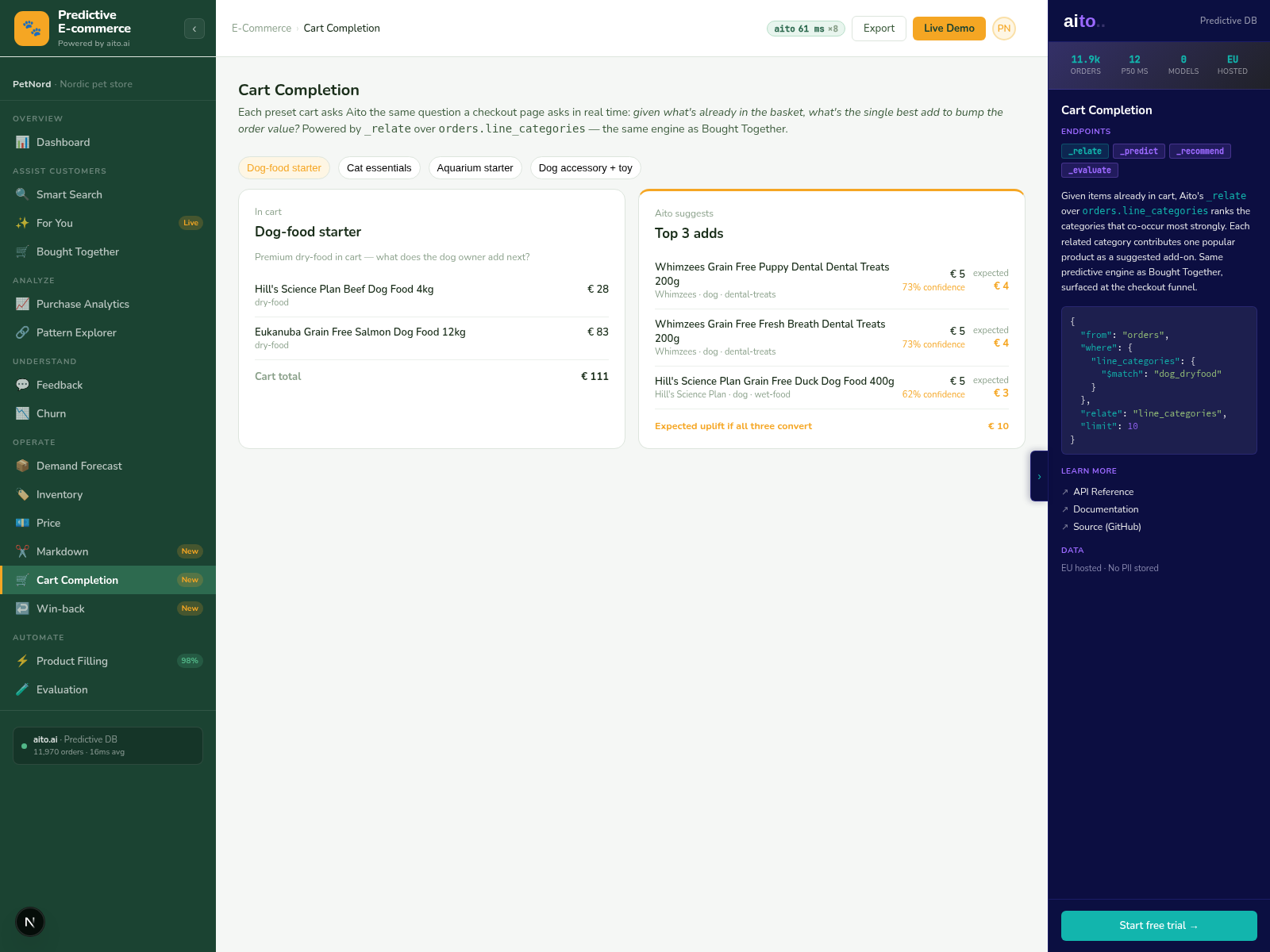
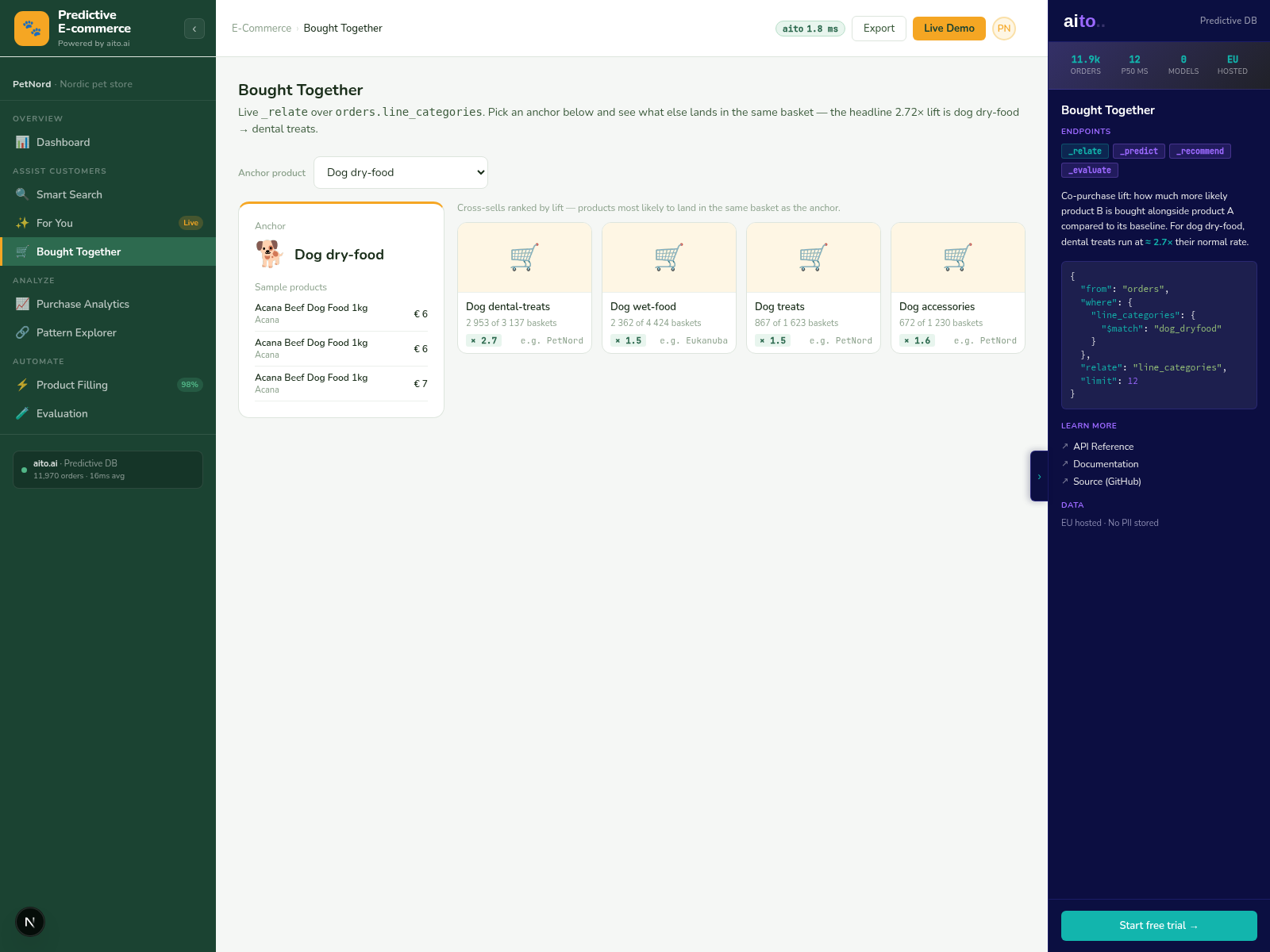
The Bought Together view in the e-commerce demo runs _relate across the order-lines table to surface the strongest cross-sell pairs ranked by lift. For a given anchor product (or anchor category), the query returns the products most disproportionately likely to appear in the same order. Lift is the ratio: of customers who bought the anchor, how much more likely are they to also buy the candidate compared to the overall population?
The dog dry-food → dental treats result at 2.72× in the PetNord fixture is not a curated rule. It is a live conditional probability over the actual co-purchase data. Run the query, get the number. Change the data (more orders accumulate, seasonal patterns shift, a new product enters the catalog), and the next query returns the updated number — no batch recommendation rebuild, no separate model.
{
  "from": "order_lines",
  "where": {
    "product.category": "dog-dryfood"
  },
  "relate": "product.id",
  "with": "category",
  "select": ["$lift", "$p", "product.id"],
  "limit": 10
}
For the full architecture, see the technology overview. For the broader narrative across multiple use cases, read The Predictive Application.
See it live
This use case runs in the 🛒 E-commerce demo today. Click through to the live application and inspect the queries that produce the result.
Frequently asked
How does this compare to collaborative-filtering recommendation engines (matrix factorization, neural CF)?
Collaborative filtering builds a user-item matrix and decomposes it. Effective on dense data; struggles on cold-start items and tail products. _relate over co-purchase data is a simpler statistical primitive that returns conditional lift directly. On dense data, neural CF often wins on raw accuracy; on the cold-start tail and on items with little history, the statistical approach degrades more gracefully and the predictions are calibrated and explainable.
What about user-personalized cross-sell (different recommendations per user)?
Personalized cross-sell is _recommend against the impressions or clicks data conditioned on the user's segment or behavior. Bought-together via _relate is the catalog-level pattern; personalized cross-sell composes that with user-conditional probability. Both run from the same data, no separate model.
How do we avoid the obvious-bundle problem (recommending things customers always buy together anyway)?
The lift metric handles this. Lift = conditional / baseline. A product pair that is bought together a lot but also bought separately a lot has low lift — the recommendation is not surprising. A pair with high lift is statistically over-represented among co-purchases; that is the recommendation worth surfacing.
Does this surface seasonality (e.g., dog dental treats at vet-visit time)?
_relate is computed over the current data — including the most recent orders. Seasonal patterns are reflected automatically because the most recent month's co-purchase data dominates the conditional probability in proportion to the volume. For explicit seasonality conditioning, add a time-range filter to the where clause.
Will this scale to a catalog with millions of SKUs?
The columnar index makes _relate scale with the data volume, not the catalog size. Query latency stays in the sub-200ms range up to ~10M rows in production; for larger catalogs, the bottleneck is usually the front-end rendering of N suggestions rather than the prediction itself.