The problem
Win-back campaigns are usually run as scheduled batches — once a quarter, send the lapsed-customer outreach to the whole list. The scheduling is convenient but it misses the win-back signal: customers lapse on different timelines, and the optimal outreach window is per-customer, not per-calendar.
The data shows when each customer becomes win-backable. The conditional probability of "will respond to outreach in the next 30 days" rises and falls per customer based on their pattern (recency of lapse, prior engagement, seasonality). Mature win-back triggers fire when that probability crosses a confidence threshold — not on the calendar.
How it works
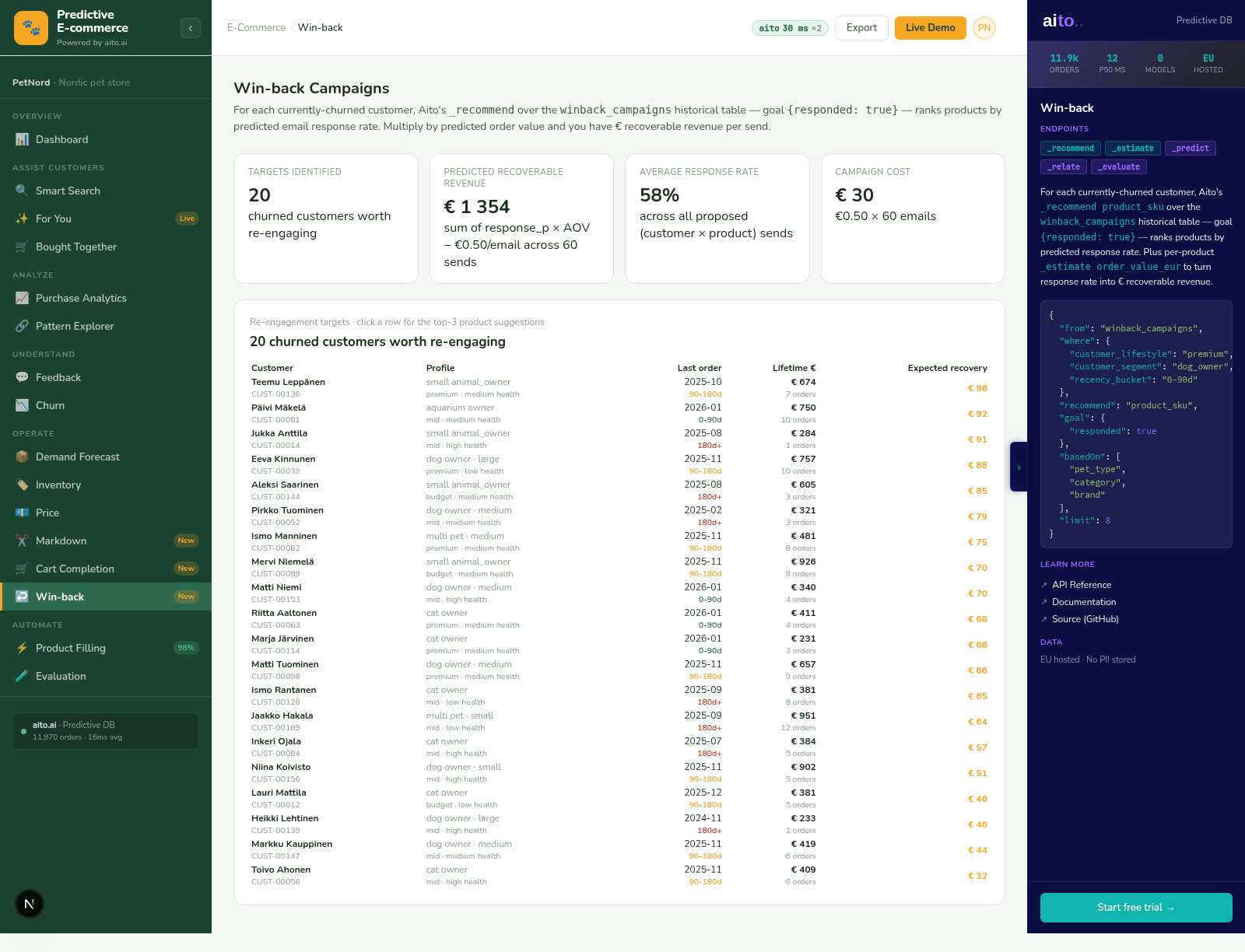
Win-back triggers compose _recommend (which offer, with its response probability) with _estimate (order value) and a cost model. The system computes per customer per day: predicted probability of return × predicted lifetime value if returned − outreach cost. When the value exceeds the cost at >70% confidence on the win-back probability, the trigger fires and the customer enters the outreach queue.
Mature deployments tune the threshold by outreach type. Low-cost outreach (email) fires at a lower confidence threshold than high-cost outreach (call from senior rep, discount offer). The same conditional probability machinery drives both decisions; the threshold is application-level configuration.
{
  "from": "customers",
  "where": {
    "status": "lapsed",
    "days_since_last_purchase": { "$range": [30, 180] }
  },
  "predict": "will_return",
  "select": ["$p", "customer_id", "predicted_recoverable_revenue"],
  "where": { "$p": { "$gte": 0.70 } },
  "limit": 500
}
For the full architecture, see the technology overview. For the broader narrative across multiple use cases, read The Predictive Application.
See it live
This use case runs in the 🛒 E-commerce demo today. Click through to the live application and inspect the queries that produce the result.
Frequently asked
How is this different from win-back ranking?
Win-back ranking sorts the queue by predicted recoverable revenue for human-driven outreach. Win-back triggers fire automated outreach when the predicted value crosses a threshold. Ranking is for the retention team's call queue; triggers are for the marketing system's auto-send.
How frequently should the trigger evaluation run?
Daily for typical e-commerce; hourly for high-cadence categories (food delivery, consumables). The conditional probability updates with every customer signal; running the trigger evaluation on a faster cadence catches windows that close quickly.
Can different outreach types compete for the same customer?
Yes. Multiple triggers can fire for the same customer; the application picks the highest-value path. Most deployments prioritize: discount-offer trigger > email-only trigger > app-notification trigger, with cooldowns to prevent over-contact.
Does this work for B2B customer win-back (longer cycles, fewer customers)?
Yes. The probability calibration is per-domain — B2B win-back probabilities are lower (longer sales cycles, smaller pool of lapsed customers). The threshold tunes accordingly. Mature B2B deployments use win-back triggers to surface account-management calls, not automated emails.
How does the trigger handle customers who recently unsubscribed?
Unsubscribe is a hard exclusion at the application layer, not a soft input to the prediction. Unsubscribed customers do not appear in the trigger queue regardless of predicted recoverable revenue. The prediction respects channel preferences set at the application level.