The problem
Outreach decisions are usually playbook decisions. Sales picks the channel and the angle from habit or from a sequence tool's fixed cadence, and the playbook treats a head of data at a SaaS company the same as a CFO at a manufacturer. The response data that would say which approach actually books meetings for which buyer sits unused in the activity log.
The decision is a goal-directed query. Out of the angles and channels we have tried on buyers like this one, which combination maximises the probability of a booked meeting? That is what _recommend computes, and it is a different operation from describing past response rates: it returns the action that optimises the outcome.
How it works
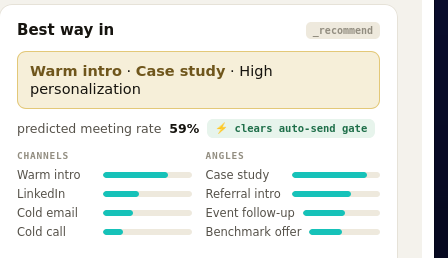
_recommend over the outreach history, conditioned on the target's attributes (industry, role), with the goal set to a booked meeting. The result is the ranked angle and channel with the predicted meeting rate attached. In the live demo, a warm intro with a case-study angle and high personalisation predicts a 59% meeting rate for the example buyer, and the per-channel and per-angle rates are visible beside the pick.
The same query works as an agent tool. The demo's sales agent calls it before drafting the email, so the draft follows the angle the data supports, and the agent quantifies the lift over the unoptimised baseline. Every send and its outcome write back, so the recommendation tracks what is currently working rather than last year's playbook.
{
  "from": "outreach",
  "where": { "target_industry": "SaaS", "target_role": "Head of Data" },
  "recommend": "angle",
  "goal": { "meeting": "yes" },
  "limit": 3
}
For the full architecture, see the technology overview. For the broader narrative across multiple use cases, read The Predictive Application.
See it live
This use case runs in the 🤖 Agent demo today. Click through to the live application and inspect the queries that produce the result.
Frequently asked
How is this different from reporting reply rates per channel?
A report describes the past per dimension; _recommend optimises across dimensions jointly toward the goal. The best angle depends on the channel and the buyer, and the recommendation accounts for the interaction instead of leaving the rep to cross-reference three reports.
Does this work with a sequence tool like Outreach or Lemlist?
Yes. The sequence tool stays the execution layer; Aito returns the recommended channel and angle per target as JSON before the sequence is chosen. Outcomes flow back as rows, which is all the learning loop needs.
What volume of outreach history is enough?
A few hundred logged sends with outcomes give usable recommendations for the common buyer shapes; the demo runs on 2,200. Low-history combinations return low confidence rather than a fabricated rate.
Can this gate automated sending?
Yes. The predicted meeting rate is calibrated, so it can drive a threshold: auto-send above it, route to a human below it. The demo shows the same pattern as a gate the agent must clear before its drafted email can send.