Blog
Aito's blog posts.

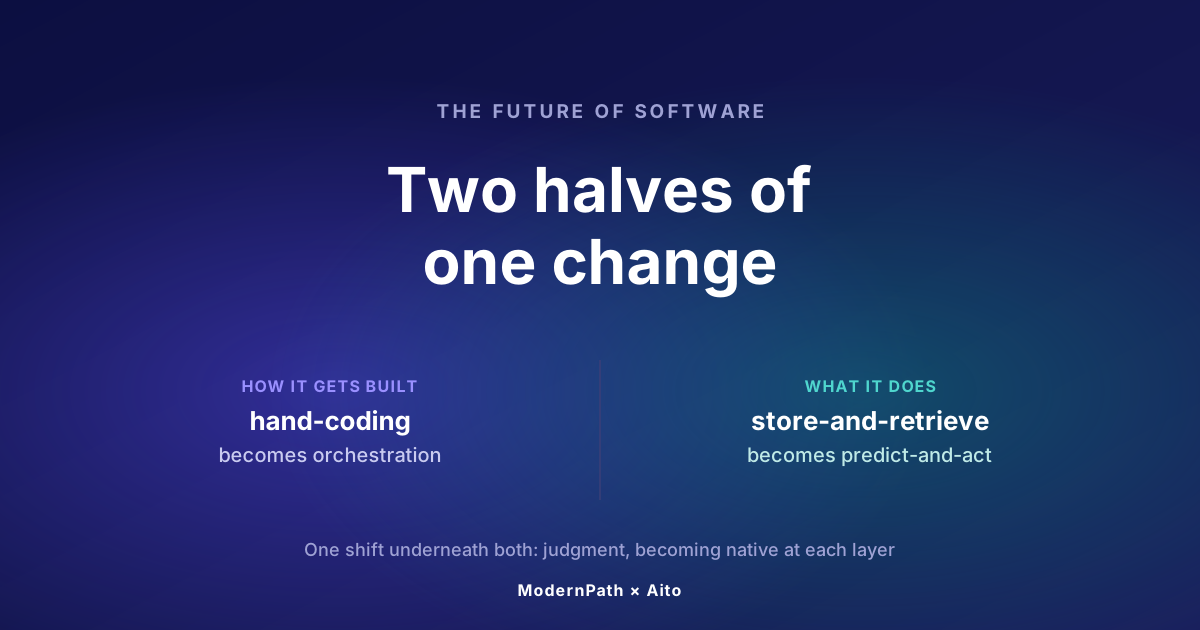
What does the future of software look like?
The world is changing and everyone in software is trying to read the same thing: where this goes. It splits into two questions, how software gets built and what the software does once it is built. This is an attempt to reason through both, written by two founders who each work one half. We are honest that the answer might not be us. What we think is that it will look like this, because the problem leaves few other shapes.
Read more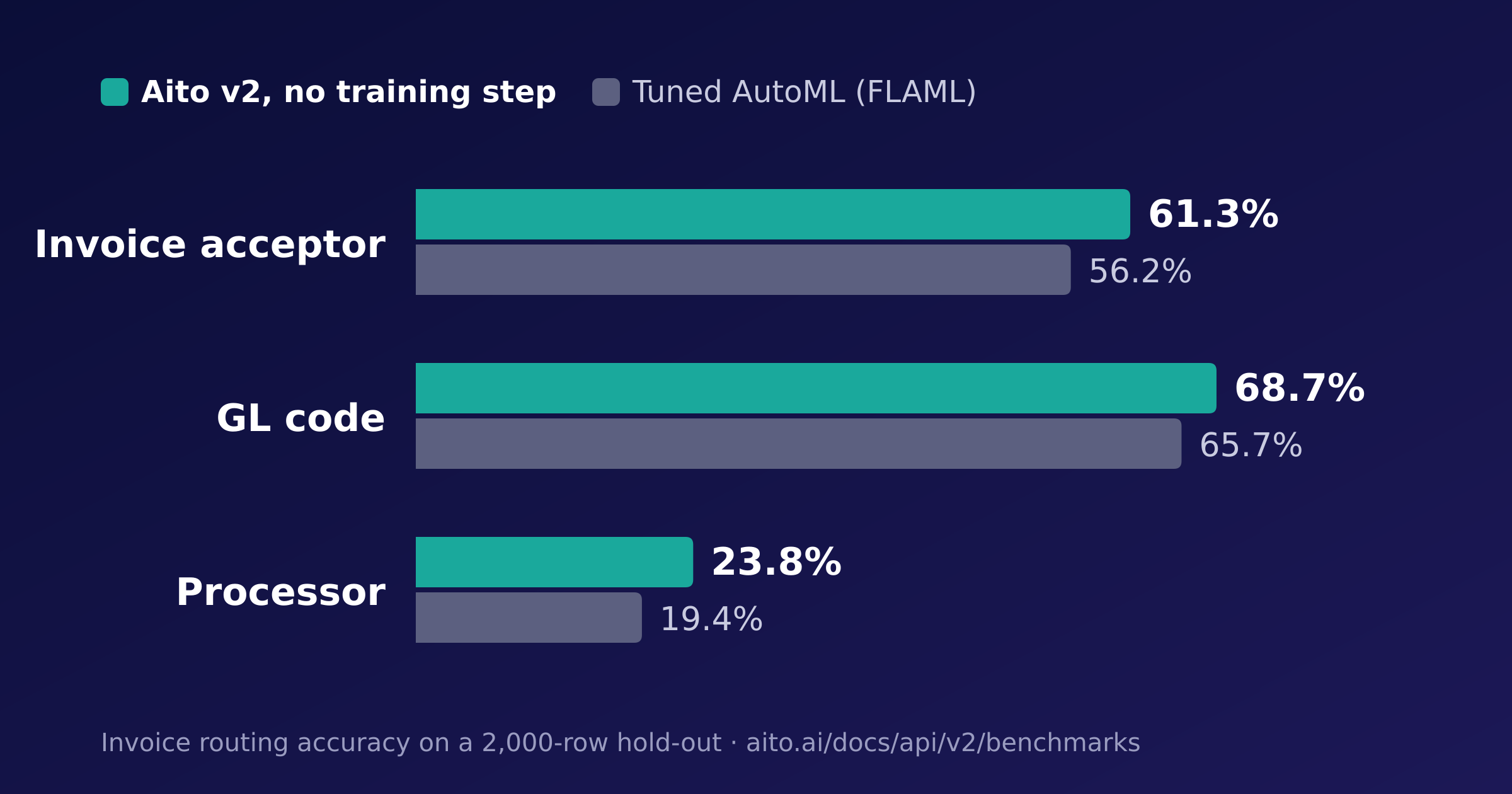
What makes an application intelligent: Aito v2 is generally available
Software is now expected to be intelligent, and most applications are missing the part that would make them so: a predictive core that knows their own data. Aito v2, generally available today, is the predictive database built to be that core. It speaks SQL to the systems you already run, holds vectors and relationships for your LLMs and agents, and our own applications run on it.
Read more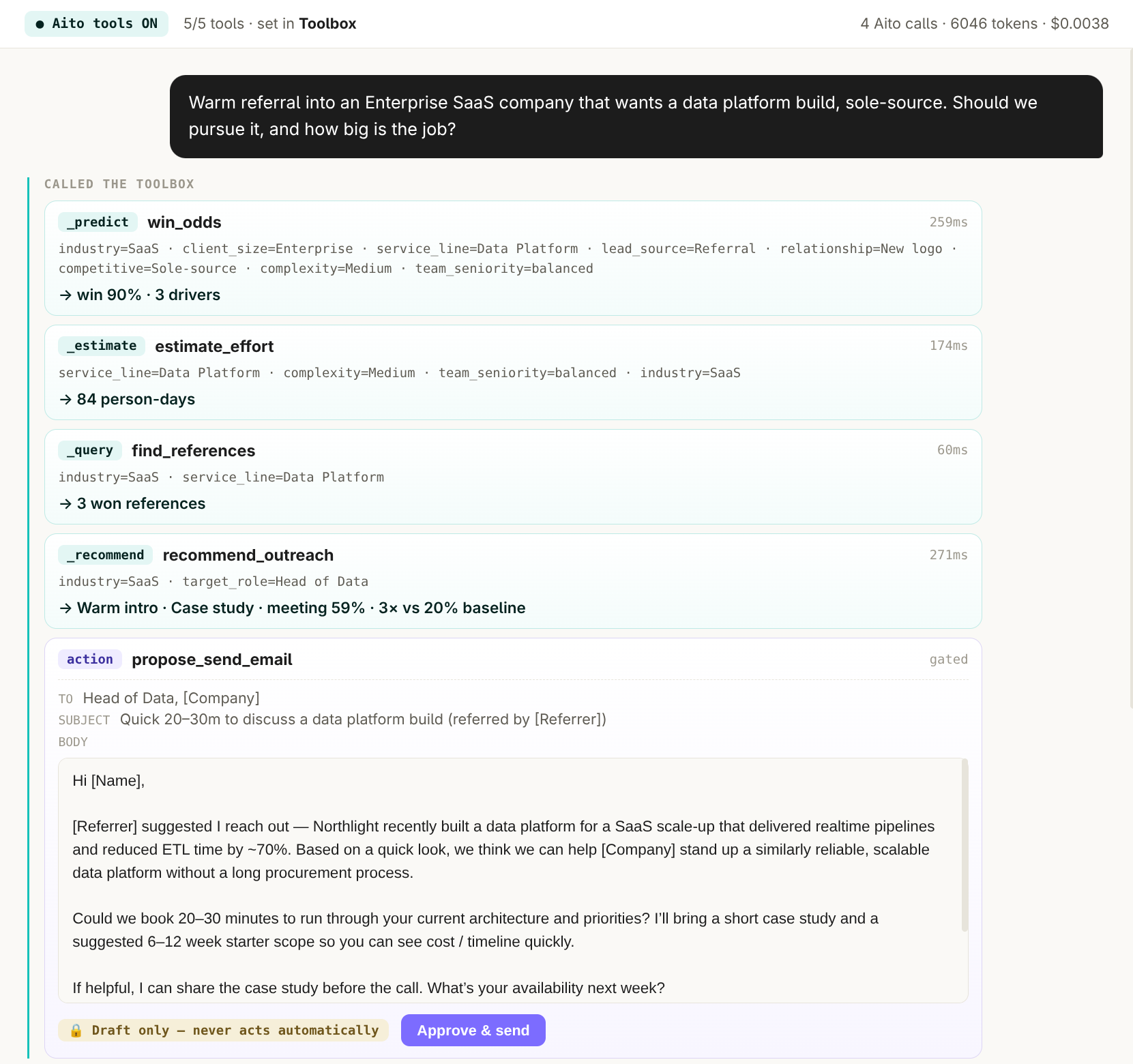
What would it take for software to act for you?
The first wave of agentic AI tried to build autonomous software out of language models alone. That was the right first move for language and the wrong design for action. Software that acts needs reasoning for the exceptions and intuition for the rule, working as peers, and it needs both to sit on one foundation. Here is the paradigm, the architecture it implies, and how Aito runs it without a Frankenstein stack.
Read more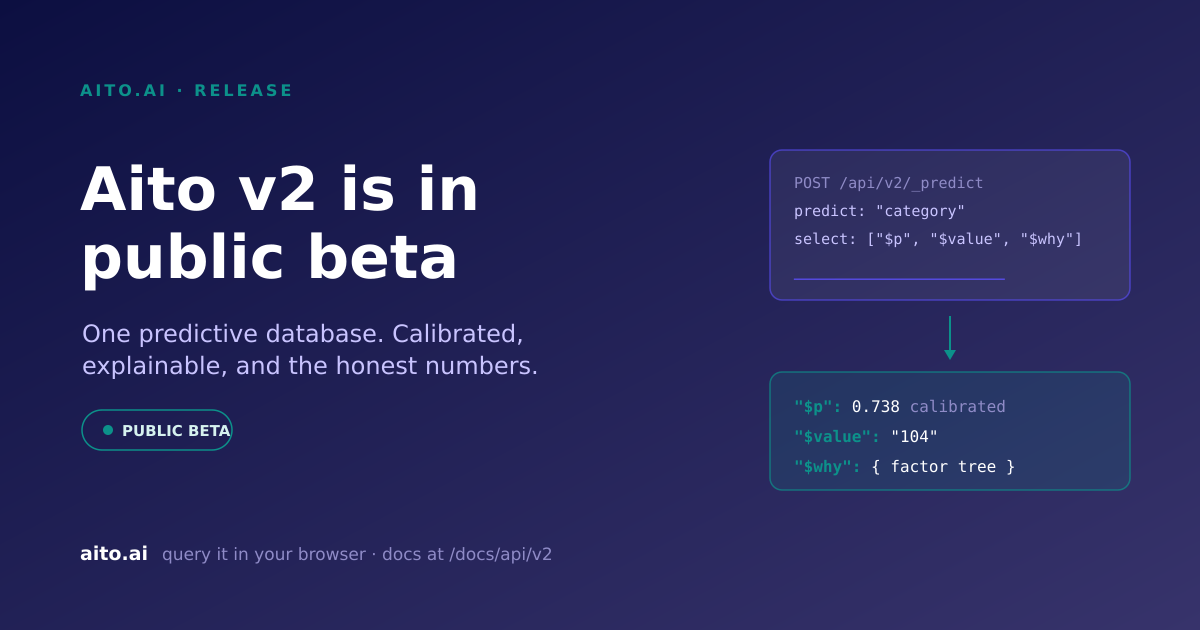
Aito v2 public beta: what shipped, and the honest numbers
Written in August 2026, when v2 was in public beta. v2 became generally available on 21 September 2026, so this post is the record of the beta rather than the current state. It is concrete on purpose: here is what the engine does, here are queries you can run, and here are the numbers, including the ones that do not flatter us.
Read more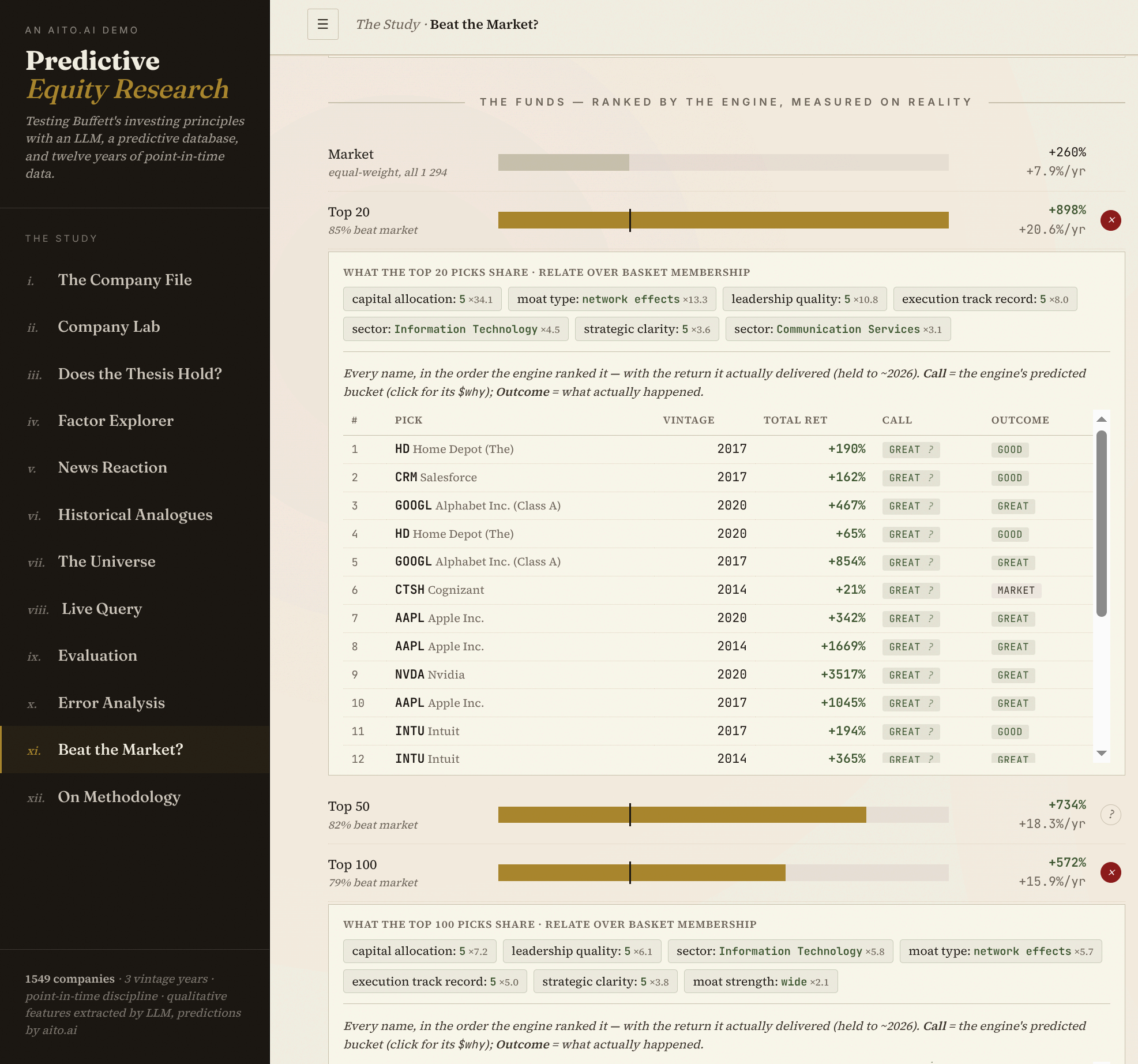
Value, quality, or growth: who was right?
The efficient market hypothesis says you cannot beat the market. Graham, Buffett, and a lineage of growth investors spent decades saying otherwise. So I ran the experiment: grade 250 S&P 500 companies on value, quality, and growth signals, point-in-time, and let a predictive database score all three philosophies against twelve years of real outcomes. The answer surprised the value investor who built it.
Read moreHow Aito Scales to Millions of Rows
Buyers ask whether a predictive database can hold up at SaaS scale. Here are the numbers from a 10-million-row invoice routing benchmark, run end-to-end through Aito's HTTP API the way production traffic actually hits it: low-hundreds-of-milliseconds predict latency, sub-linear scaling from 1k to 10M, and what the cold-start looks like before the cache warms.
Read more
Introducing a new database category - the predictive database
A predictive database lets you query predictions (classifications, recommendations, missing values) from structured data, using the same query interface you use for data retrieval. No training step.
Read moreThe AI Database Landscape in 2026: Where Does Structured Prediction Fit?
Databases are absorbing AI capabilities. A taxonomy of the four categories emerging in 2026: vector databases, ML-in-database platforms, LLM-augmented databases, and predictive databases.
Read more


Address
Episto Oy
Putouskuja 6 a 2
01600 Vantaa
Finland
VAT ID FI34337429


