Aito v2 public beta: what shipped, and the honest numbers

Antti Rauhala
CEO and founder
August 11, 2026 • 14 min read
Update, 21 September 2026: the beta is over. Aito v2 is generally available as v2.10.0 and is now the canonical API. This post is kept as the record of what the beta was; it is not the current state. For what changed between here and general availability, see What's new. For the current surface, see the v2 API reference.
I would rather you ran a query than took my word for anything in this post. So the numbers here are the ones our own benchmarks produce, the unflattering ones included, and every claim is a request you can send yourself.
What we shipped
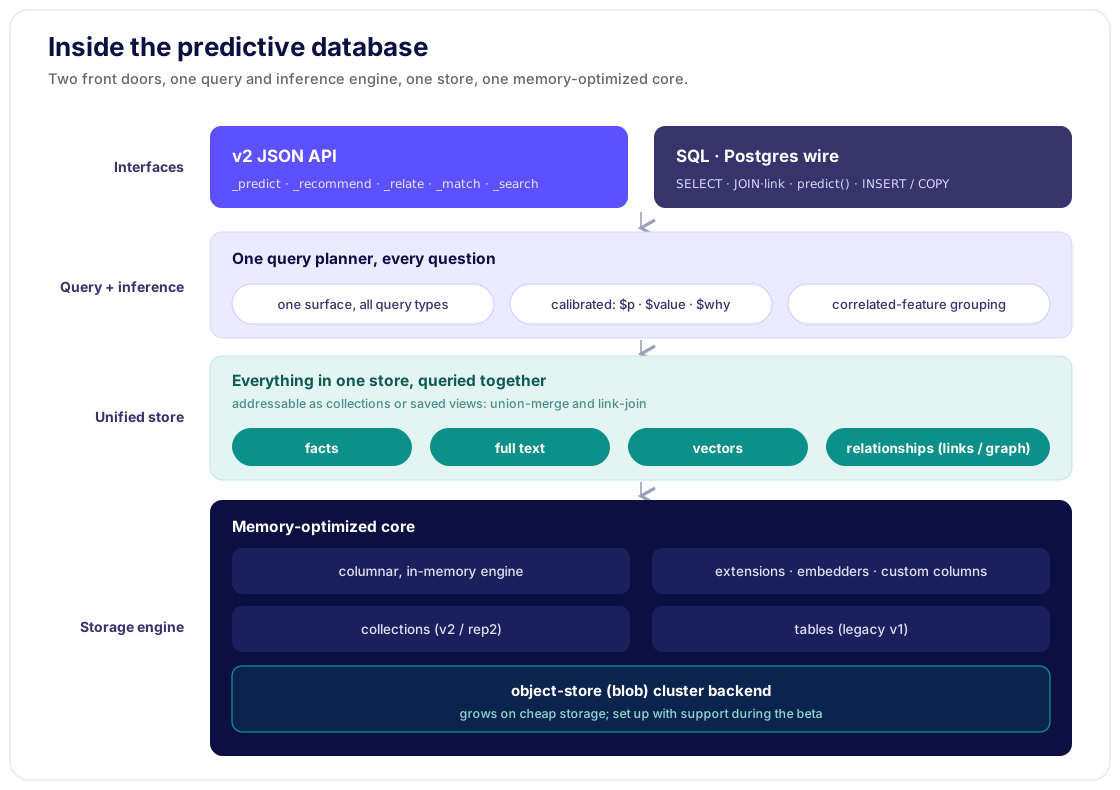
Aito v2 is a new engine for the predictive database, and it is in public beta today. It holds structured facts, full text, vectors, and linked relationships in one store, and it answers queries about the unknown the same way an ordinary database answers queries about the known: you ask for a category, an account, a next action, a ranking, and it returns the answer with a calibrated probability and the reasoning behind it.
Two honest framings up front, because they matter more than any feature.
First, v2 runs alongside v1, not on top of it. For the whole beta, v1 remains the production default. v2 is the successor engine, stable enough to build against and to cite, and we would rather you kicked its tires now than waited for a version number.
Second, this is a beta for a technical audience. The bar we set for ourselves was simple: you should be able to query v2 in your browser, write your own data to it, read numbers we did not massage, and reference the v2 surface in your own design. Nothing on that list is gated behind a sales call.
Here is the whole thing in one picture before the details.
Query it, do not trust me
Here is the query the rest of the post rests on. Ask v2 to predict a product category, and ask it to show its work:
POST /api/v2/_predict
{
  "from": "products",
  "where": { "name": { "$match": "milk" } },
  "predict": "category",
  "select": ["$p", "$value", "$why"]
}
You get back a ranked list, each candidate carrying a calibrated probability:
[
  { "$p": 0.738, "$value": "104", "$why": { /* the factor tree */ } },
  { "$p": 0.140, "$value": "109", "$why": { /* ... */ } }
]
Two things in that response are the whole point of a predictive database.
The $p is calibrated, which is a specific and testable claim: among the cases where v2 says 0.85, close to 85% really are that value. That is what makes the number safe to threshold an action on. A score you cannot trust the level of is a number you cannot automate against.
The $why is the factor tree: the evidence that moved the probability, readable by a person who has to trust or override the decision. When v2 does not have the evidence, it does not paper over it. v2 fails loud, with a typed error, rather than returning a confident empty answer.
One surface, many questions
The query above is not a special prediction endpoint. In v2, _predict, _recommend, _relate, and _match are named entry points into one query engine, dispatching on what you ask for, and _search sits alongside them for full-text retrieval with boolean operators. The same store, the same data, answers the whole surface.
Rank options against an objective, not just a label:
POST /api/v2/_recommend
{
  "from": "impressions",
  "where": { "context.user": "veronica" },
  "recommend": "product",
  "goal": { "purchase": true },
  "select": ["$p", "$value"]
}
Ask what actually relates to an outcome, which is the move an anomaly check or an approval-routing rule needs:
POST /api/v2/_relate
{
  "from": "impressions",
  "where": { "product.tags": { "$has": "vegetable" } },
  "relate": ["purchase"]
}
Notice context.user and product.tags in those queries. Those are links, relational edges walked by dot notation, and they chain: you can follow one several hops out, from a record to its vendor to that vendor's own history, in the same query, with a $refs operator to read an edge back from the entity it points at. The relationships live in the same store as the facts, so a prediction leans on the whole neighborhood of a record, not just its own columns, without a separate graph database to keep in sync. $refs reads an edge backward, here every product a user has ever ordered, walked in reverse through the orders that link them:
POST /api/v2/_query
{
  "from": "users",
  "select": ["name", { "products": "$refs.orders.buyer.product" }]
}
That backward read is also the door to using the store as a graph you predict over, not just traverse. Model your data as entities and edges, one row per subject → relation → target, and the same engine does node classification and link prediction. Classify an entity from its neighborhood, here a segment for anyone who has engaged with something:
POST /api/v2/_predict
{
  "from": "entities",
  "where": { "$refs.edges.subject": { "$exists": { "relation": "engaged_with" } } },
  "predict": "segment"
}
Or predict a missing edge endpoint, here which target a tech-role subject is likely to use:
POST /api/v2/_predict
{
  "from": "edges",
  "where": { "subject.role": "tech", "relation": "uses" },
  "predict": "target"
}
Both answers come back calibrated and explained, like every other prediction, and basedOn lets one generalize to entities it has never seen. The graph docs go deeper.
And the thing you query does not have to be a raw collection. A view is a derived relation defined in the schema: a link-join that exposes a relationship as navigable dotted paths with no content copied, or a union-merge that stacks several collections into one, column by column and lazily. You name it in from and filter, predict, and recommend against it exactly as you would a collection.
POST /api/v2/_predict
{ "from": "search_index", "predict": "category", "where": { "name": { "$match": "milk" } } }
Views are lazy by default, nothing is copied, so they stay cheap to keep around. For a hot path you can persist a union view as a materialized snapshot, built once and rebuilt with POST /api/v2/schema/{view}/_refresh when its sources change. Either way it is the same relation operators under a name, so the whole calibrated surface runs over a shape you defined once.
Text and vectors live there too. v2 has a Vector column type and retrieves with $nearest, scores rows with $similarity, and can fuse nearest-neighbor evidence into a prediction with $semantic. That last one is the point of vectors in a predictive database: the meaning of the text becomes evidence inside the calibrated answer, not a separate search you reconcile afterward.
POST /api/v2/_predict
{
  "from": "tickets",
  "predict": "category",
  "where": { "embedding": { "$semantic": { "near": [0.1, 0.9, 0.2], "k": 20, "weight": 0.5 } } }
}
Pure nearest-neighbor retrieval is the same store from the other side, $nearest with a having on $similarity:
POST /api/v2/_query
{
  "from": "products",
  "where": { "$nearest": { "near": { "embedding": [0.12, -0.03, 0.88] },
                           "where": { "category": "shoes" },
                           "having": { "$similarity": { "$gte": 0.8 } }, "limit": 10 } },
  "select": ["id", "name", "$similarity"]
}
Two honest limits worth stating plainly: the vector search is exact, with no approximate index yet, and v2 does not encode your text for you by default, so you bring your own vectors (with an optional server-side embedder you configure). Exact search is the right first move for correctness. The approximate index is on the list, not in the box.
And for the people and tools that prefer SQL, v2 speaks the Postgres wire protocol, and it is more than a read path. Inference is called inline, so a prediction is just a column:
SELECT ProductName, predict(GLCode)
FROM invoices WHERE ProductName = 'Cloud Services';
predict(col) returns the argmax and predictions(col) the ranked distribution, and recommend() and relate() are callable the same way. Around that you get a real, if deliberately minimal, surface: SELECT with WHERE, GROUP BY, HAVING, aggregates, and an INNER JOIN along a declared link, which is a thin projection over the link rather than a row-copying join. Writes and simple DDL go over the wire protocol: INSERT, COPY, CREATE TABLE, and basic CREATE VIEW. Point psql, a JDBC or ODBC client, or a connector like DuckDB or postgres_fdw at it. It is early access and not a full Postgres, a small SELECT subset by design, no subqueries yet and a SQL view definition is a single source with an equality filter (no JOIN or UNION inside it), but by construction it parses to the same _query calls as the JSON API, so the two interfaces return the same answers. The full surface is in the SQL docs.
Write to it, and it learns
Reads are only half of it, and the write path is open in the beta, with no invite and no sales call in the way. That matters more than it sounds, because in a predictive database a write is the learning step. Insert a corrected row and the next prediction already reflects it, with no retraining job, no redeploy, and no drift schedule to babysit. This is the write-back loop that lets an application get sharper as it runs: in v2 it is one ordinary insert.
Under the hood
Some of the v2 work is not a feature you call, it is engine work you feel as better answers and a smaller bill. Briefly, and without overselling what is still settling:
-
Correlated evidence is grouped, not double-counted. Real tables carry fields that all say the same thing: a vendor's name, its code, and its bank account all point at one entity. v2 can group that correlated evidence so it counts once, which is a large part of why the calibrated
$pstays honest on messy data instead of drifting overconfident. -
A lighter footprint. The v2 engine holds its working data in less memory than v1. For a multi-tenant deployment that is the difference between the feature paying for itself across every tenant and only on the flagship.
-
Query-time caching. Repeated and similar inferences are served without recomputing from scratch, so interactive latency stays flat as usage grows rather than climbing with it.
-
Object-store-backed clustering. The cluster design grows on cheap object storage rather than a fleet of always-on machines. This is real in the engine and, in the beta, set up with our help rather than one click, with more cloud backends planned.
Correction, 30 September 2026: clustering cannot be enabled in any released version. Aito runs as a single node today; clustering is in development.
-
Extensions. There are extension points, including a server-side embedder and custom column handling, so the engine can be adapted to a domain without forking it. The exact surface is still settling, so I will point you at the docs rather than pin it here.
The measurable ones, memory and latency in particular, will get their figures from the same verified run as the benchmarks below, and I would rather show them then than quote a number I have to walk back.
The honest numbers
A release post is where companies quote their best benchmark and move on. The more useful thing is to show you the shape of the results, wins and losses together, because a system that only reports its wins is one you cannot calibrate your trust in. These move as we optimize; here is where they stand today.
Where v2 is clearly ahead:
- Accounting predictions. On the invoice-routing suite, v2 leads top-1 on all three targets with zero training. The standout is
acceptorat 68.5% against v1's 27.5% and FLAML AutoML's 59.5%; the hardest, the high-cardinalityprocessorlink, nearly doubled its accuracy and moved from behind v1 to ahead, on the back of a recent scoring update with better link priors. - Calibration. v2 is the best-calibrated method we tested: expense-categorization ECE 0.086, against v1's 0.098 and LightGBM's 0.185. For a database you threshold actions on, that is the number that matters most.
- Writes. v2 sustains about 21,700 rows per second on batched commits, roughly 10 to 33 times v1 per entry. Writing is where v1 hurt.
- Retrieval and intent. On BEIR SciFact, v2 reaches nDCG@10 around 0.65 with a standard sentence-transformer. Banking77 intent lands at 82.6% top-1 with zero training, and on German and Spanish intent, cross-lingual nearest-neighbor lifts accuracy into the 0.6 to 0.75 range against a 0.13 to 0.15 token baseline. A query in one language finds evidence recorded in another.
Where v2 is not ahead, and we are shipping it anyway:
- Expense categorization. On the 48-class suite, v2's 75.0% top-1 trails v1's 79.0%. It still beats every external baseline and is the best-calibrated of them, but the raw-accuracy gap is the honest cost of the new scoring, and it is on the list to close.
- Latency. v2 does more work per prediction: it samples the linked neighborhood at query time instead of maintaining precomputed cross-link indexes, the same choice that makes writes fast and link depth unbounded. The bill is speed, about 87 ms against v1's 51 ms on a single prediction, and well behind a dedicated search engine on plain queries. Work on the engine continues, so we treat these as gaps we expect to narrow, not fixed ceilings.
(Figures come from our beta benchmark suite, single-seed and on small test sets, n≈200 for invoice routing with roughly ±7pp of noise, so treat them as directional rather than final. I would rather under-claim than quote a number I have to walk back, and we will refresh them as the engine is optimized and a dedicated-hardware run lands.)
What v2 is not, yet
The fastest way to lose a technical reader is to make them discover the caveats themselves. So, plainly:
- It is a public beta. v1 is still the production default. Build against v2, cite it, plan for it, but know which one is carrying your production load.
- SQL is deliberately minimal. Early access, a small
SELECTsubset over the Postgres wire, not a full Postgres replacement. - Vector search is exact, not approximate. Correct first, indexed later.
- v2 does not generate. There is no language model inside Aito, and there is not meant to be. v2 is the predictive, calibrated half; the generation stays in the language model above it. That division of labor is deliberate: the model reasons and phrases, the predictive database decides and grounds.
Why this, and how to get in
If you want the argument for why a database should answer the unknown at all, and how predictive applications are built on it, that is The Predictive Application. If you want to see the substrate under real agents, the live demos are at agent.aito.ai. If you want to read the surface in full, the v2 API docs are open.
And if you are building something on it, reads or writes, I would like to hear about it. The fastest line to me is plain email: antti@aito.ai. I am the founder, and I would like to know what you are trying to build.
Back to blog listAddress
Episto Oy
Putouskuja 6 a 2
01600 Vantaa
Finland
VAT ID FI34337429


