Every screen a decision: maximum impact, maximum leverage, everywhere

Antti Rauhala
CEO and founder
November 2, 2026 • 15 min read
The world changed
The cost of intelligence is going to zero. Language models made reasoning over text cheap, and a new generation of predictive systems is doing the same for the decisions hidden in a company's own data: a prediction that used to need a data science project is now a query.
E-commerce is in many ways the perfect domain for this. A webshop is made of thousands of small decisions and interactions every day: which product to show, which customer to win back and how, what to reorder, what to mark down and how deep. Each of them is small, each of them repeats, and each of them leaves its outcome behind in the shop's own data.
Still, most shops run the way they did ten years ago. The decisions are made by hand, by a fixed rule or not at all, and the data sits in dashboards, as charts of what already happened, read when someone has the time. Where AI has arrived, it has mostly arrived as features on top: a chatbot here, a product text generator there.
That is too small an ambition for a shift of this size. If intelligence is nearly free, the question is not which AI feature to add to the shop. It is: what is the most a shop can get out of its business, when every decision in it can be made well?
Maximum impact, maximum leverage, everywhere
Seen from the return, the answer breaks down into three levers. For the hours the owner can put in, a shop's results are, roughly, the value each decision creates, times the number of decisions that actually get made, times the share of the shop they reach. As such, the most a shop can get out of its business comes from pulling all three to their limit: 1) maximum impact, where every decision is weighed in euros against doing nothing, so that each one creates the most value it can; 2) maximum leverage, where the routines run on their own wherever the evidence holds, so that the owner's time no longer caps how many decisions get made; and 3) everywhere, where one database sees the whole shop, so that the same treatment reaches every decision and interaction, not only the few that a separate tool happens to cover.
Each lever alone is familiar. What is new is that cheap intelligence lets a shop pull all three at once, and as the three multiply, so do the gains.
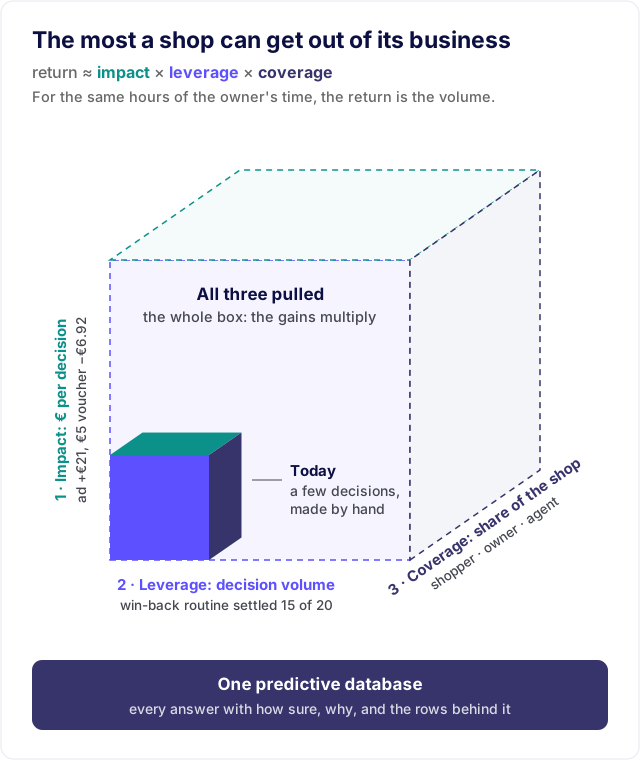
We built a shop to test this. PetNord is a reference pet shop with generated data: 3,000 customers and over 10,000 orders. Every view in it runs on one Aito predictive database, which means that there are no models to train and no feature pipeline to maintain: each screen is a query, and each answer says how sure it is and why.
The generated data lets us check that the engine finds the effects we planted. The result that matters most for a shop of this size, though, comes from real orders: on a UK wholesaler's order history, Aito's top suggestion for buyers with only one or two earlier orders turned up in their next orders twice as often as the best of five classical methods (31% against 15.4%). There is more on that test below.
1. Maximum impact: every decision optimised
The first lever is impact: the value of each decision. In PetNord, every screen opens with the decision, the euros it is worth against doing nothing, and the reasons behind it.
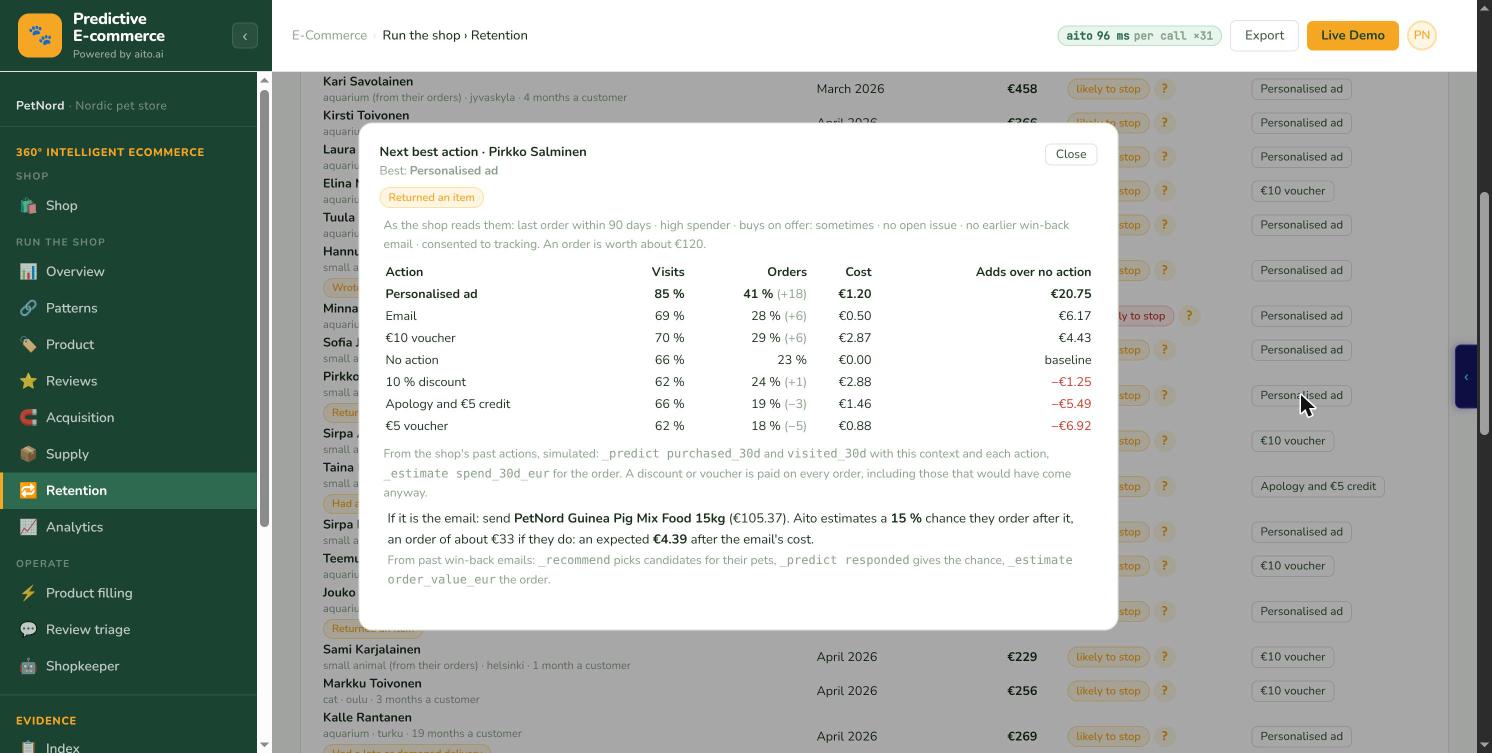
The €5 voucher that loses money. For each customer about to leave, Retention weighs six actions against doing nothing, after their cost (in marketing terms, a next best action with the cost counted in). For one of them, a personalised ad brings in an expected €21. The €5 voucher, which is the action most shops reach for first, loses €6.92, as it is paid on orders that would have come anyway.
The markdown that won't work. Supply opens with two numbers. The first is the reorder list: reorder these 83 products now, because if next month sells like the last three, about €14,400 of its sales can't be served without them. The second is the overstock: €27,691 is tied up in 79 overstocked products, and 14 of the 15 largest of them won't clear by price alone: even at 20% off, they would take between about 15 and 89 weeks to clear, against a 13-week target. That is a discount the shop was about to give for nothing.
There is a small lesson in the reorder list too. We tested Aito's own per-product forecast against the simple rule of "same as last month", and it did not beat it: 41% against 44% of products in the right sales range. As such, the reorder list needs no forecast at all, and Aito does what it is better at: finding which markdown actually clears the stock.
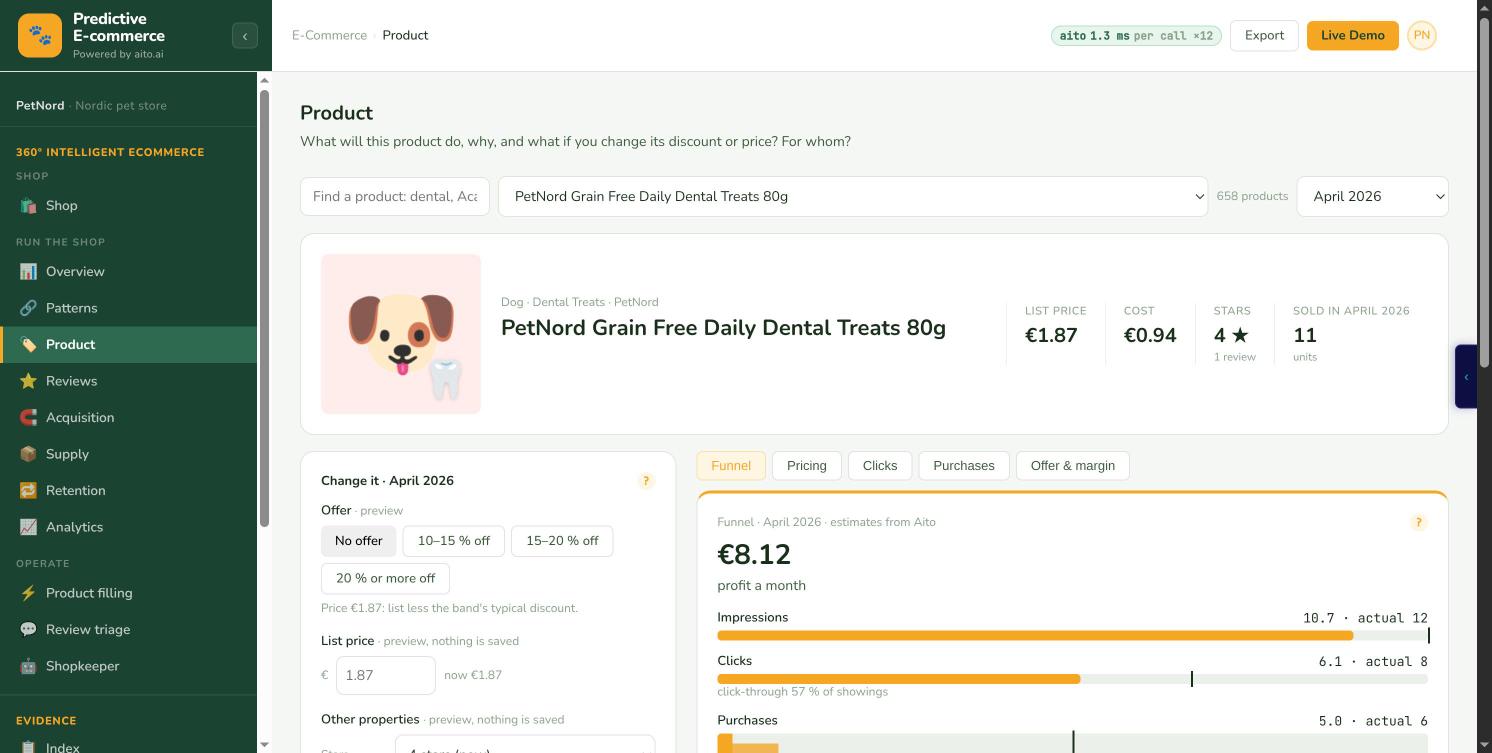
The what-if before the change. Pick a product and a month, and you see the whole funnel: how often the product will be shown, clicked and bought, and the profit it leaves, with the real month marked beside the estimate. Now, if you change the offer, the price, the stars or the pictures, the funnel moves before anything goes live.
Each of these numbers is one query. This is the one behind a customer's risk of leaving in Retention: describe the customer, and ask how likely they are to leave. It runs live against the demo's database, so try it, and two other customers beside it:
A customer's risk of leaving
Live against PetNord's database (generated data). The true row is the chance the customer leaves within three months.
Likely to leave
A dog owner in Turku, new this month, one purchase of €47.67.
{
  "from": "customer_months",
  "where": {
    "pets": "dog",
    "region": "turku",
    "tenure_months_at_month": 0,
    "visits": 4,
    "purchases": 1,
    "spent_eur": 47.67
  },
  "predict": "churned_in_3_months"
}There is no model behind it to train or deploy. The answer comes straight from the shop's own records, and "Why?" opens the reasons, with the customer's own values that drove them.
2. Maximum leverage: from assistance to automation
The second lever is leverage: how many decisions actually get made. When every decision waits for the owner, only the big ones are worth the owner's time, and the long tail of smaller ones is left undone. The more of the work runs on its own, the further down that tail the shop can go, until a decision worth a few euros is worth making too, a thousand times over. In PetNord, leverage rises in steps, and every step runs on the same database:
- Assistance. Every screen above opens with the decision already weighed, so the owner approves a call in seconds instead of building it from charts.
- The detail work, automated. The same database fills in a new product's fields from its name and brand, and triages the incoming reviews, the kind of work nobody misses when it is gone. Each field comes with its own probability, so a field it knows little about says so.
- The shop's tools, for agents. We built the shop's levers, the reorder queue, the overstock, the customers at risk and the what-ifs, as tools an agent can call. They run the same code as the screens, so the agent and the owner can't disagree, and every answer carries its evidence: how sure, why, and how many rows it rests on.
- Routines that run on their own. This is the biggest step.
Agents can already write product texts, answer customers and run campaigns, and it is tempting to hand them the shop's routines too. Most routines, though, don't need a model that reasons. They need a calculation that can be trusted, and what stops them from running on their own today is not capability. It is that a routine with no grip on the shop's data guesses, and a confident guess is the most expensive kind of mistake.
PetNord's shopkeeper runs its routines as rules on the same database, so every step carries its confidence, and the confidence decides what happens: 1) with a clear lift and enough evidence, it acts; 2) in between, it proposes, and the owner approves with one click; 3) discounts, vouchers and apologies, or whatever else the shop reserves for a person, it queues however sure it is; and 4) with too little evidence, it stays quiet and says why.
Its weekly win-back run reads like a colleague's report: "I went through the 20 customers most likely to leave. I acted on 4, expecting €67 more than doing nothing. 5 are waiting for you. I stayed quiet on 11." That is the leverage in one line: of 20 decisions, the routine settled 15 and brought 5 to the owner.
The quiet ones are the most interesting. For one customer, an apology with a €5 credit looked like the best move by far, 28 points more likely to bring them back. The routine still held off, because only 1 past case matched that exact situation and the shop's rule asks for 10. A routine that knows when not to act is one you can leave running.
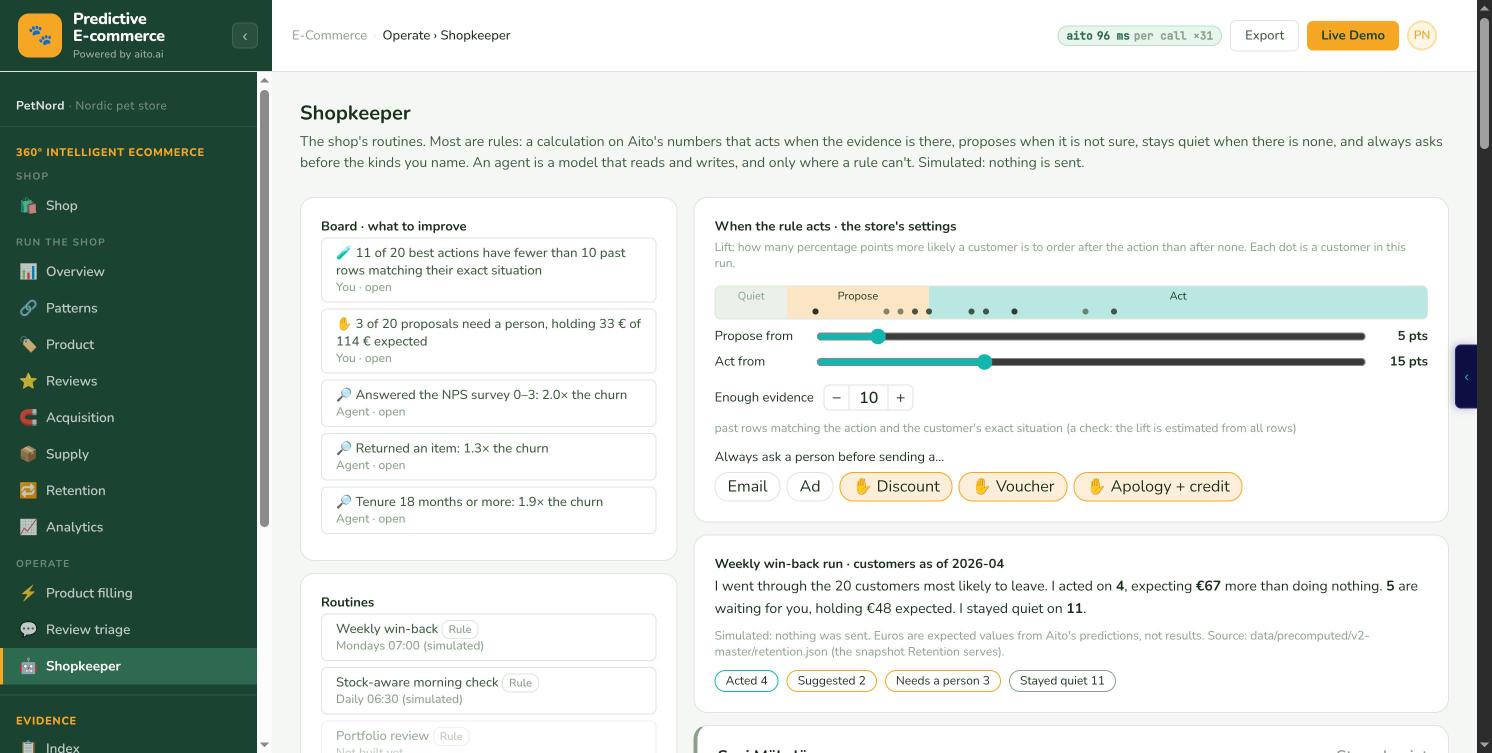
In the demo the run is simulated and nothing is sent. Win-back is the first routine, with a stock check beside it. An agent, a model that reads and writes, comes in only where a rule can't, and the first one, for new-product entry, is next.
3. Everywhere: the 360° shop
The third lever is coverage: how many of the shop's decisions get this treatment. Most shops run on a dozen tools, each with its own slice of the data: one for recommendations, one for email, one for stock, one for reviews. In PetNord, one database holds the whole shop: the catalogue, the orders, the stock, the customers, the reviews and the offers. As such, the same weighing reaches every part of it, from the shop window to retention, supply, pricing, product entry and the shopkeeper's routines, and everything sees everything: the stock shapes the recommendations, the returns shape the win-back, and the margin shapes the offer. The same answers also serve three users at once: the shopper in the shop, the owner behind the counter, and the agent working for the owner.
For the shopper, this means the shop shows what they need next, from their own history, their pets and their cart, and behind every card there is a "?" that opens the reasons for its percentage.
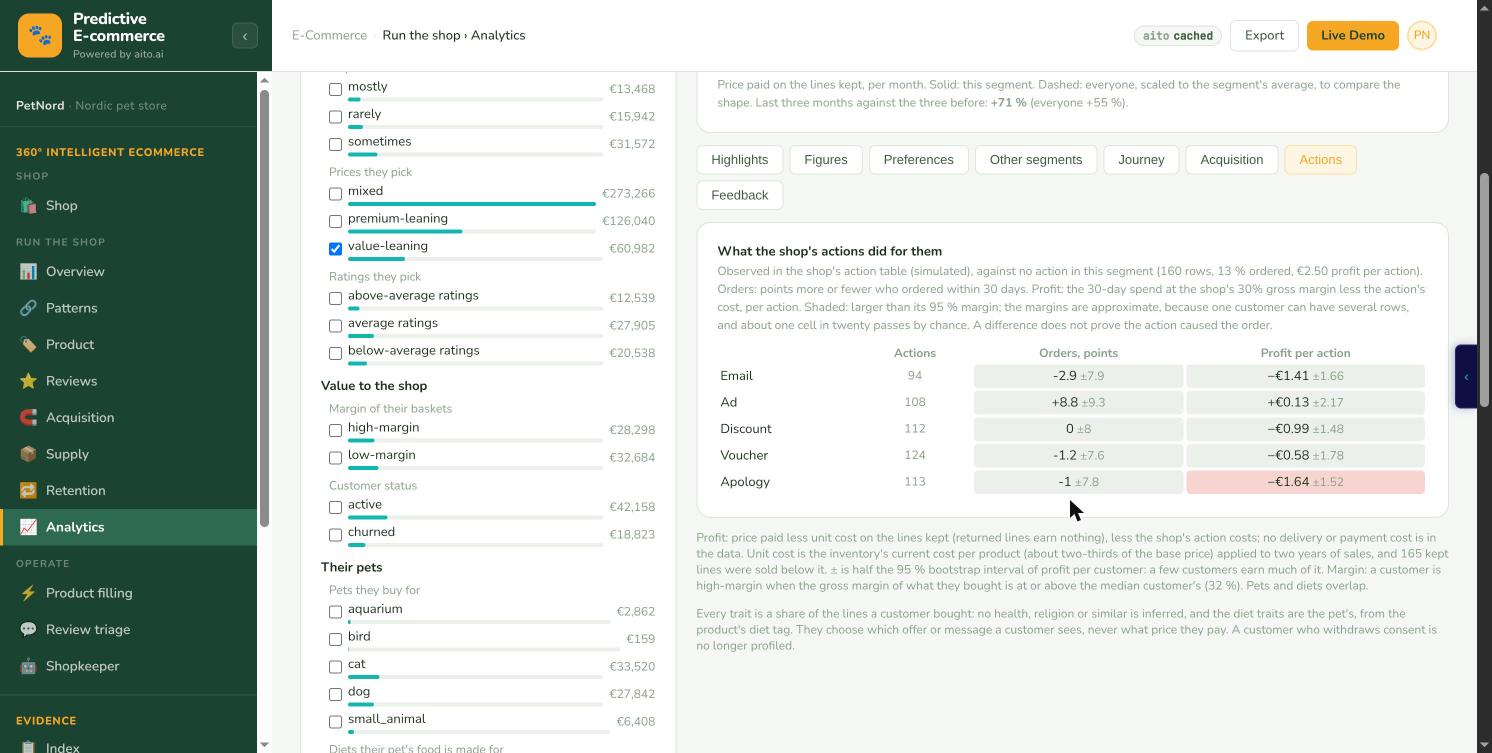
For the owner, it means knowing who the customers are and what works on them. Analytics groups the shoppers by how they actually shop, from what they bought: on offer or at full price, the cheaper or the better-rated half of a category, and which pets they buy for. Then it shows what each group earns the shop. Value-leaning customers earn €51 each against €77 on average, and in the shop's records an apology with a credit loses about €1.6 per customer it reached.
It also shows where each group comes from. Across the shop, customers who first arrived through organic search earn €84 each against €65 for those from social. These are differences in the shop's records rather than proven causes, but they are the start of knowing which channel brings the customers worth having. Only customers who consented are profiled, and a profile chooses which message a customer sees, never the price they pay.
Built on evidence
The demo shows how it works, but the proof of how much it works has to come from real data. The test behind the 31% against 15.4% above ran on UCI Online Retail II, a UK giftware wholesaler's order history, with the test plan fixed before the run: 197 of 636 buyers with one or two earlier orders, against the strongest of five classical methods. What makes the result matter is where it lands: buyers with only one or two earlier orders are exactly where most shops' customers are, and where big-store recommenders typically give up (the cold start problem).
We publish where it ties too. For regular buyers, with three orders or more, Aito ties the best simple method, and with no history at all it equals a popularity list. All of it is on the demo's evidence page, as a shop should know where not to spend as well as where to.
Why this year
There are three reasons why I think this can't wait: 1) agents are arriving on both sides of the counter: shops will run them and buyers will send theirs, and the shops whose data can answer "what fits, is it in stock, and how sure are you" are the ones the agents will work with and buy from; 2) learning compounds: every week a shop runs on its own outcomes, it knows more about what works for its customers, and that lead does not come in a box you can buy next year; and 3) the platforms are choosing now, and the ones that wait will be offering apps glued together against platforms where the whole shop learns.
Your orders, your numbers
The fastest way to see what this is worth is your own data. Pick one decision with money behind it, be it win-back, reorders, offers or recommendations. We fix the plan before the run, replay your past orders, and show the decisions your shop would have made, in euros, against what actually happened. It takes weeks, not a project.
If you build shops for others, as a platform or an agency, the same applies one level up. The reference shop is open source, and each of its screens is built from queries on one schema, so the same decisions can become part of your own product, for every merchant on it at once. That is a conversation we want to have.
Try the shop: ecommerce.aito.ai · Code and schema: GitHub · Start with your data, or build it into your platform: antti@aito.ai
Or let your coding agent try it: uvx aito-mcp, listed in the MCP registry as io.github.AitoDotAI/aito
(setup).
Address
Episto Oy
Putouskuja 6 a 2
01600 Vantaa
Finland
VAT ID FI34337429


